Showing posts with label coming-of-age story. Show all posts

Wednesday, 13 August 2014

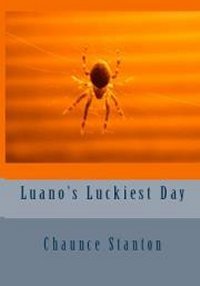
Luano's Luckiest Day by Chaunce Stanton


When two deadly spiders mysteriously appear in young Luano's room, the boy makes a dangerous decision to believe their promise - the promise of his mother's return. Luano's Luckiest Day is set in an isolated desert town, full of colorful characters. Luano lives with his uncle in their small grocery store. He is a normal nine-year-old boy who wants nothing more than to be reunited with the woman who abandoned him soon after he was born. The fulfillment of Luano's deepest wish takes him on a life-and-death journey that promises readers plenty of action and imagination, sadness and laughter. It is suitable for adults and middle-grade readers.
Goodreads Description

I first encountered this book through last year's Magic Realism Bloghop and it has been sitting on my to-read shelf ever since. So my apologies to Chaunce Stanton for taking so long to review his book.

The writer says that he got the idea for this book from a dream he had, in which he saw a boy searching for his mother on a white tiger. Luano's real world does not feature a white tiger, but the world of his imagination and of his dreams does.  When Luano is asked by his teacher to write about his luckiest day he wrote about how finding his mother would be his luckiest day, and how it would be better to wear a long cape and to ride a giant white tiger to look for her.  But Luano's luckiest day did not begin with white tigers but with spiders. 

Luano believes that the two spiders that arrive in his bedroom are portents of his mother's return and so allows and encourages them to stay. Soon they have festooned the bedroom with webs and are feeding off the boy as he sleeps. Clearly this is not a book for arachnophobes.  But the spiders are what tilt the book into magic realism. The poison in Luano's veins transforms his view of the world so that his dream world and his waking life merge. 

Whilst much of the book is seen from Luano's point of view, the writer at times presents the point of view of the key adults - mostly but not exclusively those of Luano's uncle, his mother and the new man in town, Conejo. At the beginning of the book we are very much with Luano as the writer draws a very clear picture of Luano's world. Luano is restricted physically to a small town in an unnamed desert, but he escapes using his imagination. So much did I enjoy being in Luano's head that the POV shifts away from Luano sometimes jarred as did some of the factual description which almost felt to be unnecessary telling rather than showing. But the story is built on the difference between adult reality and a child's dreams and hopes and therefore maybe the jarring was necessary. The ending (which I will not spoil) was also somewhat disquieting. How could it not be? This is a coming-of-age story and they don't end neatly.

Someone (I can't remember who) said that all children are magic realists in a world of adults. Chaunce Stanton shows that beautifully in this book.

Wednesday, 24 July 2013

Dandelion Wine by Ray Bradbury


This post is part of the Magic Realism Blog Hop. On Monday I wrote a post about what I have learned from my year of reading magic realism books and my attempt at a definition. Yesterday I gave short summaries of the 55 magic realist books I have reviewed so far on this blog. This is the 56th book in my magic realism challenge.

An endearing classic of childhood memories of an idyllic midwestern summer from the celebrated author of ‘Farenheit 451’.

In the backwaters of Illinois, Douglas Spaulding's grandfather makes an intoxicating brew from harvested dandelions. ‘Dandelion Wine’ is a quirky, breathtaking coming-of-age story from one of science fiction's greatest writers. Distilling his experiences into "Rites & Ceremonies" and "Discoveries & Revelations", the young Spaulding wistfully ponders over magical tennis shoes, and machines for every purpose from time travel to happiness and silent travel. Based upon Bradbury's own experiences growing up in Waukegan in the 1920s, ‘Dandelion Wine’ is a heady mixture of fond memory, forgiveness, magic, the imagination and above all, of summers that seemed to go on forever.
Amazon description

I had not read any books by America's great science fiction writer and had no idea what to expect. What I found was a book that reminded me of Cider with Rosie by Laurie Lee, another coming-of-age story, this time set in rural England not far from my hometown and a great favourite of mine. Both books are written by older men looking back at the golden days of their early teens. At the same time both Laurie Lee and Ray Bradbury remember the joyousness, wonderment and optimism of youth and also are able as adults to understand the world better. In particular Bradbury creates some lovely portraits of old people approaching death with dignity. Both writers enjoy a poetic love of words that shines through their descriptions, something not all readers appreciate, but I do. Bradbury's language is just beautiful.

Dandelion Wine is a series of short stories woven together by the boy's perceptions and his brother's. Each is bottled, stored and allowed to mature like the wines of the title. Each one is delightful and a pleasure to read. I enjoyed all of them. I know some people find Bradbury wordy but I loved his writing. I felt that the lushness of the writing suited the tales of golden times.

Although Bradbury is quoted as saying 'Dandelion Wine' is magic realism about my childhood, the magic realism is quite subtle and one cannot always be certain whether the magic is created by looking at the world through the eyes of a child. But then does that matter? Children believe in magic. Does it matter if the Lonely One is an evil monster or the local psychopath? Or whether Honeysuckle Ladies Lodge is really a coven of witches? The key to reading this book is to go along with it, to lay aside adult assumptions against magic. For a child the everyday world is magic realist and Bradbury conjures up that magic brilliantly. Plus there are some episodes which cannot be easily reasoned away.

Although the world Douglas inhabits is bright and magical, at the same time there is sadness in the book, as befits a realist account of childhood. There is that major disaster of childhood, the loss of a best friend, the friend's parents are moving away and suddenly taking him with them. There is illness, even a death of a much-loved family member, the end of summer and the impending return to school. And behind it all is the loss of childhood itself. This is the year when Douglas realizes: I’m ALIVE. Thinking about it, noticing it, is new. You do things and don’t watch. Then all of a sudden you look and see what you’re doing and it’s the first time, really. We as adults know that this is a sign of growing older.

The Magic Realism Blog Hop
Below are the other blogs on the Magic Realism Blog Hop. Please take time to visit them, you'll find some fascinating posts. Oh and while you're about do take part in the Rafflecopter giveaway at the bottom of the post. You could win a collection of magic realism ebooks. You get free entries by commenting on this or other posts, by joining the Magic Realism Facebook page (see right) or following this blog, and lots of other ways.


a Rafflecopter giveaway
Enhanced by Zemanta