Showing posts with label feminism. Show all posts

Monday, 20 March 2017

The Stolen Child by Lisa Carey


May 1959. From one side of St. Brigid’s Island, the mountains of Connemara can be glimpsed on the distant mainland; from the other, the Atlantic stretches as far as the eye can see. This remote settlement, without electricity or even a harbor, has scarcely altered since its namesake saint set up a convent of stone huts centuries ago. Those who live there, including sisters Rose and Emer, are hardy and resourceful, dependent on the sea and each other for survival. Despite the island’s natural beauty, it is a place that people move away from, not to—until an outspoken American, also named Brigid, arrives to claim her late uncle’s cottage.

Brigid has come for more than an inheritance. She’s seeking a secret holy well that’s rumored to grant miracles. Emer, as scarred and wary as Rose is friendly and beautiful, has good reason to believe in inexplicable powers. Despite her own strange abilities—or perhaps because of them—Emer fears that she won’t be able to save her young son, Niall, from a growing threat. Yet Brigid has a gift too, even more remarkable than Emer’s. As months pass and Brigid carves out a place on the island and in the sisters’ lives, a complicated web of betrayal, fear, and desire culminates in one shocking night that will change the island, and its inhabitants, forever.


The Stolen Child is a powerful example of how magic realism can give pyschological depth to a work. The small island, cut off for weeks from the mainland by the sea, is a world in itself. Or should I say two worlds because the two central characters, Emer and Brigid, are in different ways touched by that other world of Irish myth - the world of the fairy, the "Good People" as they are called. But the Good People are far from good, they are a sinister presence feared by the Islanders and in particular by Emer who is terrified by the belief that the fairies will steal her son when he gets to the age of seven.  Brigid on the other hand is looking for the healing waters of St Brigid's well, which will grant her the child that fate has denied her. St Brigid of course was/is herself an ambiguous figure, a pagan goddess before she was made a saint, so the modern Brigid is in some ways seeking a blessing from the fairies. The well she is seeking is as much an entrance into the underworld as was the beehive that turned on Emer, filling her with poison.

There are many themes in this book, too many perhaps, but for me the overriding one was that of motherhood. The island has lost many of its men to the mainland or foreign shores and on occasion to the cruel sea. St Brigid's Island is an island of women without a future and so the bearing of children is particularly symbolic. In the two sisters we see very different mothers. Rose is easy-going in her fecundity, bearing her handsome husband a succession of twins. Emer has the one son, Niall, whom she watches over obsessively. Then there is Brigid, who has had a succession of pregnancies all of which have resulted in the loss of the baby. Brigid's desperation for a child drives her to the island from which her mother had been driven, to seduce the emotionally wounded Emer and then cruelly push her away, thus lighting a touchpaper for the explosive final chapters.

Lisa Carey has said that she was inspired in part by a documentary Inishark: Death of an Island (Inis Airc: Bas Oileain), which you can view on Youtube. Here is the trailer on IMDb.


Carey does a wonderful job of evoking the bleak beauty of the island, the loneliness and closeness of its community. Her writing about the place is quite intoxicating and haunting and I was not surprised that she has found herself visiting and revisiting Inisboffin, just over the channel from Inishark. I was less taken by the sections in the book where we learn Brigid's backstory in America, just as I was less taken with her as character. I was fascinated by Emer, who is a wonderful character. She should be unappealing, given the way she can suck joy out of everyone she touches (everyone except for Brigid and Rose). But her love for her son and her desperate desire to protect him ring so true to this mother of a boy.

A powerful piece of magic realism, not suited to those who like their books to shy away from dark subjects.

I received this book free from the publisher in return for a fair review.

Wednesday, 24 December 2014

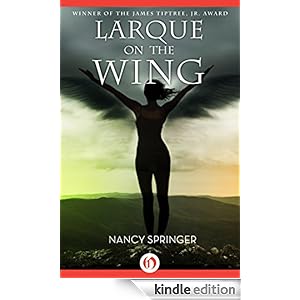
Larque On The Wing by Nancy Springer

A middle-aged housewife whose rebellious inner child runs away with her talent transforms herself into a fearless young gay man in this winner of the James Tiptree, Jr. Award

Larque Harootunian is having a midlife crisis like no other—but then again, there is much about the frumpy, middle-aged housewife and mother that could never be considered ordinary. Larque’s lifelong ability to generate “dopplegangers,” for example—physical manifestations of her thoughts and emotions—has been a constant source of stress. And now she is being tormented by Skylark, a re-creation of her younger self, an angry inner child who is tormenting Larque about abandoning her youthful ambitions while running away with her artistic abilities, thereby depriving the older Larque of a livelihood as a painter of kitsch.

But perhaps this is Larque’s opportunity to explore her options. Acquiescing to Sky’s demands that she change herself, Larque tries on a series of different personas—to the consternation of her mother, husband, and teenage sons—and finds her way to Popular Street. There, among the devil-may-care misfits, Larque can be Lark, a handsome young gay man, and quite possibly discover what her life is really about.

Amazon description

Yet again the clever folks at Open Road Media have taken a fascinating out-of-print magic realism book and given it in ebook format to a new audience. I really enjoyed this book.

For starters even now you don't get to read many books with spunky middle-aged women as their central character. We middle-aged women seem to disappear from fiction as we sometimes feel we do in real life, the latter being something Larque bemoans. This book is an exploration of how we deny what we are. Springer uses the magic realist device of the doppelgangers as a way of manifesting the aspects of Larque's personality.

As the enigmatic Shadow says: People, most people, are like flowers with three parts, three petals that overlap. One part is the child. Whatever you were as a child, everything you feared, everything you wanted or dreamed, it all stays with you. One part is the parent. Whatever your mother or father or teachers told you or wanted you to be, that is part of you too. And the rest of you is self, your unique mind and will. One part in three. Very Jungian (after all, the person saying this called Shadow for goodness sake) only it is Jungian with jokes. Lots of jokes.

If you think dealing with teenage children is bad, just imagine what it is like dealing with your young self who feels unloved and rejected. Larque initially really dislikes her childhood self, particularly when Sky puts her foot through Larque's canvases covered with kitsch but lucrative images of twee rural scenes. Until Sky arrives whenever Larque felt the urge to produce something creative, she lay down until the spasm passed. Brain farts did not sell. Real people did not want originality; they just wanted something that matched the living room drapes.  Sky's actions makes Larque rethink what she wants from her art.

Larque is forced to confront the fact that she doesn't like herself as she is and so, urged on by Sky, she allows Shadow to transform her into the character she dreamed of being. This, it turns out, is a young cowboy. Larque as a child had identified with male cowboy heroes in film or on the television  rather than any female role models. But despite her physical transformation Larque retains her soul and her woman's heart and so remains sexually attracted to men. This opens a whole can of worms about gender and sexuality, which the book deals with with the same wry lightness of touch. The homosexuality of three of the main characters in the book is handled sensitively and with understanding. It is worth remembering that this book was first published in 1994 when AIDS was a death sentence and homophobic attitudes were more mainstream. But for me the key thing that stands out is that even the adult Larque cannot see her middle-aged female self as being bold enough to pursue her dreams.

The third element in Larque's character is her mother's creation: The Virtuous Woman. Larque's mother like her daughter has a magic ability to transform people, but in contrast to Larque she does so in a way that denies what they truly are, instead getting rid of what she doesn't like and replacing it with what she does. Thus tomboy Sky is transformed into a prissy little girl. Larque calls this behaviour of her mother's "blinking". It is such a wonderful image of what most of us will have experienced - a parent who sees us as something other than we are and as a consequence we find ourselves falling into that role.

I realize on looking at what I have written so far, that one might feel that this book is feminist magic realism and indeed it does have some similarities to Virginia Woolf's Orlando, but it is actually about a midlife crisis that men and women experience, so I have no qualms about recommending it to all my readers.

I received this book free from the publisher via Netgalley in return for a fair review.


Wednesday, 2 October 2013

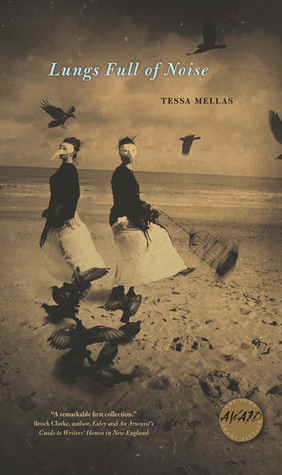
Lungs Full of Noise by Tessa Mellas


This prize-winning debut of twelve stories explores a femininity that is magical, raw, and grotesque. Aghast at the failings of their bodies, this cast of misfit women and girls sets out to remedy the misdirection of their lives in bold and reckless ways.

Figure skaters screw skate blades into the bones of their feet to master elusive jumps. A divorcee steals the severed arm of her ex to reclaim the fragments of a dissolved marriage. Following the advice of a fashion magazine, teenaged girls binge on grapes to dye their skin purple and attract prom dates. And a college freshman wages war on her roommate from Jupiter, who has inadvertently seduced all the boys in their dorm with her exotic hermaphroditic anatomy.

But it isn’t just the characters who are in crisis. In Lungs Full of Noise, personal disasters mirror the dissolution of the natural world. Written in lyrical prose with imagination and humor, Tessa Mellas’s collection is an aviary of feathered stories that are rich, emotive, and imbued with the strength to suspend strange new worlds on delicate wings.

Goodreads description

Sometimes a book comes along in my magic realism challenge which makes me rethink what makes magic realism work so well for me. Pedro Paramo was one such book and this is another. This is magic realism which is pushing the boundary of form, at times distinctly weird and often verging on poetry. Do all the stories work equally well? No, of course not, but then Mellas' writing wouldn't be experimental if it was predictable. 

The subject matter - about being female - is something that I interests me. Mellas' stories cover a number of feminist issues - the menopause, empty nest syndrome, body image, motherhood, the repression of girls' voices, competition for the attention of men - in a way that is at once fantastical and very, very real. 

The best story for me was The White Wings of Moths, which is about a woman trying to cope with the menopause and her relationship with her absent daughter by adopting and caring for caterpillars. Not only is it wonderfully poetic and lyrical, it also has some accurate descriptions of the heat of menopause: Menopause has made sleep a difficult thing, a hidden room in a hidden house in a hidden town... Her body burns and tingles. And there's a quaking inside her limbs. The bones in her spine have turned to ice. Her ovaries too. She feels them heavy and cold like stones nestled against her womb. 

In Dye Job teenage girls turn themselves blue by gorging on fruit in the hope of gaining prom partners.  Their health and friendships are strained as they compete for that all important young man. In Mariposa Girls the girls are aspiring figure skaters, willing to sacrifice everything for perfection in their sport.

Beanstalk is a story which has similarities with the Czech folk story Otesánek about a woman who adopts a baby made out of a tree root, who grows and takes over her life and her world (the tale was adapted into the film Little Otik by Jan Svankmejer). In this story it is implied that the baby the woman gives birth to may have been fathered by a plant rather than her rather boring neighbour. It is about the desire for motherhood, but it also could be considered a story about the power of nature.

Other stories also have an environmental theme. Blue Sky White is a mythic or folkloric account of a world in which one day the sky ceases to be blue. Landscapes in White is a prose poem of a world in which birds fall from the sky: The sky full of feathers, a quarrel of wings. Plumage blooms across our windows, the glass smeared cloudy with milky streaks. The beltway a blur of sparrows. City towers beaten by doves.

As the book progresses the stories tend to lose their conventional story structure and become more experimental, in grammar as well as form. These will not be for everyone, but I enjoyed and was inspired by them, although I will not claim to have understood them all.

The book concludes with the story of a woman who steals the severed arm of her former husband in an effort to reconnect with the life she once had. At once lyrical, shocking and thought-provoking it is typical of the stories in this wonderful collection.

I received this book from the publisher via Netgalley in return for a fair review.

Wednesday, 26 September 2012

Nights at the Circus by Angela Carter


It's 1899 and all of Europe is agape at the arrival of the new century. The world crackles with possibilities and people dance to the irresistible rhythms of money, sex, love and freedom. Swinging above them all is a showbiz sensation: a fierce, vulgar, pant-droppingly sexy trapeze artist called Fevvers.
Goodreads description

Wow! This book doesn't so much begin as launches - "Lor' love you, sir!" Fevvers sang out in a voice that clanged like dustbin lids. What follows is a rollicking good read, full of invention, humour, earthiness and magic realism. This is a circus world in which chimps take over the management of their act, tigers waltz, a pig acts as management consultant to the circus owner spelling out advice in alphabet cards, clocks repeatedly strike midnight and of course a buxom Cockney aerialist hatched from an egg and now flies on dyed purple wings. Or do they? As Fevvers wonders at one point  Am I fact or am I fiction?

The book opens in a theatre dressing room strewn with underwear, discarded costumes and empty bottles where Fevvers assisted by Lizzie, her assistant and adoptive mother, tells a cynical reporter by the name of Walser the story of her youth and life to that point. Throughout the interview Fevvers constantly uses slight of hand and word to bemuse the young reporter, combining her physical presence and some apparently verifiable references to put him off the scent. We, the readers, watch as the game is played out and Walser is reeled in. This section sets up the rest of the book. Like a magician's dupe Walser is encouraged to focus on the wrong things, like the clock constantly striking twelve, while not focusing on the major (whether Fevvers really has wings). The clock episode is mirrored later in the book in which time passes at different speeds for the two protagonists. Indeed we readers sometimes feel like Walser in the dressing room and we certainly do at the end.

So is the magic just artifice - as in Life of Pi? No, this is more than a story told to befuddle. Everything is larger than life, in Fevvers' case quite literally. As I indicated above there are plenty of magic realism elements in the story, which we accept without question, perhaps because we are watching to see if Fevvers can really fly. The questions we are left with rather than diminishing our capacity to imagine increase it. The picture Angela Carter is painting is bigger than the canvas and we are left to think outside the frame. 

An important element in this book is its feminism. In addition to the wonderful Fevvers, an earthy goddess albeit one who flies, there is the ex-whore Lizzie who is politically active and scathing about men and authority and too can perform magic: For the things my foster mother can pull off when she sets her mind to it, you'd not believe! Shrinkings and swellings and clocks running ahead or behind you like frisky dogs. Then there are a series of women in Fevvers' life who have been the sexual and abused objects of mens cruelty and who find strength and love in other women. Men have always seen woman's body as at once real and magical. Fevver's body is a larger than life example of that, but it is one which Fevvers denies the men who crave to control and own it. For women Fevvers' wings are an assertion of a woman's right to soar. My body was the abode of countless freedom. It is often said of magic realism that it is a means of the oppressed to express themselves. If women's experience of reality is a denial of access to power then it becomes necessary to create an alternative reality. It is therefore appropriate if magic realism is used to explore the magical strength of women. This is something that interests me as a writer. I too have chosen to use magic realism to explore the potential of women in my trilogy about the healer Judith.