Showing posts with label Argentina. Show all posts

Saturday, 7 July 2018

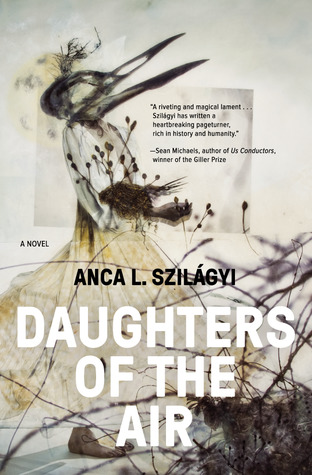
Daughters of the Air by Anca L. Szilagyi


Tatiana "Pluta" Spektor was a mostly happy, if awkward, young girl—until her sociologist father was disappeared during Argentina’s Dirty War. Sent a world away by her grieving mother to attend boarding school outside New York City, Pluta wrestles alone with the unresolved tragedy and at last runs away: to the streets of Brooklyn in 1980, where she figuratively—and literally—spreads her wings. Told with haunting fabulist imagery by debut novelist Anca L. Szilágyi, this searing tale of love, loss, estrangement, and coming of age is an unflinching exploration of the personal devastation wrought by political repression.
Goodreads description

I was asked to read this book by its author, who is also a member of the Magic Realist Books Facebook Group. I am under no obligation to write a review, however here it is. 

This is an interesting book, beautifully written. It is also, as the Goodreads description makes clear, an unflinching account of the devastation wrought by political repression. Indeed there will be some readers who will find this novel somewhat too unflinching. It does not look away from what too often happens when a naive teenage girl runs away to the big city. The magic realism reflects this grittiness. In another writer's hands when Pluta grows and spreads her wings (literally and metaphorically) they would be a bird's or an angel's - all soft feathers - but Pluta has the wings of a bat or similar. 

For the Disappeared in the world of the Argentinian Dirty War, flying was a matter of being hurled from a helicopter into the ocean. It is against this background and the unknown fate of Pluta's beloved father that Pluta's story and that of her mother, Isabel, unfolds. In some ways Pluta's descent into the hell of 1980's Brooklyn, mirrors that of her father, who like Pluta is both naive and innocent. 

The book's chapters alternate between Pluta's story and that of her mother, between Pluta's current story and the family's backstory. This seems to be a popular story structure at the moment, but it relies heavily on the reader being engaged by both stories to the same degree, or otherwise the reader gets frustrated with the shifts in story. Unfortunately Isabel is not as sympathetic character as her daughter. 

Szilagyi's treatment of both the main characters require the reader to think and fill in the gaps. The ending is in many ways not a resolution but a compromise that allows life to continue. In every way this is a mature intelligent book which may not suit all readers, but it is an example of how magic realism is so suited to ambiguity and  to difficult subjects. 

Sunday, 28 February 2016

The Blue Line by Ingrid Betancourt


Buenos Aires, the 1970s. Julia inherits from her grandmother a gift, precious and burdensome. Sometimes visions appear before her eyes, mysterious and terrible apparitions from the future, seen from the perspective of others. From the age of five, Julia must intervene to prevent horrific events. In fact, as her grandmother tells her, it is her duty to do so—otherwise she will lose her gift.

At fifteen, Julia falls in love with Theo, a handsome revolutionary four years her senior. Their lives are turned upside down when Juan Perón, the former president and military dictator, returns to Argentina. Confronted by the realities of military dictatorship, Julia and Theo become Montoneros sympathizers. Julia and Theo are radical idealists, equally fascinated by Jesus Christ and Che Guevara. Captured by death squadrons, they somehow manage to escape. . .

From the Goodreads description

Ingrid Betancourt is the former French Columbian politician who was kidnapped by the FARC guerillas in 2002 and endured over six years in capitivity before she was released by the Columbian army. She has written about what and how she endured her captivity in the jungle in Even Silence Has an End. In this, her first novel, Betancourt revisits in fiction many of the themes in the earlier book. At the heart of the novel is a young woman's experiences at the hands of the Argentinian military junta's thugs and torturers. Like Unspeakable Things, the previous book reviewed on this site, The Blue Line is also about the survivors of oppression and the legacy of guilt and psychological damage that impacts on their personal relationships.

The obvious comparison for this book is with Isabel Allende's The House of Spirits. It focuses on a brave young woman drawn to helping the poor and thus into radical politics. A naive idealist in the face of the political betrayals and complexity of Argentinian politics, Julia is no different from most young activists the world over, but the consequences of her decision to engage are terrible. Her treatment in the notorious military interrogation centres, and the details of her and others' torture are not glossed over and may be shocking to some readers, but are absolutely based on facts.

Also at the heart of the book are Julia's two key relationships: with her grandmother, who helps her understand and use her gift of second sight and in whose footsteps she follows in more ways than one, and with Theo, her lover and husband. It is Julia's relationship with Theo that sits at the heart of the story and drives the narrative arc, even though for much of their lives they are apart. It is Theo who introduces Julia to radical politics.

Loyalty is a major theme in the book. Julia's loyalty to Theo and other women in the detention centre is a major motivator, which at times puts her life in danger. Theo's loyalty to his brother is likewise key. Of course the betrayal and manipulation of loyalty also features. As in Unspeakable Things the survivors have a loyalty that will not let go of the past and so blights the present. 

The novel moves backwards and forwards in time, a structure that I seem to be seeing more and more in books. This can be frustrating at times and halfway through I was inclined to think that it was hindering rather than helping the story move forward. However on finishing the book I could see why this technique was used.

This is a fascinating book and, despite the graphic depictions of torture, one that demands to be read by anyone who wants to get a feel for the dilemmas facing good people living under tyranny.

I received this book free from the publisher in return for a fair review.