Showing posts with label Latin American. Show all posts

Sunday, 28 February 2016

The Blue Line by Ingrid Betancourt


Buenos Aires, the 1970s. Julia inherits from her grandmother a gift, precious and burdensome. Sometimes visions appear before her eyes, mysterious and terrible apparitions from the future, seen from the perspective of others. From the age of five, Julia must intervene to prevent horrific events. In fact, as her grandmother tells her, it is her duty to do so—otherwise she will lose her gift.

At fifteen, Julia falls in love with Theo, a handsome revolutionary four years her senior. Their lives are turned upside down when Juan Perón, the former president and military dictator, returns to Argentina. Confronted by the realities of military dictatorship, Julia and Theo become Montoneros sympathizers. Julia and Theo are radical idealists, equally fascinated by Jesus Christ and Che Guevara. Captured by death squadrons, they somehow manage to escape. . .

From the Goodreads description

Ingrid Betancourt is the former French Columbian politician who was kidnapped by the FARC guerillas in 2002 and endured over six years in capitivity before she was released by the Columbian army. She has written about what and how she endured her captivity in the jungle in Even Silence Has an End. In this, her first novel, Betancourt revisits in fiction many of the themes in the earlier book. At the heart of the novel is a young woman's experiences at the hands of the Argentinian military junta's thugs and torturers. Like Unspeakable Things, the previous book reviewed on this site, The Blue Line is also about the survivors of oppression and the legacy of guilt and psychological damage that impacts on their personal relationships.

The obvious comparison for this book is with Isabel Allende's The House of Spirits. It focuses on a brave young woman drawn to helping the poor and thus into radical politics. A naive idealist in the face of the political betrayals and complexity of Argentinian politics, Julia is no different from most young activists the world over, but the consequences of her decision to engage are terrible. Her treatment in the notorious military interrogation centres, and the details of her and others' torture are not glossed over and may be shocking to some readers, but are absolutely based on facts.

Also at the heart of the book are Julia's two key relationships: with her grandmother, who helps her understand and use her gift of second sight and in whose footsteps she follows in more ways than one, and with Theo, her lover and husband. It is Julia's relationship with Theo that sits at the heart of the story and drives the narrative arc, even though for much of their lives they are apart. It is Theo who introduces Julia to radical politics.

Loyalty is a major theme in the book. Julia's loyalty to Theo and other women in the detention centre is a major motivator, which at times puts her life in danger. Theo's loyalty to his brother is likewise key. Of course the betrayal and manipulation of loyalty also features. As in Unspeakable Things the survivors have a loyalty that will not let go of the past and so blights the present. 

The novel moves backwards and forwards in time, a structure that I seem to be seeing more and more in books. This can be frustrating at times and halfway through I was inclined to think that it was hindering rather than helping the story move forward. However on finishing the book I could see why this technique was used.

This is a fascinating book and, despite the graphic depictions of torture, one that demands to be read by anyone who wants to get a feel for the dilemmas facing good people living under tyranny.

I received this book free from the publisher in return for a fair review.

Tuesday, 28 July 2015

The Autumn of the Patriarch by Gabriel Garcia Marquez

Gabriel Garcia Marquez, renowned as a master of magical realism, creates stories that grip the imagination. Set in exotic locals, peoples with unforgettable characters, and crafted with exquisite prose, his stories transport the reader to a world that is at once fanciful and real.

One of Gabriel Garcia Marquez's most intricate and ambitious works, The Autumn of the Patriarch is a brilliant tale of a Caribbean tyrant and the corruption of power. Employing an innovative, dreamlike style, the novel is overflowing with symbolic descriptions as it vividly portrays the dying tyrant caught in the prison of his own dictatorship. From charity to deceit, benevolence to violence, fear of God to extreme cruelty, the dictator embodies at once the best and the worst of human nature.

Goodreads description

This novel by the great Gabo himself comes with a reputation for being hard work and dark. And to be sure The Autumn of the Patriarch deals with the darkest of subjects - inside the mind of a psychopathic dictator. So I was nervous as I settled down to read this book in advance of this review. I needen't have worried. Afterall this is a book by the master.

First of all I had to develop a new way of approaching reading the book. The Autumn of the Patriarch is made up of six huge chapters, each consisting of one paragraph. Sentences can go on for pages and are divided almost exclusively with commas (the semicolon is discarded). And within these sentences the narrative voice can shift from the Patriarch's to another character to the general mass of the Patriarch's subjects like a Greek chorus without either punctuation or formating signposting. 

Clearly you cannot read this book anywhere where you will be interrupted, but even so I soon found myself relaxing into the book and not worrying when I lost sense of who was speaking. There is a reason for that - the subject of the entire narration is the omnipresent Patriarch. The nation is an extension of the Patriarch. Or at least that is how he sees the world - he is totally self-centred - and it is one reason that The Autumn of the Patriarch is a "poem on the solitude of power" as Garcia Marquez has described it. 

It is a tribute to the author's genius that I found myself at times feeling sympathy for the monstrous Patriarch. He is a man who cannot feel love. He is also a man for whom the power he seeks and clings too brings no joy:
but he learned to live with those and all the miseries of glory as he discovered in the course of his uncountable years that a lie is more comfortable than doubt, more useful than love, more lasting than truth, he had arrived without surprise at the ignominious fiction of commanding without power, of
being exalted without glory and of being obeyed without authority.

The book opens with the people he rules breaking in to the palace to find his body. They cannot believe that he has died: afterall he has already died once. That first death was when the Patriarch's double is killed and he watches his subjects' response to his "death" - some grieving, some celebrating. When he reappears he takes typically brutal action against the latter. So it is not surprising that his subjects are cautious when he dies a second time. He has magically lived longer than a normal mortal. Can he die?

The book focuses on the Patriarch after his first death, in the autumn of his years to his end. Of course the book moves backwards and forwards in time without warning, as you would expect, but a portrait of the old man evolves as layer upon layer of story are applied. The story is at times grotesque (but no more grotesque than reality, as the stories of dictators like Idi Amin or Caligula or Pinochet show us). The cruelty of the Patriarch is likewise all too true to life. People are tortured, killed and disposed of. The shocking fate of several thousand innocent children, whose only crime was to have drawn the numbers of the lottery that the Patriarch always won, is perhaps the hardest to take. 
At the same time there is a crude gallows humour about the book, which at once relieves and heightens the horror. Some of that humour comes from the Patriarch himself: 
the day shit is worth money, poor people will be born without an asshole. 

The book reveals that the Patriarch came from a poor background, and there may have been a time when he had some sympathy for the underclass. He is set up by the British as a puppet and then they abandon him and the island. He doesn't use their departure to restore the island's fortunes but to plunder them as the British did. Towards the end of the book we learn that the Americans too have exploited the country and brought it so much into debt that they demand and get the sea surrounding the island in payment. This is magic realism as political comment as well as an exploration of the psychology of the individual. 

This is an amazing book. Whether it is a pleasurable read is another matter.


This review is my first contribution to the Magic Realism Bloghop 2015. I am planning two more posts on this blog and there are plenty more posts on the hop to be enjoyed (see below).


Wednesday, 28 January 2015

Thus Were Their Faces by Silvina Ocampo

Silvina Ocampo is undoubtedly one of the twentieth century’s great masters of the short story. Italo Calvino once said about her, “I don’t know another writer who better captures the magic inside everyday rituals, the forbidden or hidden face that our mirrors don’t show us.” Thus Were Their Faces collects a wide range of Ocampo’s best short fiction and novella-length stories from her whole writing life. Stories about creepy doubles, a marble statue of a winged horse that speaks to a girl, a house of sugar that is the site of an eerie possession, children who lock their perverse mothers in a room and burn it, a lapdog who records the dreams of an old woman.
Jorge Luis Borges wrote that the cruelty of Ocampo’s stories was the result of her nobility of soul, a judgment as paradoxical as much of her own writing. For her whole life Ocampo avoided the public eye, though since her death in 1993 her reputation has only continued to grow, like a magical forest. Dark, gothic, fantastic, and grotesque, these haunting stories are among the world’s finest.
Goodreads description.

With a description like that you can see why I asked Silvina Ocampo's publisher, New York Review of Books, for a review copy. And I can tell you the book lived up to the description.

Ocampo's style is sometimes demanding on the reader and I found myself putting down the book between stories to muse over what I had just read.  But the book is all the better for that.

Even though I read the stories several days ago, they have stayed with me like a dark shadow somewhere on the periphery of my vision.  The word "dark" is rightly used of Ocampo's stories. At times they reminded me of the adult short stories by Roald Dahl in the way they would jolt me with a sudden dark turn. But then Ocampo also  shows that the dark is only seen in the context of light. As she writes in the preface, Writing is having a sprite within reach, something we can turn into a demon or a monster, but also something that will give us unexpected happiness or the wish to die. 

English: Photo taken by Bioy Casares in Posada...
English: Photo taken by Bioy Casares in Posadas, published at the magazine Pajaro de fuego (Bird of fire) Español: Foto sacada por Bioy Casares en Posadas (Photo credit: Wikipedia)
Ocampo is probably better known as a poet  and it shows in her prose, which is at times sublime.  I could fill this review with quotations. But let us just take this one, which ends  probably my favourite story in the collection: Beauty has no end or edges. I wait for it. But where is my bed, where can I wait in comfort? I'm not lying down: I'm unable to lie down. A bed is not always a bed. There is the birthing bed, the bed of love, the deathbed, the riverbed. But not a real bed... How perfect is that! The short sentences, the repetition, the symbolism, all could be translated into poetry, all you have to do is add line-breaks. And the poetical form is also appropriate for the story and the voice of the narrator - a woman, who with these words is slipping into death.

Ocampo is masterly in her use of narrative voices. As well as the dying, she is capable of speaking as a child. Sometimes the innocence of the child's voice contrasts with the story the child is unwittingly telling. Sometimes the child narrator is far from innocent. Nor is Ocampo's skill in the use of voices restricted to children. In The Prayer the female narrator is unable to confront the horror of what might/will happen as a result of her action and so the horror is left unstated and yet can clearly be read between the lines, leaving us with a sense of impending doom.

Magic realism appears in many of the stories, sometimes subtly, sometimes overtly.  In one story a gardener's hand digs into the earth only to take root there. In the short story which lends its title to the collection a group of deaf children dream the same dreams, make the same mistakes in their notebooks and when asked to draw all draw pictures of wings. The story culminates with children jumping from a plane. When interviewed, their teacher asserts that when the children threw themselves into the void they had wings.  

I commend this magical, dark and wonderful book and its remarkable author to you.

I received this book free from the publisher in return for a fair review.


Wednesday, 3 July 2013

Spirits of the Ordinary by Kathleen Alcala


A spectacular tapestry of folklore, spirituality, and landscape, this extraordinary first novel vividly blurs fantasy and reality as it details one family's search for identity. In a small village in northern Mexico, the Carabajals have long been practicing their Jewish faith in secret. The father, Julio, spends his days dabbling with alchemy. His wife, Mariana, cannot speak but is clairvoyant. Their son has allied himself with a Catholic woman and is obsessed with his search for gold. Central to the surprising destinies of these characters are the momentous events and the ancient and sacred cliff dwellings of Casas Grandes, high in the mountains. This story of two cultures, of the elusive bonds of love and faith, is dazzling in its originality.
From Goodreads description.


This book is one of a number of novels which followed on in the wake of One Hundred Years of Solitude and the Latin American magic realism boom. This book is not a simple Marquez or Allende wannabe. Unusually it combines Jewish mysticism with the dual belief systems of the indigenous peoples and their Catholic Spanish overlords. 

Kathleen Alcala, although a US citizen, comes from a Mexican family and regularly stayed in the area she writes about as a child. This gives the book great authenticity and the reader has a strong impression of the landscape, towns and culture of the area. In addition Alcala draws on the mix of Judaism and indigenous beliefs held by her mother's family. As the book makes clear, Judaism was still a persecuted religion at this time, practiced behind closed doors and far removed from organised Judaism and so open to dilution. 

There are several forms of belief in the book. One is Julio's strenuous approach, obsessively pursuing the Lord's truths and plans for the world in the texts and alchemical formulae that he hoards in his secret room, shuttered against the eyes of the world. When he tries to apply this approach to the garden, he ends up destroying its life force. Julio's wife, Mariana, dumb since being attacked as a child, is the opposite of her husband, open to receiving the divine through her oneness with nature. And then there is their son, Zacarius, who starts off as obsessive as his father destroying his marriage in his pursuit of gold and silver in the hills of Mexico, but who discovers a mystical understanding of the world and god through his experience of the local indigenous peoples and nature. These belief systems are in turn contrasted with the severity, worldliness and intolerance of Roman Catholicism. 

The book jumps from the story of one character to another, and not just Zacarius and his parents, but also Zacarius' wife Estela and her family, the Zacarius' twin brother and sister, even a visiting photographer gets a chapter or two. Unlike One Hundred Years of Solitude where the width of canvas could allow us to view a whole family through several generations, this novel is comparatively slim and so the movement between characters is jerky and unsatisfactory. That is not to say that the characterization is not good, it is. I would have preferred it if the writer had focused on giving us more of a narrative of Zacarius' life and the Jewish side of the family.   

The book's cover blurb speaks of the novel being in the tradition of Isabel Allende and Laura Esquivel - a multigenerational tale of family passions. To my mind it does not live up to Allende or Marquez, but then not many authors do. Nevertheless it is an enjoyable piece of magic realism. 

Wednesday, 19 June 2013

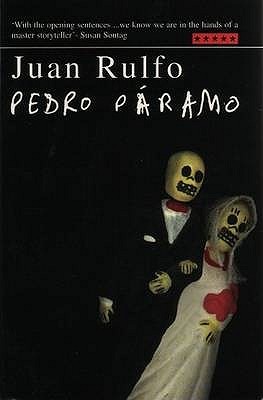
Pedro Paramo by Juan Rulfo


As one enters Juan Rulfo's legendary novel, one follows a dusty road to a town of death.Time shifts from one consciousness to another in a hypnotic flow of dreams, desires, and memories, a world of ghosts dominated by the figure of Pedro Paramo - lover, overlord, murderer. Rulfo's extraordinary mix of sensory images, violent passions and unfathomable mysteries has been a profound influence on a whole generation of Latin American writers including Carlos Fuentes, Mario Vargas Llosa and Gabriel Garcia Marquez. To read Pedro Paramo today is as overwhelming an experience as when it was first published in Mexico nearly fifty years ago.
Amazon description.

Wow! This is one of those books, which when you read the last sentence you want to immediately turn back to page one and start again. I have never read a novel like it. It is as the description states an extraordinary mix of images, passions and mysteries. So much so that it seems to me to be prose poetry. Indeed the works it most reminds me of are the verse plays by Federico Garcia Lorca, in particular Blood Wedding. This is in part because like poetry the book is a distillation of a story: only 122 pages long, it is what is left after Rulfo cut and cut a much longer book. Having written it, Rulfo wrote no more books, but then why, after writing such a masterpiece, would one feel the need?

This book profoundly influenced South American magic realism. Marquez has said that it is the book he would most like to have written and he is able to quote large chunks of the book. It is hard to credit that such a modern feeling book was written in 1955.  

The book is not an easy book to read and those readers who need to be clear about what is going on and who is speaking will hate it. The book is multi-voiced. It starts simply in the first person: I came to Comala because I had been told that my father, a man named Pedro Paramo, lived there. It was my mother who told me. The speaker is Juan Preciado. But as he arrives in the ghost town of Comala, more voices press in, in the third and first person and in the past and present tense. They are the voices of the dead, confused and confusing, for it becomes clear that Comala is a sort of purgatory. At one point Juan dies: There was no air; only the dead, still night fired by the dog days of August. Not a breath. I had to suck in the same air I exhaled, cupping it in my hands before it escaped. I felt it, in and out, less each time…until it was so thin it slipped through my fingers forever. I mean, forever.  

Juan lies in the ground, listening to the whispering of the dead all around, and we lie there with him. From the words of the dead the picture forms of Pedro Paramo's life. But the dead, like the living, do not always tell the truth and seldom tell the whole truth. The best approach to this book is, to my mind, to relax and let the words and images form, as you cannot get it all at first reading. Then read it again and more will become clear.  

This book was listed by the Guardian newspaper in the top 100 novels of all time. I have to agree. I can't tell you how excited I have been to discover it. It alone makes this magic realism challenge worthwhile.  This book is out of print and is hard to obtain. Beg, borrow, besiege your local library, but get it! 

Wednesday, 20 February 2013

Bless Me, Ultima by Rudolfo Anaya


Exquisite prose and wondrous storytelling have helped make Rudolfo Anaya the father of Chicano literature in English. Indeed, Anaya's tales fairly shimmer with the haunting beauty and richness of his culture. The winner of the Pen Center West Award for Fiction for his unforgettable novel Alburquerque, Anaya is perhaps best loved for his classic bestseller, Bless Me, Ultima... Antonio Marez is six years old when Ultima comes to stay with his family in New Mexico. She is a curandera, one who cures with herbs and magic. Under her wise wing, Tony will probe the family ties that bind and rend him, and he will discover himself in the magical secrets of the pagan past-a mythic legacy as palpable as the Catholicism of Latin America. And at each life turn there is Ultima, who delivered Tony into the world...and will nurture the birth of his soul.
Goodreads description


In this novel, as in The Hummingbird's Daughter, an elderly woman healer educates the young hero/ine spiritually. And as in that book the traditional healer character is a symbol of older traditions in a more modern world and she is also a symbol of the power of women in a man's world. I talked in my review of The Hummingbird's Daughter of the duality of the woman healer - regarded as a saint but also seen as a witch often by the same people. That duality is at the heart of this story.

In fact the issue of the conflict between different cultures is central to the book more generally. It is present in the boy's family. The Marez family of Antonio's father are descended from the Spanish conquistadors and so carry the restless blood of the sea. They are vaqueros (cowboys) and roam the llano. The Luna family of his mother are descended  from the Pueblo farmers who settle in one place and plant by the moonlight (Luna): “The sun was good. The men of the llano were men of the sun. The men of the farms along the river were men of the moon.”  Antonio wrestles to reconcile these two conflicting cultures and their demands. The struggle is also a spiritual one - between imported Catholicism and the indigenous pagan traditions, between the Christ and the Golden Carp. Although Ultima is a healer from the indigenous Pueblo tradition, she is able to help Antonio reconcile the conflict: Without the waters of the moon to replenish the oceans there would be no oceans. And the same salt waters of the oceans are drawn by the sun into the heavens, and in turn become again the waters of the moon. Without the sun there would be no water formed to slake the dark earth’s thirst. The waters are one. . . . You have been seeing only parts . . . and not looking beyond into the great cycle that binds us all.

There is a third culture in the book - that of Protestant non-Spanish speaking America. It is that culture that pulls Antonio's brothers away from the way of life of the Marez and Luna families. Antonio is made to speak English at school and is laughed at when he produces a tortillas instead of sandwiches.

Antonio is a naturally spiritual child, and responds intuitively to the power in the old healer. Ultima practices magic - she is called upon to counter the witches' curse laid on Antonio's uncle. She takes Antonio with her as her helper when she does so. The question as to whether Ultima is a witch is unresolved in the book. Being magic realism Ultima's magic is accepted as normal. As a result of this acceptance of "witchcraft" the book has been criticized by fundamentalist Christians andeven being banned from schools in one area of the USA. It is as if the conflict in the book is being reflected in real life. 

The book has been hailed as a masterpiece and it certainly has an important place in Latin American literature and in particular Chicano culture. But I have to differ. The book is an enjoyable read, the themes are interesting and young Antonio is an attractive hero. But there are continuity issues with the book - most noticeably at one point where the subject matter jumps. The struggle is portrayed as very much a case of good versus bad. Ultima's arch-enemy is referred to as evil and his sisters as witches. It seems a simplistic interpretation. So much more could have been done with these characters, given the focus on duality. And lastly Antonio just doesn't sound or behave like a nine-year old boy to me.


Enhanced by Zemanta