Showing posts with label Gabriel García Márquez. Show all posts
Wednesday, 12 April 2017
Magic Realism Bookclub to read 100 Years Of Solitude.
Over on the Magic Realism Books Facebook group I am launching a monthly bookclub. Discussion starts May 1st.
The first book we will be reading is the book that in many ways started magic realism: One Hundred Years of Solitude by Gabriel Garcia Marquez. It also happens to be the first book of magic realism I ever read.
The book is available in kindle format in the UK for £4.99 (£3.99 for the audio download) and is often picked up for less in second-hand shops.
The Facebook Group's address is https://www.facebook.com/groups/magicrealism/
Monday, 17 August 2015
Video - Isabel Allende on Gabriel Garcia Marquez
After the death of the great Gabo - Isabel Allende gave this interview to Democracy Now about the importance of Marquez "the master of masters" to South America and to her personally: "It was as if someone was telling me my own story."
It's a fascinating interview and includes some clips from an interview with Gabo himself.
Tuesday, 28 July 2015
The Autumn of the Patriarch by Gabriel Garcia Marquez
Gabriel Garcia
Marquez, renowned as a master of magical realism, creates stories that
grip the imagination. Set in exotic locals, peoples with unforgettable
characters, and crafted with exquisite prose, his stories transport the
reader to a world that is at once fanciful and real.
One of Gabriel Garcia Marquez's most intricate and ambitious works, The Autumn of the Patriarch is a brilliant tale of a Caribbean tyrant and the corruption of power. Employing an innovative, dreamlike style, the novel is overflowing with symbolic descriptions as it vividly portrays the dying tyrant caught in the prison of his own dictatorship. From charity to deceit, benevolence to violence, fear of God to extreme cruelty, the dictator embodies at once the best and the worst of human nature.
Goodreads description
This novel by the great Gabo himself comes with a reputation for being hard work and dark. And to be sure The Autumn of the Patriarch deals with the darkest of subjects - inside the mind of a psychopathic dictator. So I was nervous as I settled down to read this book in advance of this review. I needen't have worried. Afterall this is a book by the master.
First of all I had to develop a new way of approaching reading the book. The Autumn of the Patriarch is made up of six huge chapters, each consisting of one paragraph. Sentences can go on for pages and are divided almost exclusively with commas (the semicolon is discarded). And within these sentences the narrative voice can shift from the Patriarch's to another character to the general mass of the Patriarch's subjects like a Greek chorus without either punctuation or formating signposting.
Clearly you cannot read this book anywhere where you will be interrupted, but even so I soon found myself relaxing into the book and not worrying when I lost sense of who was speaking. There is a reason for that - the subject of the entire narration is the omnipresent Patriarch. The nation is an extension of the Patriarch. Or at least that is how he sees the world - he is totally self-centred - and it is one reason that The Autumn of the Patriarch is a "poem on the solitude of power" as Garcia Marquez has described it.
It is a tribute to the author's genius that I found myself at times feeling sympathy for the monstrous Patriarch. He is a man who cannot feel love. He is also a man for whom the power he seeks and clings too brings no joy:
but he learned to live with those and all the miseries of glory as he
discovered in the course of his uncountable years that a lie is more comfortable
than doubt, more useful than love, more lasting than truth, he had arrived
without surprise at the ignominious fiction of commanding without power, of
being exalted without glory and of being obeyed without authority.
The book opens with the people he rules breaking in to the palace to find his body. They cannot believe that he has died: afterall he has already died once. That first death was when the Patriarch's double is killed and he watches his subjects' response to his "death" - some grieving, some celebrating. When he reappears he takes typically brutal action against the latter. So it is not surprising that his subjects are cautious when he dies a second time. He has magically lived longer than a normal mortal. Can he die?
The book focuses on the Patriarch after his first death, in the autumn of his years to his end. Of course the book moves backwards and forwards in time without warning, as you would expect, but a portrait of the old man evolves as layer upon layer of story are applied. The story is at times grotesque (but no more grotesque than reality, as the stories of dictators like Idi Amin or Caligula or Pinochet show us). The cruelty of the Patriarch is likewise all too true to life. People are tortured, killed and disposed of. The shocking fate of several thousand innocent children, whose only crime was to have drawn the numbers of the lottery that the Patriarch always won, is perhaps the hardest to take.
At the same time there is a crude gallows humour about the book, which at once relieves and heightens the horror. Some of that humour comes from the Patriarch himself:
the day shit is worth money, poor people will be born without an asshole.
The book reveals that the Patriarch came from a poor background, and there may have been a time when he had some sympathy for the underclass. He is set up by the British as a puppet and then they abandon him and the island. He doesn't use their departure to restore the island's fortunes but to plunder them as the British did. Towards the end of the book we learn that the Americans too have exploited
the country and brought it so much into debt that they demand and get
the sea surrounding the island in payment. This is magic realism as political comment as well as an exploration of the psychology of the individual.
This is an amazing book. Whether it is a pleasurable read is another matter.
This review is my first contribution to the Magic Realism Bloghop 2015. I am planning two more posts on this blog and there are plenty more posts on the hop to be enjoyed (see below).
Wednesday, 19 June 2013
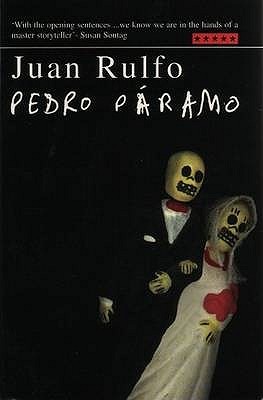
Pedro Paramo by Juan Rulfo
As one enters Juan Rulfo's legendary novel, one follows a dusty road to a town of death.Time shifts from one consciousness to another in a hypnotic flow of dreams, desires, and memories, a world of ghosts dominated by the figure of Pedro Paramo - lover, overlord, murderer. Rulfo's extraordinary mix of sensory images, violent passions and unfathomable mysteries has been a profound influence on a whole generation of Latin American writers including Carlos Fuentes, Mario Vargas Llosa and Gabriel Garcia Marquez. To read Pedro Paramo today is as overwhelming an experience as when it was first published in Mexico nearly fifty years ago.
Amazon description.
Wow! This is one of those books, which when you read the last sentence you want to immediately turn back to page one and start again. I have never read a novel like it. It is as the description states an extraordinary mix of images, passions and mysteries. So much so that it seems to me to be prose poetry. Indeed the works it most reminds me of are the verse plays by Federico Garcia Lorca, in particular Blood Wedding. This is in part because like poetry the book is a distillation of a story: only 122 pages long, it is what is left after Rulfo cut and cut a much longer book. Having written it, Rulfo wrote no more books, but then why, after writing such a masterpiece, would one feel the need?
This book profoundly influenced South American magic realism. Marquez has said that it is the book he would most like to have written and he is able to quote large chunks of the book. It is hard to credit that such a modern feeling book was written in 1955.
The book is not an easy book to read and those readers who need to be clear about what is going on and who is speaking will hate it. The book is multi-voiced. It starts simply in the first person: I came to Comala because I had been told that my father, a man named Pedro Paramo, lived there. It was my mother who told me. The speaker is Juan Preciado. But as he arrives in the ghost town of Comala, more voices press in, in the third and first person and in the past and present tense. They are the voices of the dead, confused and confusing, for it becomes clear that Comala is a sort of purgatory. At one point Juan dies: There was no air; only the dead, still night fired by the dog days of
August. Not a breath. I had to suck in the same air I exhaled, cupping
it in my hands before it escaped. I felt it, in and out, less each
time…until it was so thin it slipped through my fingers forever. I mean,
forever.
Juan lies in the ground, listening to the whispering of the dead all around, and we lie there with him. From the words of the dead the picture forms of Pedro Paramo's life. But the dead, like the living, do not always tell the truth and seldom tell the whole truth. The best approach to this book is, to my mind, to relax and let the words and images form, as you cannot get it all at first reading. Then read it again and more will become clear.
This book was listed by the Guardian newspaper in the top 100 novels of all time. I have to agree. I can't tell you how excited I have been to discover it. It alone makes this magic realism challenge worthwhile. This book is out of print and is hard to obtain. Beg, borrow, besiege your local library, but get it!
Wednesday, 2 January 2013
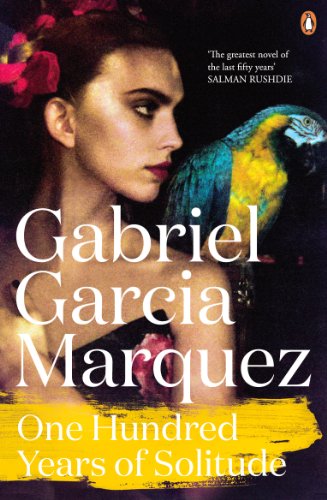
One Hundred Years Of Solitude - Gabriel Garcia Marquez
One of the 20th century’s enduring works, One Hundred Years of Solitude is a widely beloved and acclaimed novel known throughout the world, and the ultimate achievement in a Nobel Prize-winning career.
The novel tells the story of the rise and fall of the mythical town of Macondo through the history of the Buendía family. It is a rich and brilliant chronicle of life and death, and the tragicomedy of humankind. In the noble, ridiculous, beautiful, and tawdry story of the Buendía family, one sees all of humanity, just as in the history, myths, growth, and decay of Macondo, one sees all of Latin America.
Love and lust, war and revolution, riches and poverty, youth and senility—the variety of life, the endlessness of death, the search for peace and truth—these universal themes dominate the novel. Whether he is describing an affair of passion or the voracity of capitalism and the corruption of government, Gabriel García Márquez always writes with the simplicity, ease, and purity that are the mark of a master.
The novel tells the story of the rise and fall of the mythical town of Macondo through the history of the Buendía family. It is a rich and brilliant chronicle of life and death, and the tragicomedy of humankind. In the noble, ridiculous, beautiful, and tawdry story of the Buendía family, one sees all of humanity, just as in the history, myths, growth, and decay of Macondo, one sees all of Latin America.
Love and lust, war and revolution, riches and poverty, youth and senility—the variety of life, the endlessness of death, the search for peace and truth—these universal themes dominate the novel. Whether he is describing an affair of passion or the voracity of capitalism and the corruption of government, Gabriel García Márquez always writes with the simplicity, ease, and purity that are the mark of a master.
Goodreads description
This blog post is part of the Classic Reads Bloghop, in which a number of book blogs will be discussing what makes a classic read. Among fans of magic realism there can be little argument that Marquez's tale of one hundred years in the lives of the Buendia family and of Macondo, the town founded by patriarch Jose Arcadio is a magic realism classic. People who don't like magic realism hate it.
I first read this book about thirty years ago, when I had just finished university. It was a formative time for me - I discovered my favourite poet (Anna Akhmatova) and the magic realist films of Tarkovsky at the same time. This book was just as influential: it totally blew me away. Just as Kafka's Metamorphosis transformed Marquez's views on what he could write, so this book completely changed my understanding of literature.
I had grown up on fantasy and historical fiction: loving books by Alan Garner, Rosemary Sutcliff and Mary Renault. I had then been introduced to "literature" at my strait-laced grammar school, where fantasy and historical fiction were regarded as inappropriate for serious reading. I gave up any thoughts of studying English Literature at university and instead pursued my love of history. With One Hundred Years of Solitude I found a book that brought together both history and fantasy and was clearly literature.
It may come as a surprise to people who have problems with the magic in this book that the author started work as a journalist. But as he said in an interview in The Paris Review:
It always amuses me that the biggest praise for my work comes for the imagination, while the truth is that there’s not a single line in all my work that does not have a basis in reality. The problem is that Caribbean reality resembles the wildest imagination.
Some people might argue that the magical elements cannot possibly be confused with reality. Take the incident of the massacre at the train station in which three thousand people are machine-gunned down and the inhabitants of the town believe the government propaganda that nothing happened. That is incredible isn't it? And yet think of all those Germans who failed to acknowledge the holocaust, even though they lived close to the camps or of the people who believed the official accounts of the Hillsborough disaster and suddenly One Hundred Years of Solitude becomes less fantastical. Magic realism is often used, as here, to talk about serious political issues and about the oppressed. The bloody history of Latin America is mirrored in the history of this fictional town in an unnamed land and time, in the book's thirty-two bloody and pointless revolutions, the exploitation by ruthless foreign capitalists and the suppression of workers' protests.
I am not a journalist, but I am a historian. And I am struck by how similar One Hundred Years of Solitude is at times to historical texts I have studied, such as chronicles and hagiographies as well as oral history sources. The fantastical is reported with equal seriousness as the realistic. In Marquez's novel the same is true. Marquez acknowledges his grandmother's storytelling style as a major influence: She told things that sounded supernatural and fantastic, but she told them with complete naturalness.
That is the definition of magic realism and that is why this book is a magic realist classic.
Another aspect of the book that I love is the richness of the descriptions. You can feel the heat of the sun-baked streets, smell the lemon trees and the shit, hear the scream of love-making or the chomping of the ants in the beams, and see the yellow butterflies that surrounded Renata Remedios whenever her lover was nearby.
Does the book have any flaws? I have to confess that I do get confused with the characters, especially in the first fifty pages, and was grateful for the family tree at the beginning of my copy. Of course there are good reasons for the repetition of names - it's common practice in Latin America and it is symbolic of the way history and the Buendia family are doomed to repeat their mistakes. One of the themes of the book is that time was not passing...it was turning in a circle. As a result readers will not find the conventional storyline or character arc in One Hundred Years of Solitude. As the six generations of the family come and go in the book, there is only one character, that of the matriarch Ursula, who is present almost to the end of the book and when she dies the force that has held the family, and perhaps even the town, together fails.
If you love magic realism and maybe even if you don't, this is a book that you should read.
If you wish to explore other blogs on the Classic Reads Blog Hop, please click on the links below:
Subscribe to:
Posts (Atom)