Showing posts with label Dennis Vickers. Show all posts

Saturday, 2 May 2015

Interview with Dennis Vickers

This is a new development for this blog: interviews with writers of magic realism. First up is Dennis Vickers, whose book Mikawadizi Storms I reviewed a few months ago. Any other authors interested in doing an interview should check out the interview tab above. 

Welcome, Dennis. Before we start, here's a bit of introduction: Dennis is a member of the Magic Realism Books Facebook Group. He has quite a few books to his name, check out his Amazon Author page for more info.


1. Who are your favourite magic realist authors and why?
Gabriel Garcia Marquez. One Hundred Years of Solitude was the first Magical Realism book I read. I found the story charming, but didn’t think much about why until later. I also enjoy Isabel Allende, Jorge Luis Borges, Louise Erdrich, and Sherman Alexie.

2. What is your all-time favourite magic realist book?
Surprisingly (given Laura Esquivel isn’t among the authors I listed above) I thought Like Water for Chocolate was a marvelous story. I especially like how Esquivel infuses the magic into the characters. It’ s probably the MR book I think about most and the one I’ll most likely reread one day.

3. Why do you write magic realism?
The real world is filled with events that are beautiful or delightful in a way that seems removed from everyday life (one definition of magical), but we often don’t notice. Sometimes twisting or exaggerating these events highlights them. For example, greed often leads to consequences greedy people struggle to deal with. In my last novel, a greedy mining engineer’s hands grow, leading to all sorts of difficulties for him. This story element is my way of drawing attention to the everyday development that greed leads to life-draining consequences, usually debilitating absorption in the acquisition and retention of money.

4. Can you give us your definition of magic realism?
Magical realism is a literary genre in which two cultures are presented together, usually embedded in characters that represent both. One culture accepts magic as an everyday factor; the other rejects magic. Thus, some events are everyday events from one cultural perspective, but magical from the other. In One Hundred Years of Solitude, José Arcadio is shot in his bedroom. Blood flows out of his ear, down the street, around some corners, up the stairs of Úrsula's house, and through the rooms there, until it finds her. Garcia Marquez tells this story as if there’s nothing unusual about it, and indeed, it’s an everyday occurrence that a person would come to know that a tragic misfortune has befallen a loved one – from one perspective it’s quite real. Yet, of course, blood doesn’t do that – from the other perspective it’s magic.  

5. Tell us about your latest magic realist book?
Mikawadizi Storms tells the story of a freelance journalist who reports on the controversy surrounding an open-pit iron ore mine dug into idyllic woodlands just up river from an Indian Reservation. The plot mirrors a conflict that unfolded near where I live: Gogebic Taconite sought to put the largest open-pit iron mine in the world in the Penokee Hills upstream of the Bad River Ojibwe. Interestingly, the outcome predicted in my novel, i.e. the Earth rejects the mine, is in fact what came about – the Penokee Hills hold too much ground water for such a mine to be feasible. No doubt the conflict will resume one day when the value of iron ore has increased to the point where massive pumping of ground water seems a good idea.

I am struck by how many people are involved in conflicts like the Penokee Hills mine, and so I structured the novel into forty-six small stories, each a chapter focused primarily on one character. I found the subtle perspective shifts implied by that structure to be useful when presenting the worldview of the Native American characters, many of whom were intently concerned about the mine but only indirectly connected to the main plot (namely the politics of mine approval and the actual construction of the mine). Magical Realism elements include sentient animals (with a ghost cat), karmic developments (for example, the greedy mine engineer with growing hands), an old man who transforms into a butterfly, all set against the background of conflict between perspectives of the indigenous culture and the mining company.

Wednesday, 7 January 2015

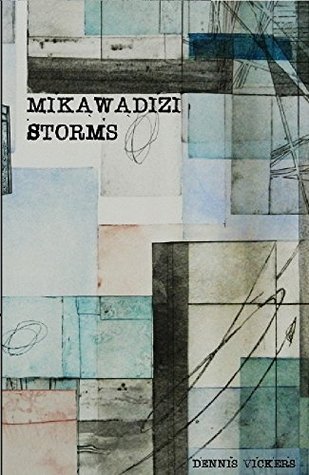
Mikawadizi Storms by Dennis Vickers


Freelance journalist Evie Arnold agrees to cover the emerging conflict between mining magnate Clive Gready, who plans to dig an open-pit mine in the Mikawadizi hills, and La Roche Verte Indian Nation, who intend to stop him. As she watches and records, the conflict spirals from serious to severe to ominous. and finally explodes into an epic battle between good and evil. 

Mikawadizi Storms casts bold characters into conflicts bristling with magic and smoldering with contradictory world views. 

Goodreads description


Every month I review an independently published book by a member of the Magic Realism Books Facebook Group. Indie books get a lot of stick  about quality, but in my experience indie magic realist books are often very good indeed. Maybe that is partly because the people on the Facebook Group are genuinely interested in magic realism and want to know more and maybe it is because the nature of magic realism attracts a certain type of writer - one that thinks about his/her work and more generally about the nature of reality. Dennis Vickers falls into both categories. 
 
This book falls into two types of magic realism - Indigenous American and environmental magic realism. Vickers teaches creative writing at the College of Menominee Nation, a tribal college located in north-central Wisconsin and, whilst he's not a member of an Indian Nation, this has clearly influenced the content of his book. The book contrasts the two world views of the Indian community and the white community to the land and nature. This split is literally depicted in the characters Ed and Ward Cormmercant. Edward Commercant is of mixed French/Indian descent and as a result of the conflict between his two backgrounds splits into Ed and Ward - an interesting magic realist concept. 

The abuse of the environment by the white mining consortium and its defence by the La Roche Verte Indian Nation and supporters is at the heart of the novel.  Early on a contrast is made between the white approach to the land of ripping it open and tearing out the treasures they seek and the Roche Verte who harvested only the silver that fell from the walls of a secret cave. The danger of digging too deep is made clear towards the end of the story when nature takes her revenge, but I will not spoil the ending for you by explaining more.

The central character in the book is the reporter Evie Arnold. Thus we get to hear and see both sides of the story, although Evie shares the writer's bias in favour of the Roche Verte. Evie too is conflicted - in her case in her attitude to her sexuality and having children. This brings her to the magical  house of Lotta Moore, where another, this time European,  shamanism is active.

On his Goodreads author's page Dennis writes: I write stories to explore concepts. The more fundamental the concepts the better. The more interesting the concepts the better. But, it still has to be a good story. What I find interesting about people are their stories, the stories they tell and the stories they live. In the end there isn't much difference.
Vickers uses that approach in structuring the book. Each chapter of the book starts with a  drawing of a different character and some of their words. The chapter then has that character at its heart. There are forty four chapters in the book. That is a lot of characters to introduce and for the reader to retain in their heads. Does the device work? Up to a point. The drawings certainly helped my memory, but at times I felt that the need to introduce a new character dictated the story rather than the other way. 

I enjoyed reading this book. There is a lot to think about within its pages (possibly a bit too much for some readers) and I always like that.

I received this book free from the author in return for a fair review.