Showing posts with label Indigenous American. Show all posts

Wednesday, 9 December 2015

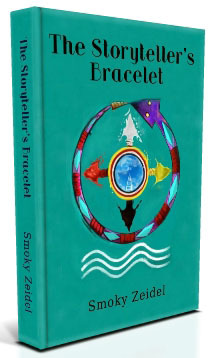
The Storyteller's Bracelet by Smoky Zeidel


It is the late 1800s, and the U.S. Government has mandated native tribes send their youth to Indian schools where they are stripped of their native heritage by the people they think of as The Others.
Otter and Sun Song are deeply in love, but when they are sent East to school, Otter, renamed Gideon, tries to adapt, where Sun Song does not, enduring brutal attacks from the school headmaster because of her refusal to so much as speak.

Gideon, thinking Sun Song has spurned him, turns for comfort to Wendy Thatcher, the daughter of a wealthy school patron, beginning a forbidden affair of the heart. But the Spirits have different plans for Gideon and Sun Song. They speak to Gideon through his magical storyteller's bracelet, showing him both his past and his future. You are both child and mother of The Original People, Sun Song is told. When it is right, you will be safe once more.

Will Gideon become Otter once again and return to Sun Song and his tribal roots, or attempt to remain with Wendy, with whom he can have no future?

Goodreads description

This is a story which takes a terrible and hidden part of American history - the enforced schooling of Native American children in the ways of the white man. There is an excellent Wikipedia article on the subject here: http://en.wikipedia.org/wiki/American_Indian_boarding_schools which reveals that the events depicted in The Storyteller's Bracelet - such as the abuse of Sun Song by the evil headmaster - are very much based on what really happened. Hats off to Smoky Zeidel for writing about the subject and doing so in a way that gives us an excellent story whilst not shirking from the darkness of the subject. Sadly the removal of indigenous children from their homes to often brutal boarding schools with the aim of taking away their culture and identity was not confined to North America.

The novel is not simply an account of Otter and Sun Song's experience in the school. It is also a spiritual and mythical journey, which evolves into a creation story. The fact that magic realism is so often focused on a clash between a dominant white European culture and an indigenous one is a problem for those of us white European authors who want to explore the subject. How does one approach it without appropriating the indigenous culture one is writing about? Smoky Zeidel is very clear that she is not Native American and so rather than take one first nation's experience and legends as her focus, she has drawn on different First Nations' beliefs and culture to create a creation story of her own. She does so with huge respect, admiration and love for the beliefs in question. That is one approach. Another, and one I followed, is to create a realistic fantasy world. Some people may understandably argue that no appropriation is acceptable. But where does that leave the freedom of the artist and the imagination? Comments/thoughts welcome.

Smoky Zeidel is an excellent storyteller herself. The central characters are well drawn - sympathetic while not being perfect. The pacing of the story was compelling. Recommended.

I received this book from the author in return for a fair review.

Wednesday, 7 January 2015

Mikawadizi Storms by Dennis Vickers


Freelance journalist Evie Arnold agrees to cover the emerging conflict between mining magnate Clive Gready, who plans to dig an open-pit mine in the Mikawadizi hills, and La Roche Verte Indian Nation, who intend to stop him. As she watches and records, the conflict spirals from serious to severe to ominous. and finally explodes into an epic battle between good and evil. 

Mikawadizi Storms casts bold characters into conflicts bristling with magic and smoldering with contradictory world views. 

Goodreads description


Every month I review an independently published book by a member of the Magic Realism Books Facebook Group. Indie books get a lot of stick  about quality, but in my experience indie magic realist books are often very good indeed. Maybe that is partly because the people on the Facebook Group are genuinely interested in magic realism and want to know more and maybe it is because the nature of magic realism attracts a certain type of writer - one that thinks about his/her work and more generally about the nature of reality. Dennis Vickers falls into both categories. 
 
This book falls into two types of magic realism - Indigenous American and environmental magic realism. Vickers teaches creative writing at the College of Menominee Nation, a tribal college located in north-central Wisconsin and, whilst he's not a member of an Indian Nation, this has clearly influenced the content of his book. The book contrasts the two world views of the Indian community and the white community to the land and nature. This split is literally depicted in the characters Ed and Ward Cormmercant. Edward Commercant is of mixed French/Indian descent and as a result of the conflict between his two backgrounds splits into Ed and Ward - an interesting magic realist concept. 

The abuse of the environment by the white mining consortium and its defence by the La Roche Verte Indian Nation and supporters is at the heart of the novel.  Early on a contrast is made between the white approach to the land of ripping it open and tearing out the treasures they seek and the Roche Verte who harvested only the silver that fell from the walls of a secret cave. The danger of digging too deep is made clear towards the end of the story when nature takes her revenge, but I will not spoil the ending for you by explaining more.

The central character in the book is the reporter Evie Arnold. Thus we get to hear and see both sides of the story, although Evie shares the writer's bias in favour of the Roche Verte. Evie too is conflicted - in her case in her attitude to her sexuality and having children. This brings her to the magical  house of Lotta Moore, where another, this time European,  shamanism is active.

On his Goodreads author's page Dennis writes: I write stories to explore concepts. The more fundamental the concepts the better. The more interesting the concepts the better. But, it still has to be a good story. What I find interesting about people are their stories, the stories they tell and the stories they live. In the end there isn't much difference.
Vickers uses that approach in structuring the book. Each chapter of the book starts with a  drawing of a different character and some of their words. The chapter then has that character at its heart. There are forty four chapters in the book. That is a lot of characters to introduce and for the reader to retain in their heads. Does the device work? Up to a point. The drawings certainly helped my memory, but at times I felt that the need to introduce a new character dictated the story rather than the other way. 

I enjoyed reading this book. There is a lot to think about within its pages (possibly a bit too much for some readers) and I always like that.

I received this book free from the author in return for a fair review.