Showing posts with label Indian. Show all posts

Wednesday, 9 December 2015

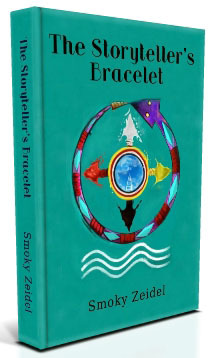
The Storyteller's Bracelet by Smoky Zeidel


It is the late 1800s, and the U.S. Government has mandated native tribes send their youth to Indian schools where they are stripped of their native heritage by the people they think of as The Others.
Otter and Sun Song are deeply in love, but when they are sent East to school, Otter, renamed Gideon, tries to adapt, where Sun Song does not, enduring brutal attacks from the school headmaster because of her refusal to so much as speak.

Gideon, thinking Sun Song has spurned him, turns for comfort to Wendy Thatcher, the daughter of a wealthy school patron, beginning a forbidden affair of the heart. But the Spirits have different plans for Gideon and Sun Song. They speak to Gideon through his magical storyteller's bracelet, showing him both his past and his future. You are both child and mother of The Original People, Sun Song is told. When it is right, you will be safe once more.

Will Gideon become Otter once again and return to Sun Song and his tribal roots, or attempt to remain with Wendy, with whom he can have no future?

Goodreads description

This is a story which takes a terrible and hidden part of American history - the enforced schooling of Native American children in the ways of the white man. There is an excellent Wikipedia article on the subject here: http://en.wikipedia.org/wiki/American_Indian_boarding_schools which reveals that the events depicted in The Storyteller's Bracelet - such as the abuse of Sun Song by the evil headmaster - are very much based on what really happened. Hats off to Smoky Zeidel for writing about the subject and doing so in a way that gives us an excellent story whilst not shirking from the darkness of the subject. Sadly the removal of indigenous children from their homes to often brutal boarding schools with the aim of taking away their culture and identity was not confined to North America.

The novel is not simply an account of Otter and Sun Song's experience in the school. It is also a spiritual and mythical journey, which evolves into a creation story. The fact that magic realism is so often focused on a clash between a dominant white European culture and an indigenous one is a problem for those of us white European authors who want to explore the subject. How does one approach it without appropriating the indigenous culture one is writing about? Smoky Zeidel is very clear that she is not Native American and so rather than take one first nation's experience and legends as her focus, she has drawn on different First Nations' beliefs and culture to create a creation story of her own. She does so with huge respect, admiration and love for the beliefs in question. That is one approach. Another, and one I followed, is to create a realistic fantasy world. Some people may understandably argue that no appropriation is acceptable. But where does that leave the freedom of the artist and the imagination? Comments/thoughts welcome.

Smoky Zeidel is an excellent storyteller herself. The central characters are well drawn - sympathetic while not being perfect. The pacing of the story was compelling. Recommended.

I received this book from the author in return for a fair review.

Wednesday, 19 February 2014

House of Purple Cedar by Tim Tingle


"The hour has come to speak of troubled times. It is time we spoke of Skullyville." Thus begins Rose Goode's story of her growing up in Indian Territory in pre-statehood Oklahoma. Skullyville, a once-thriving Choctaw community, was destroyed by land-grabbers, culminating in the arson on New Year's Eve, 1896, of New Hope Academy for Girls. Twenty Choctaw girls died, but Rose escaped. She is blessed by the presence of her grandmother Pokoni and her grandfather Amafo, both respected elders who understand the old ways. Soon after the fire, the white sheriff beats Amafo in front of the town's people, humiliating him. Instead of asking the Choctaw community to avenge the beating, her grandfather decides to follow the path of forgiveness. And so unwinds this tale of mystery, Indian-style magical realism, and deep wisdom. It's a world where backwoods spiritualism and Bible-thumping Christianity mix with bad guys; a one-legged woman shop-keeper, her oaf of a husband, herbal potions, and shape-shifting panthers rendering justice. 
Goodreads description

One of the joys of this blog has been my discovery of novels by writers of native American heritage, such as Louise Erdrich, Leslie Marmon Silko, Alfredo Vea and Rudolfo Anaya. Now to that list I can add Tim Tingle. Tingle is perhaps better known for his children's books: Crossing Bok Chitto won the American Indian Youth Literature Award in 2008. This book however is for the adult market, although it would also be suitable to older children.

Maybe because of the author's background in writing children's literature the book has a gentleness and morality which was appealing. These didn't prevent the author from tackling hard subjects - the book opens with the murderous arson attack on a Choctaw school by white racists and two women in the story are victims of domestic violence. Nevertheless these are countered by both Amafo's choice of forgiveness rather than violent response and an attempt to understand the motivation of even the most vicious of men. A part of me (maybe the adult part) kept thinking that life isn't/wasn't like this, but then another part wanted the moral resolution that the book offers.

Justice prevails in this book. Amafo is able to find allies within the white community, such as the wonderful one-legged Maggie Johnston. Most importantly for the purpose of this blog the Choctaw central characters find allies in the natural world and the spirits of their family. This is where the magic realism appears, especially in the form of a panther, that may or may not be Rose's dead grandmother. As is so often the case in magic realist books, there is an ambiguity about what is happening at this crucial point in the story. But earlier we see the spirits of the dead through the eyes of the young narrator Rose, who has inherited her grandfather's sight: Rose, if you are real quiet and learn to see people, you can know the ones weighed down by death. Find out what makes them happy, what they like to do or talk about. Making Walking People laugh is a very good thing to do too, sweetheart. When the spirits laugh, everybody is happy.

Tim Tingle is an experienced oral storyteller and this shows in the book. House of Purple Cedar's central plot may be the serious matter of the persecution of Amafo and his family by the hateful marshal, but the book is leavened by the tale of how Maggie Johnston saves her future husband, Terrance, from the gallows. This tale of the most incompetent bank robber you can imagine reads like a comic fable. It had me giggling when Terrance is threatening to cut a hostage's throat with a butter knife to the bemusement of onlookers. But then there is something fable-like about the whole book. The story is partly told by an elderly Rose and it feels like something told by the fireside. Indeed, as I discovered in the book's acknowledgement section, the tale of the panther/protector had been inspired by just such an account by a real woman remembering her childhood. All of which reminds me of what Marquez once said: the truth is that there’s not a single line in all my work that does not have a basis in reality. 

I received a review copy of this book from the publisher via Edelweiss in return for a fair review.