Showing posts with label Elizabeth Hand. Show all posts

Wednesday, 15 July 2015

Wylding Hall by Elizabeth Hand


When the young members of a British acid-folk band are compelled by their manager to record their unique music, they hole up at Wylding Hall, an ancient country house with dark secrets. There they create the album that will make their reputation, but at a terrifying cost: Julian Blake, the group’s lead singer, disappears within the mansion and is never seen or heard from again.

Now, years later, the surviving musicians, along with their friends and lovers—including a psychic, a photographer, and the band’s manager—meet with a young documentary filmmaker to tell their own versions of what happened that summer. But whose story is true? And what really happened to Julian Blake?

Goodreads description

Can a ghost story be magic realism? And if not, why not? 

This book rang a lot of bells for me. I spent my teenage years listening to Fairport Convention, Pentangle, and Led Zeppelin. I was into ancient British customs and mythology (especially Celtic legends), wore Celtic crosses, Indian cotton blouses and layered skirts, I even had the ubiquitous Afghan coat which smelled when it rained.  The posters that lined my bedroom wall were of Tolkien's Lord of the Rings (if you are over 50 you will know the one I am referring to) and sensitive poetic lead singers. Oh yes, I would have been a fan of Julian Blake and band. Elizabeth Hand is of my generation and I guess that she too was into the same things as I. She certainly knows how to conjure up the atmosphere of the time. 

This realism is added to by the narrative style - a series of short chapters each part of an interview with one of the surviving characters. These build to create a picture of the events of that summer. It took me a little while to form an image of the characters and to hear their voices, but they are generally well-drawn and distinct and so I soon settled back into the story. 

Other aspects of the story are more predictable, indeed regular, parts of any ghost story:  a tumbledown labyrinthine abandoned manor house, strange local customs, the locals coming out with cryptic comments which give the impression that they know something of the hall's dark secrets but aren't saying, and even a naive bunch of teenagers fascinated with the occult. I had the added insight that I know enough about the traditions and myths referenced by the book to see where things were heading. With the exception of one sentence (which I will not reveal to avoid spoiling the book for you) I was not surprised by the climax of the story, however that did not worry me or dent my enjoyment.

All of which brings me back to my opening questions? I think the answer to the first question is yes, ghost stories can be magic realism. And to the second: why can't they? Just because these are British traditions and beliefs and not those of Latin Americans or any other ethnic group, why are they not acceptable as magic in the magic realist sense? It is precisely because ghost stories are moored in a deep British collective subconscious that they work so well. 

You will note that I say ghost stories can be magic realism and not that they all are. Wylding Hall certainly is magic realism as far as I am concerned. This is because of the realism in the book, which is partly down the way the narrative works. The voices are real. They also differ in their interpretation and even in their accounts. There is an ambiguity about the conclusion to the story and how the characters feel about Julian. I would go so far as to say that despite the ghost story/horror set-up the book isn't actually about what really happened to Julian. For this reason the predictability I refered to earlier does not matter. For me the book is about the dynamic of the group and their relationship with the missing man, the way they are still trying to come to terms with and explain not only Julian's disappearance but also with him their ability to regain the magic of the music generated in the sessions at Wylding Hall. 

I really enjoyed this book and thank Open Road Media for granting me a copy of the book free in return for a fair review.


Tuesday, 24 June 2014

Saffron and Brimstone - Strange Stories by Elizabeth Hand


America boasts no finer, more acclaimed or accomplished literary fantasist than Elizabeth Hand. Poetry, magic, and love intermingle as she tears down the walls that separate the mundane from faerie and fancy. In this stunning collection of eight “strange stories,” the multiple Nebula Award– and World Fantasy Award–winning author weaves spells that enrapture her readers, ranging freely from Greek mythology to the contemporary nightmares of AIDS and 9/11.

The celebrated chiller “Cleopatra Brimstone” chronicles the aftermath of a brutal rape and the bizarre transformation of a young entomology student into a vengeful angel of death. An emotionally unmoored tattoo artist discovers an unusual deck of tarot cards that enables her to profoundly alter bare skin and her personal reality in the mind-expanding masterwork “The Least Trumps.” An artist attempts to capture her wayward modern-day Odysseus in oils and otherwise; a woman tragically in love isolates herself from a catastrophe-prone world; the death of a dear friend inspires profound personal reflections and strange pagan rituals; and in the brilliant concluding story, an artifact from a lost world reveals the inescapable vulnerability of our own. Odd and touching, provocative and disturbing, the selections in this magnificent collection showcase a master of the fantastic at the very peak of her storytelling powers.

Goodreads description

This collection was first released in 2006 and has just been published by Open Road as an ebook. In doing so Open Road has again revived a gem for us magic realism fans. In my review of Hand's collection Last Summer on Mars Hill (also published by Open Road) I suggested that although the author is known as a writer of speculative fiction and horror a strong case could be made for her as a writer of magic realism. I think that case is even stronger with this later collection. The stories seem more realistic, the fantastical grounded in important issues. We see again the themes that appeared in her earlier work - reworking of Greek classical mythology, isolation and loneliness, alternative lifestyles - but the stories are even stronger.  

Cleopatra Brimstone is probably the most conventional horror story in the collection. It left me unnerved, not by the horror (although that is not my favourite genre) but by the psychology. Hand carefully draws the psychology of the two sides of the central character, but then introduces a secondary character whose motivation is not clear. As a feminist, I was not sure what to make of this and the resulting ending.  Nor am I sure about the decision to place this story first in the collection. It seems sufficiently out of keeping with the other stories as to make it an unsuitable introduction.

If I had doubts about the first story in the collection I loved Pavane for a Prince of the Air. An account of the sudden illness and rapid decline of a close friend and mentor rang so true (painfully so) to me. My instinct is that this story is based on true life. For the most part the story is totally realistic. Even if the dying man is a hippy and believer in various alternative faiths, the narrator is not, which makes the ending utterly magical.

The Least Trumps is a fascinating story that explores loneliness and creativity (especially the impact of children's fiction and its writers).  This story has a theme of links to place (literally as the central character is agrophically attached to her remote island home) which appears in several stories. Hand has great skill in her portrayal of place and her characters' relationship to it.

Wonderwall is an account of an alienated young student's descent into the wild side and smashing into the wonderwall. Will she come through this self-destructive stage in her life and will her friend? The account is superbly graphic and realistic. 

The second part of the book is entitled The Lost Domain and is made up of four shorter stories or story variations. All are variations on Greek mythology.  The first, Kronia, is the most experimental section in the book - a series of recollections by a man and a woman weaving in and out of each other, creating a collective and at times conflicting impression of memories. 

In the second variation, Calypso in Berlin, Odysseus's abandoned lover Calypso may be living in the twenty-first century but she is still being abandoned. This time she plots to keep her lover when he returns.  Again we see Hand's skill at portraying place, as well as the magic of art (Calypso is a painter). 

Echo is a superbly subtle post-apocalyptic piece. Like the character in The Least Trumps, Echo lives on an island and waits eagerly for the irregular correspondence of those she loves. But then some unspecified disaster happens on the mainland and her wait becomes almost unbearable. 

The final piece also touches on an apocalypse. The Saffron Gatherers of the title appear in a wall painting in Santorini. Santorini is a place that was destroyed by a volcanic eruption and at the same time its artwork was preserved by the volcanic ash. The central character is a journalist researching the story of Santorini, who appears just about to settle down with her long-term long-distance lover in San Francisco, but before she does, history repeats itself in a shocking conclusion. 

I have said before that magic realism has much in common with poetry, in particular how themes and images are woven together to create great depth. I have barely touched on the many themes and images in this collection nor the expert way Elizabeth Hand weaves them into her story.  It is not possible with the restrictions on space in this blog. You will have to read the collection yourself and I will have to read it again.

I received this book from the publisher in return for a fair review.


Friday, 24 May 2013

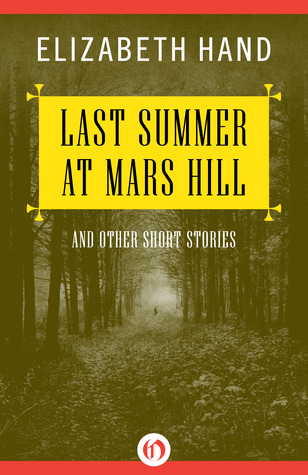
Last Summer At Mars Hill by Elizabeth Hand


Twelve exceptional stories by the multiple award–winning author of Waking the Moon and Black Light prove that Elizabeth Hand is just as adept with short fiction as she is in the novel form. The title story traces a world-changing summer at a New England artists’ colony for young Shadowmoon Starlight Rising, who comes to know life, death, and an unbelievable secret about the strange apparitions that dwell in her community.

Other stories include “Snow on Sugar Mountain,” which features a young boy who has the power to shapeshift into any form with the help of a Native American artifact; “The Bacchae,” in which womankind rules a savage futuristic version of our world; and “The Erl-King,” where a fairy tale horrifyingly comes true. Each story includes an afterword by the author.

From Goodreads description 


Before I started this blog I had read very few collections of short stories, but since starting I have discovered just what I had been missing. This collection is no exception.

Elizabeth Hand is a writer of speculative fiction and horror. This collection of short stories first appeared in 1998 and has just been issued as an ebook. The story that gives its name to the collection won the 1995 Nebula Award and the World Fantasy Award. 

When is speculative fiction magic realism? It seems to me that especially in short stories the boundaries can very definitely overlap. This is partly because the brevity of short stories makes it easier to start in reality than in a constructed world. There are a number of stories in the collection for which a strong case can be made that they are magic realism. 

My two favourites were Last Summer at Mars Hill and Snow on Sugar Mountain.

The wonderful Last Summer at Mars Hill is set in a spiritualist retreat in Maine. The characters and their alternative beliefs are recognizable, as they try to deal with their feelings about their mortality. The magic element is used brilliantly to look at those feelings in a totally different perspective.

In Snow on Sugar Mountain a teenage boy who has inherited from his mother an amulet that allows him to shapeshift meets with a dying former astronaut. The story follows the growing relationship between the old man and the boy. It has one of the best opening lines I have ever read: When Andrew was seven, his mother turned into a fox. 

The Have-Nots is a tale of a woman deprived of her new-born child but given a cadillac by Elvis. It is narrated by a cosmetics saleswoman to a customer, which at times got wearisome, but nevertheless is engaging with a magical twist in the tail. 

Engels Unaware focuses on a down-at-heel (literally) temporary secretary working in a financial investment house at the height of a financial boom. The arrival of brother and sister Graedig and Avaratia Engel sets in train financial Armageddon. 

As you might have observed, my favourites in the collection tend to be the stories with the more optimistic endings. But Elizabeth Hand is known for her horror and some of the stories are distinctly dark. The Bacchae was even voted the "most hated" story by Interzone readers in 1991! The Erl King is a take on the fairytale and Goethe's poem, and reflects the bleakness of the originals. Hand's work has been described as having heart and also sharp little teeth, which I think is an excellent description of this collection. 

Elizabeth Hand is obviously much inspired by Greek myths - Justice is inspired by Circe, On The Town Route by the Persephone story (with a bit of Pied Piper of Hamelin thrown in), then there is the Bacchae...One of the pluses with this collection is that after each story we get the author's notes on its creation and influences. These make for fascinating reading.

The weakest story, to my mind, is the Prince of Flowers. The story of a malevolent puppet is not original. It is interesting though to consider why puppets in literature (and film) are so often stereotyped, but that would take up a whole post. Nevertheless it, like all the stories in this collection, is beautifully written. Hand is a wonderful writer - every word is chosen for its contribution, building strong images and stories. I may not be a fan of the horror genre, but I am delighted that the publisher offered me this book to review.

This book was given to me, via Netgalley, by the publisher in return for a fair review.


Enhanced by Zemanta