Showing posts with label Lisa Goldstein. Show all posts

Wednesday, 4 March 2015

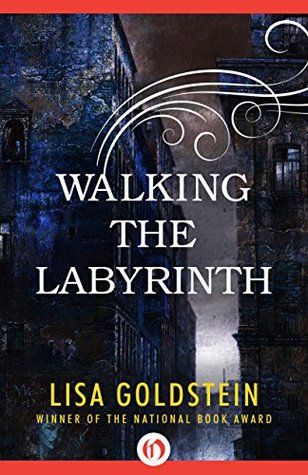
Walking the Labyrinth by Lisa Goldstein


Investigating her family history, Molly slips into a world of magic

Backstage at a vaudeville in Oakland, California, a reporter sits down for an interview with Callan Allalie, patriarch of a family of traveling magicians. As the journalist asks his questions, Callan’s sisters dazzle him with tricks too delicate for the stage. The night quickly whirls out of control as all manner of untold magic warps the writer’s mind, and the next morning, he can’t be sure that he witnessed it at all.

Sixty years later, a private detective confronts Molly, the last descendent of the Allalie clan, to ask questions about one of Callan’s sisters, who seemed to vanish after the performance in Oakland. As Molly delves into the mysteries of the Allalies, she discovers a connection to a shadowy organization of nineteenth-century mystics—and a family secret that will change the way she looks at the world forever.

Goodreads description


I read Walking the Labyrinth in two sittings, which tells you that it is relatively short and easy to read. Lisa Goldstein has a writing style that is economical and deceptively simple. I say deceptively because there is actually quite a lot going on underneath the surface in terms of allegory. 

The concept of walking the labyrinth to find the answer to a  mystery seems to be as old as labyrinths themselves. One could argue that this is a mystery book - there is one murder and one disappearance, and a secret society. And there is the family and its "magical powers". There are of course red herrings (some big ones) too. But I can't say I was that surprised by the denouement. Nor was I surprised to see that at the end Molly realizes the labyrinth she has been walking is her own. Anyone who has read about mystic symbolism will know that. 

"What have you learned?"
"Oh God, you're going to ask me questions again. You're going to ask me what I've learned."
"Well, what have you?"
"I learned--I learned that illusion is a way to truth. That illusion can reveal truth, a deeper truth. That there are things beyond or beneath or on the other side of what most people...think of as reality,"

Magic as a way of illuminating truth is one reason why magic realism exists and works. Molly's metaphysical journey through the labyrinth reflects the reader's.

I would not claim that this book is particularly profound: it isn't. And that is partly because there are some flaws in the plot line. One is the ease with which Molly goes from distrusting the detective to flying off to England with him. Drifting from one temporary job to the next and obsessing over a relationship with the wrong guy (perhaps both are an indication for her need for a family), Molly is nevertheless a strong outspoken character and her change of mind is unexplained.
 
Despite this quibble, Walking the Labyrinth is an enjoyable read and I shall be recommending it to my niece, who likes this sort of book.

I received this book free from the publisher in return for a fair review.
 

Saturday, 25 October 2014

The Red Magician by Lisa Goldstein

Winner of the National Book Award: In the shadow of the Holocaust, a young girl discovers the power of magic.

In the schoolroom of a simple European village, Kicsi spends her days dreaming of the lands beyond the mountains: Paris and New York, Arabia and Shanghai. When the local rabbi curses Kicsi’s school for teaching lessons in Hebrew, the holy tongue, the possibility of adventure seems further away than ever. But when a mysterious stranger appears telling stories of far-off lands, Kicsi feels the world within her grasp.

His name is Vörös, and he is a magician’s assistant who seems to have powers all his own. There is darkness growing at the edge of the village—a darkness far blacker than any rabbi’s curse. Vörös warns of the Nazi threat, but only Kicsi hears what he says. As evil consumes a continent, Vörös will teach Kicsi that sometimes the magician’s greatest trick is survival.

Publisher's description

I had seen this title on lists of magic realist books and so had added it to the list of books which I carry with me whenever I visit second-hand bookshops. However when I found a copy in Hay-on-Wye the cover put me off, making me think that whoever had listed it had made a mistake and that this book was too fantastical to be magic realism. Here is that cover: 


Then a few weeks ago I saw the book featured on Netgalley. It has been republished as an ebook by the excellent Open Road Media. My interest was piqued by the description and I requested a review copy. I am glad I did. 

For those of you who are interested in the debate about where fantasy begins and magic realism ends this is definitely a book to ponder. Yes, there are straight fantasy scenes showing the magician's duels with the rabbi which could be in a Peter Jackson movie, but there is also a historical reality about the book, a reality which was more horrendous than anything that can be dreamed up by any horror writer. The chapters depicting Kicsi's experience in the death camps are powerfully accurate. Lisa Goldstein, a daughter of two Holocaust survivors, asks some awkward questions about the role of magic in modern Europe.

The key thing to note is that the magic fails. The magician can foresee the impending holocaust but can do nothing about it. He fails to persuade the Jewish residents to flee.  The magician fails to create a golem to protect the little town where Kicsi lives. Although he is prevented from doing so by the Rabbi, there is an underlying question - could the magician ever have succeeded, was the old magic powerless in the face of the very real terror of the Nazi machine?

The Prague Golem legend has always struck me as tragic. The Golem was created to protect the Jewish community and was/is meant to be sleeping in the attic of the Old-New Synagogue waiting, like Arthur and his knights, the call to rise up at times of the greatest danger. But when that danger came, the giant in the attic did not stir.

The magic in magic realism is often that of the underclass, the oppressed, the disenfranchised. It gives power to the powerless. For that reason there is an important strand of magic realism, which draws on the ancient beliefs of the Jewish people. In the camp there are tales among the detainees of a red-haired man and people disappearing from the camp. Goldstein does not make clear if this is wishful thinking and the "escapees" have actually been killed. After the war Kicsi is found by the magician among the dying and physically recovers. But her spirit does not revive and she suffers from survivors' guilt. She accompanies the magician on a journey back to her home town and another duel between the two men. That process brings her back to life. 

As a book for teenagers I think The Red Magician would work particularly well, although it is suitable for adults too. The book is an excellent short read and I thank Open Road Media for making it available.

I received this book free from the publisher via Netgalley in return for a fair review.