Showing posts with label holocaust. Show all posts

Sunday, 14 August 2016

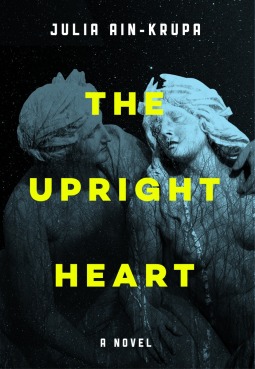
The Upright Heart by Julia Ain-Krupa


The Upright Heart chronicles the return from Brooklyn of a Jewish man, Wolf, to his native Poland soon after World War II. He is haunted by the memory of his Catholic lover, Olga, whom he abandoned to marry a woman of his own faith and start a new life in America, and who perished sheltering the parents and younger sister he left behind. Harassed on the streets of postwar Poland, Wolf is watched over by the spirits of those who died during and after the war but have yet to let go. His story is woven together with those of others, living and dead, Catholic and Jew, including the deceased students of a school for girls, a battalion of fallen German soldiers, and an orphan boy who wanders the streets of Krakow, believing in a magic pill he has conjured up as a way to survive.


Goodreads description

The war is over, but the suffering is not. Not for the living, nor for the dead. Dead and living exist in a state of limbo, all trying to move on. The living with their lives and the dead from the world they now inhabit as ghosts. 

Julia Ain-Krupa weaves a lyrical, dreamlike novel of intermeshed stories. The narrative shifts from one point of view to another and from first to third-person voices. Often the point of view is not easy to identify immediately and the reader must rely on picking up clues. This can be distracting, but it is usually best to go with the flow and not worry about it. The disorienting effect is probably deliberate, reflecting as it does the circles of limbo in which the characters exist. The story does move forward, even if at times this is not apparent. And for most of the characters there is a resolution of some kind by the end of the novel. 

This is not an easy book to read and not every reader will enjoy it. First there is the bleakness of the subject matter  - Holocaust literature isn't for everyone. And secondly there is the style. 

I have read and reviewed several magic-realist novels that deal with the Holocaust. Most recently there was In the Land of Armadillos by Helen Maryless Shapiro. You will find an interesting insight into Magic Realism and the Holocaust on Helen's blog here.  I must say I preferred Helen's approach to the Holocaust to Julia Ain-Krupa's. Stylistically The Upright Heart is similar to that of A Kingdom of Souls by Daniela Hodrová, which likewise presents a world in which the dead exist alongside the living. It is interesting to note the similarity in cover design. However Hodrova's novel is grounded in a place (a house overlooking a cemetery in Prague), which gives it a framework that The Upright Heart lacks. 
 
Reviewing has made me familiar with several outstanding examples of Holocaust literature and how magic realism can throw light on the subject. This book therefore was not as much as a surprise for me as it might be for others. But for most readers its approach will be new and very different to that of much of the Holocaust literature one sees on bookstore shelves. 

I receive this book free from the publisher in return for a fair review.

Sunday, 21 February 2016

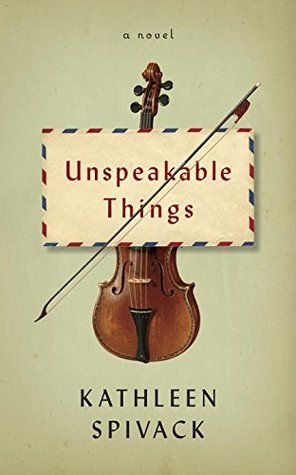
Unspeakable Things by Kathleen Spivack


A strange, haunting novel about survival and love in all its forms; about sexual awakenings and dark secrets; about European refugee intellectuals who have fled Hitler’s armies with their dreams intact and who have come to an elusive new (American) “can do, will do” world they cannot seem to find. A novel steeped in surreal storytelling and beautiful music that transports its half-broken souls—and us—to another realm of the senses. 

The setting: the early 1940s, New York—city of refuge, city of hope, with the specter of a red-hot Europe at war.

From the Goodreads description 

Unspeakable Things is a dark (very dark) and amazing book, both disturbing and beautiful. Although this is a book about the Holocaust and its consequences the unspeakable things in the title are for the most part sexual abuse rather than violent death. The phrase "Unspeakable Things" is first used in the book by the Russian countess Anna to describe what happens to her at the hands of Rasputin, who is called The Devil. Anna is a tiny woman with a  humpback and a long nose and whiskers growing out of a facial mole, which have earned her the nickname “the Rat.” But her "deformity" seems to attract the perverted attentions of not only the mad monk but also the German doctor Felix, a Nazi fetishist and asexual predator on the young children brought to him by their Jewish mothers. Note: if the subject of sexual perversion is difficult for you, do not read this book. 

But Anna is also genuinely loved by her cousin Herbert, the book's central character. Herbert is a fixer, who uses his connections and possibly magical powers, to bring fellow Jews out of Europe. He however cannot save everyone, in particular his youngest son Michael, and the gypsies of Europe. There is a cost for survival and the cost to Herbert is his son's loss and his wife's resulting madness. This is the central theme of the book - the cost and guilt of survival. It is in the context that the sexuality of the book should be seen. How do you deal with the unspeakable things that have happened to you and others, with the scars that are burned into your soul, and in Anna's case literally into your skin, by the devilish hands of others?
Hands play an important part in the story - Rasputin's devilish hand prints are burnt onto Anna's inner thighs, Herbert's wife is a pianist whose hands feverishly play on her bedsheet, and in a jar in Felix's fridge the severed little fingers of the Tolstoi Quartet tap out Schubert melodies. The jar of fingers are part of Felix's bizarre experiment in genetic engineering sponsored by the Fuhrer himself. Fed on a diet of good Teutonic foods (wurst etc), the fingers are being engineered to produce pure Germanic music. As you might be able to see from this, there are elements of satire and humour in this novel alongside the darkness I have written about above.

There are also passages of sublime beauty in the book. This is a writer who is also a poet and it shows. As in a poem it is important to understand that nearly everything is a metaphor and has more than one meaning. The severed fingers are metaphors for the exiles in New York, severed forcibly from their birthplace and confined in cramped single-room lodgings. Music pervades the book. Out on the streets of New York there are new "optimistic" rhythms and music, but the exiles are waltzing to the old tunes. The only way for the survivors to come to terms with their continued existence is to let go of the dead and for the dead to let go of them.  


I received this book free from the publisher in return for a fair review

Sunday, 31 January 2016

They Were Like Family to Me: Stories by Helen Marles Shankman


A radiant debut collection of linked stories from a two-time Pushcart Prize nominee, set in a German-occupied town in Poland, where tales of myth and folklore meet the real-life monsters of the Nazi invasion.

1942. With the Nazi Party at the height of its power, the occupying army empties Poland’s towns and cities of their Jewish populations. As neighbor turns on neighbor and survival often demands unthinkable choices, Poland has become a moral quagmire—a place of shifting truths and blinding ambiguities.

Blending folklore and fact, Helen Maryles Shankman shows us the people of Wlodawa, a remote Polish town.

Extract from the Goodreads description


January 27th was Holocaust Memorial Day, so I have moved this review forward a week to coincide with it. You might be forgiven for thinking that everything that can be said about the Holocaust and every way of saying it has already been published, but you would be wrong. They Were Like Family to Me  is an interesting addition to the corpus of holocaust literature, taking an original approach to the subject. 

This book is described as a collection of linked stories and so it is. But I would argue it is more than that. Each story is set in the town of Wlodawa and surroundings and each is seen from the point of view of a different character, German, Polish or Jew. The story of what happened in that town is built up in a way that is impossible if seen from one viewpoint. Certain incidents and characters which happen en passant in one story come to the fore and into focus in another. This is what a historian always experiences - there is no one narrative, no overriding story arc. There is only a series of perspectives that together enable you to form a view, but, and this is a big but, there is always the knowledge that there are millions of people's points of view that you never hear. Where is that historical reality more apparent than in the case of genocide? 

Helen Maryles Shankman comes from a family of holocaust survivors and she integrates aspects of her family's history into the stories. She also bases some of the storylines and characters on other historical personalities. The artist and writer in the title story is obviously inspired by the death of Bruno Schultz, whilst the benevolent and enigmatic Willy Reinhart bears strong similarities to Oskar Schindler and a similar less-known character from Shankman's family stories. 

One of the book's strengths is that its structure allows us to see the world through the eyes of the oppressor as well as the oppressed. The story They Were Like Family to Me is told from the point of view of a hardened SS killer who takes the artist under his protecton. In The Jew Killer the central character is an anti-semitic Pole, who is forced to confront his feelings when he has to protect a young Jewish girl. Finally of course there is the story at the end of the book told from the point of Willy Reinhart. These stories were my favourites in the collection and it seemed to me the enigma of Reinhart in some way was the narrative driver of the book. 

Magic realism pervades the stories - the resistance to the Germans is often personified in the form of a mythical being such as the Golem or a werewolf, and on one occasion the very land of Poland rises up against the oppressors. Wlodawa sits on the edge of the dark forest. It is where the Germans take the Jews to be murdered, but it is also where the mythical and subconscious dwell. It is where the Jewish partisans can be shapeshifters. The magic only partly succeeds. It cannot do otherwise. Magical monsters are no match in the long term for the real monsters of the Nazi killing machine. And yet there is a mysticism in these stories and a hope that transcends the darkness.

I received this book free from the publisher in return for a fair review.
NB this book was originally titled In the Land of Armadillos

Saturday, 25 October 2014

The Red Magician by Lisa Goldstein

Winner of the National Book Award: In the shadow of the Holocaust, a young girl discovers the power of magic.

In the schoolroom of a simple European village, Kicsi spends her days dreaming of the lands beyond the mountains: Paris and New York, Arabia and Shanghai. When the local rabbi curses Kicsi’s school for teaching lessons in Hebrew, the holy tongue, the possibility of adventure seems further away than ever. But when a mysterious stranger appears telling stories of far-off lands, Kicsi feels the world within her grasp.

His name is Vörös, and he is a magician’s assistant who seems to have powers all his own. There is darkness growing at the edge of the village—a darkness far blacker than any rabbi’s curse. Vörös warns of the Nazi threat, but only Kicsi hears what he says. As evil consumes a continent, Vörös will teach Kicsi that sometimes the magician’s greatest trick is survival.

Publisher's description

I had seen this title on lists of magic realist books and so had added it to the list of books which I carry with me whenever I visit second-hand bookshops. However when I found a copy in Hay-on-Wye the cover put me off, making me think that whoever had listed it had made a mistake and that this book was too fantastical to be magic realism. Here is that cover


Then a few weeks ago I saw the book featured on Netgalley. It has been republished as an ebook by the excellent Open Road Media. My interest was piqued by the description and I requested a review copy. I am glad I did. 

For those of you who are interested in the debate about where fantasy begins and magic realism ends this is definitely a book to ponder. Yes, there are straight fantasy scenes showing the magician's duels with the rabbi which could be in a Peter Jackson movie, but there is also a historical reality about the book, a reality which was more horrendous than anything that can be dreamed up by any horror writer. The chapters depicting Kicsi's experience in the death camps are powerfully accurate. Lisa Goldstein, a daughter of two Holocaust survivors, asks some awkward questions about the role of magic in modern Europe.

The key thing to note is that the magic fails. The magician can foresee the impending holocaust but can do nothing about it. He fails to persuade the Jewish residents to flee.  The magician fails to create a golem to protect the little town where Kicsi lives. Although he is prevented from doing so by the Rabbi, there is an underlying question - could the magician ever have succeeded, was the old magic powerless in the face of the very real terror of the Nazi machine?

The Prague Golem legend has always struck me as tragic. The Golem was created to protect the Jewish community and was/is meant to be sleeping in the attic of the Old-New Synagogue waiting, like Arthur and his knights, the call to rise up at times of the greatest danger. But when that danger came, the giant in the attic did not stir.

The magic in magic realism is often that of the underclass, the oppressed, the disenfranchised. It gives power to the powerless. For that reason there is an important strand of magic realism, which draws on the ancient beliefs of the Jewish people. In the camp there are tales among the detainees of a red-haired man and people disappearing from the camp. Goldstein does not make clear if this is wishful thinking and the "escapees" have actually been killed. After the war Kicsi is found by the magician among the dying and physically recovers. But her spirit does not revive and she suffers from survivors' guilt. She accompanies the magician on a journey back to her home town and another duel between the two men. That process brings her back to life. 

As a book for teenagers I think The Red Magician would work particularly well, although it is suitable for adults too. The book is an excellent short read and I thank Open Road Media for making it available.

I received this book free from the publisher via Netgalley in return for a fair review.


Thursday, 29 August 2013

Rising Up by Evie Woolmore


Tom Macindeor is an itinerant English teacher, spending the summer in Warsaw in the hope of finding out the truth about his grandfather, a Polish resistance fighter. But when he hears the voice of Ela, a young woman trapped in the Jewish Ghetto of 1942, a window opens not just on his past but the future of the ghetto and all those who live in it. Should he share what he knows of their fate, or will Ela's search for the truth about her own family doom them both?
Goodreads Description

I admire Evie Woolmore's courage in tackling a story set in the Warsaw Ghetto. I doubt I could ever do the same. The subject of the holocaust is one which is extremely sensitive and I suspect I could never be confident that my historical research was sufficient to tackle this darkest of periods in human history. 

Evie Woolmore's language and writing style are excellent. As the description above shows, there are two story lines in this book - Tom's story set in the present day and Ela's in 1942 -but the two are linked as the two central characters discover they can talk to each other. As someone who spends a lot of time in the Czech Republic, I was struck by how accurately Evie Woolmore portrays life in Warsaw. There was much here that struck a chord, for example the brightly coloured dyed hair of one of the Polish characters. 

Ela's story opens strongly with the description of her job working for the Germans, which consisted of disposing of the dead, looting their bodies and homes of any valuables. This shows some of the horror of the ghetto. However as the book went on there were times when I found the portrayal of Ela's life less believable, for example I had a problem with the ease with which Ela talks to her sister about a contact with a resistance member.  Ela's family are actually very well-off in terms of most of the  families around them. They are not living six to a room, which was the norm in the ghetto, and they even occasionally eat meat, when thousands of people were dying each month, most of hunger. I would have liked Ela to feel survivor's guilt, perhaps to do something about helping others.  

Both stories are written in the present tense and in the third person. This is essential to the story as at its heart is the fact that Tom and we know the awful truth of what will happen to the inhabitants of the ghetto and Ela's story, but Ela of course does not.  Tom is faced with the dilemma of whether to warn Ela, when she probably can do nothing about her fate. I was reminded of the work of Kate Atkinson, where the magic realism in the book poses philosophical questions and is at the heart of the dramatic tension. But is it right to use magic realism in this way, when the subject matter is so dramatic? Would I have liked the book more if it had simply been Ela's story, perhaps with Tom discovering it? Probably. But I certainly did get drawn in to Ela's story and wanted to see if she survived. 

I was given this book by the author in return for an honest review.
Enhanced by Zemanta