Showing posts with label surrealism. Show all posts

Saturday, 17 October 2015

Inside the Head of Bruno Schulz by Maxim Biller


Bruno Schulz has foreseen catastrophe and is almost paralysed by fear. His last chance of survival is to leave the home town to which, despite being in his late forties, he clings as if to a comforting blanket. So he retreats into his cellar (and sometimes hides under his desk) to write a letter to Thomas Mann: appealing to the literary giant to help him find a foreign publisher, in order that the reasons to leave Drohobych will finally outweigh the reasons to stay. 

Evoking Bulgakov and Singer, Biller takes us on an astounding, burlesque journey into Schulz's world, which vacillates between shining dreams and unbearable nightmares - a world which, like Schulz's own stories, prophesies the apocalyptic events to come.

Goodreads description


This is a novella about a Polish author who was hugely influential on magic realism and writers of magic realism, despite Schulz' small body of  work - The Street of Crocodiles and Sanatorium Under the Sign of the Hourglass. Magic realist authors Cynthia Ozick, David Grossman, Nicole Krauss, and Milan Kundera have all acknowledged his influence and some (Ozick and Grossman) have even referenced Schulz in their writing. Now German writer Maxim Biller can be added to that list. 

In Biller's short novella Schulz is writing to Thomas Mann about a man who is pretending to be Mann. It is unclear to me whether the impostor is real or a figment of Schulz's fevered imagination. The novella is perhaps more surreal than magic realist with a nightmarish and scabrous quality. The sofa Schulz sits on walks out of a room when he pats it. Schulz's students (he was an art teacher in reality and in this novella) appear as talking birds. 

Biller mixes fact and fiction in this insight into the writer's mind. The novella is set in 1938 in the small Polish town of Drohobych. He gives the Jewish Schulz a prescient fear of the holocaust to come. The false Thomas Mann holds court to members of the Jewish community in a bathroom the size of a large school hall. The room has no fixtures, just showers. Everyone is naked and smoke pours out of the shower heads. The imposter is seen giving a German dressed in a black leather coat a list  of Jewish names. "Dr Franck and I... are in no doubt, Dr Mann, of what is going on here: we are being spied on."  Schulz was to die, shot casually by a Gestapo officer, as he walked home to the ghetto with a loaf of bread. 

The novella comes with two of Schulz's own short stories: Birds and Cinnamon Shops. And it is possible to see from these how Biller has incorporated themes in Schulz's works into Inside the Head. It is also possible to see that skilful though Biller is, he is not as gifted as his novella's subject. 

I have to confess that I have yet to read Schulz's other works, although they have been on my to-read list for many years. In fact I first came across Schulz's work in the Quay Brothers' animated interpretation of The Street of Crocodiles in 1986, which I share with you below. Like Biller's novella it is a work of dark surrealism. 


I received this novel free from the publisher, the excellent Pushkin Press, in return for a fair review.

Wednesday, 24 June 2015

The Puppet Turners of Narrow Interior by Stephanie Hammer


Just down the road from John Crowley’s characters is the town of Narrow Interior, the setting for Stephanie Hammer’s fable-ous first novel of secrets and heritage. Henry, the youngest son of a hotel magnate, is sent to calm the inhabitants as the hoteliers set about to despoil this odd byway. Instead, aided by his black sheep cousin and a cast of quirky characters, including Quirk, Henry sets out to discover the town secrets. The more he learns, the darker his mission appears, until Henry must choose if he is willing to risk all.
Goodreads description

The Puppet Turners of Narrow Interior has much in common with Magic America (see my last review). It starts with magic realism as the world seen through the eyes of a child; it features a fight against American big business whose plans are endangering a community; it even has a magic realist tattoo! But in many ways it is very different. In contrast to Magic America the frequency of magic increases through the course of the book, so much so that the book moves away from magic realism towards fantasy à la Neil Gaiman. 

The book can be categorized in many ways - there is a strong streak of humour and satire here, which had me chuckling at times; there are a lot of references to classic philosophers and writers (including Schiller and Goethe as talking condiment pots), legends (Parsifal and the Fisher King anyone?) and then there's surrealism (I was reminded of Leonora Carrington's writing at times). In fact there is so much going on and Stephanie Hammer is having so much fun in writing the story that sometimes I felt the book failed to deliver completely on its promise(s). But then how could it?

I personally was interested in the puppets strand, which disappointed as did the religious backstory to the community of Narrow Interior.  The two elements are related and so much more could have been done with them. Puppet theatre has always had a relationship with religion and not just in Japan: marionette means little Maria and the shadow puppets of South Asian portray tales from the Mahabharata and Ramayana. I worked for several years as the manager of the Puppet Centre of Great Britain and in that capacity saw the power and magic of puppets, nowhere more evident than in the ancient Japanese art of Bunraku, which the novel draws from, but doesn't explore.

The book could have been simply a book of ideas, but the characterization is strong and amusing. We engage with Henry from the get-go and even as he decides to hide his character (So, I become secret. I study unspecialness and silence. While most people in American work to develop ersatz talents, individualistic quirks, and even the occasional eccentricity, I let mediocrity shine like a beacon of nothingness. A black hole of personality.) we empathize and yearn for the real Henry to reappear.  But again I felt that the author engaged our interests in certain characters (most notably Quirk and the old man Olsen) only to let them drop. 

So, in conclusion, what did I make of this book? I enjoyed it, it is a fun and interesting read, but I don't think it is magic realism.

I received this book from the publisher in return for a fair review.


Wednesday, 24 April 2013

The Hearing Trumpet by Leonora Carrington


A classic of fantastic literature, Leonora Carrington's The Hearing Trumpet is the occult twin to Alice in Wonderland.

One of the first things ninety-two-year-old Marian Leatherby overhears when she is given an ornate hearing trumpet is her family plotting to commit her to an institution. Soon, she finds herself trapped in a sinister retirement home, where the elderly must inhabit buildings shaped like igloos and birthday cakes, endure twisted religious preaching and eat in a canteen overlooked by the mysterious portrait of a leering Abbess. But when another resident secretly hands Marian a book recounding the life of the Abbess, a joyous and brilliantly surreal adventure begins to unfold. Written in the early 1960s, The Hearing Trumpet remains one of the most original and inspirational of all fantastic novels.
Amazon description.

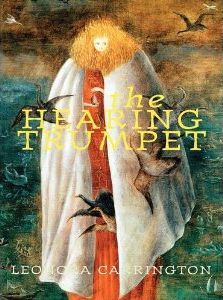
I am a fan of Leonora Carrington's art (an example of which is above) and I recommend liking her Facebook page: https://www.facebook.com/leonoracarringtonweisz where new pictures and sculptures are regularly posted. She was a prominent surrealistSalvador Dali called her "the most important female artist". But since reading this delightful book I've become a fan of her writing as well. 

One of the joys of the book is Carrington's portrayal of old women. The heroine and narrator of the book, Marian, is a ninety-two year old woman with a "gallant" beard, ignored and despised by her unpleasant family.  Carrington is brilliant at portraying a woman who at times is forgetful but is far from "senile". Indeed the portrayals of all the elderly inhabitants of Lightsome Hall are wonderful - each an individual woman, but the best is undoubtedly that of Carmella, Marian's friend, a first class eccentric, given to flights of the imagination:
You might escape to Lapland...We could knit a tent. 
At first the reader is inclined to see Carmella as a slightly dotty old lady, but as the book goes by this view changes. Carmella is often remarkably astute, as in possibly the best line in the book: People under seventy and over seven are very unreliable if they are not cats.

This is another magic realist feminist novel.  The old women rise up against their oppressors and release ancient magic. Marian feels attracted to the leering portrait of the Abbess, identifying with her even though Marian reads a censorious book written by a male contemporary of the Abbess. Later in the book she is mystically part of a Jungian trilogy of women. 

I wondered whether the book would be more surreal than magic realist, but was pleasantly surprised to find the opening to be very realistic. The magic realism grows during the course of the narration, rather as it does in OneHundred Years of Solitude. We start with the hearing trumpet: prior to receiving it as a gift from Carmella, Marian is badly deaf but afterwards she is able to eavesdrop through walls. Then Marian moves to the residential home, which sounds like a bad theme park with houses made in the shape of toadstools, boots and towers. By the end of the book we are passing beyond realism to the surreal and symbolic. One of the magic realist devices that Carrington uses is that Marian will add realist modifiers to the magic/surreal elements: This of course might have been an optical illusion.  

My one criticism of the book is that the ending feels rushed. The details that made the body of the book so enjoyable are dropped and Carrington relies heavily on the surreal and on symbolism.  Nevertheless this book is a joyous and fun read, with some serious points underpinning it. I recommend it to you.


Enhanced by Zemanta

Wednesday, 6 March 2013

The Man Who Walked Through Walls by Marcel Aymé


A collection of funny and fantastical short stories, Marcel Aymé's The Man Who Walked Through Walls (Le Passe-muraille), is a classic of French literature, loved by children and adults alike.

Monsieur Dutilleul has always been able to walk through walls but has never bothered using his gift, given the general availability of doors. One day, however, his bullying boss drives him to desperate measures, and he develops a taste for intramural travel... 

The titular tale sets the tone for this collection of ten stories from the great French humourist, novelist and children's writer Marcel Aymé. Elements of science-fiction and fantasy are present throughout this volume, written under Nazi occupation during the Second World War, which pokes fun at the occupiers and occupied alike.
Amazon description

I am embarrassed to say I had not heard of Marcel Aymé until I came across his work  while searching for magic realist books. I was somewhat relieved to hear that my bibliophile husband hadn't either. And yet Aymé is a writer described by George Simenon as The greatest French writer of the day.

Unfortunately little of Aymé's writing has been translated into English, which, if this collection of short stories is anything to go by, is a great shame. 

There are ten short stories in this book and nearly all can be considered magic realism. I was reminded of Kafka when I read the book. Aymé's approach is to take a fantastical element, set it in a realistic setting and follow the internal logic to its conclusion.This appeals to me - as I said in my review of The Peculiar Sadness of Lemon Cake I like there to be a logic within the story. Dutilleul, the man who walks through walls, starts hardly using his "gift" at all but a series of actions and events take him down a slippery path. Likewise the woman who can duplicate herself starts with just one other self , but after a while her other selves are duplicating and the numbers increase exponentially. 
Jean Marais' tribute to writer Marcel Aymé
Jean Marais' tribute to writer Marcel Aymé (Photo credit: towse)

Some of the stories are amusing surrealism, but others have a dark tone to them. Published in 1943, the stories reference the grim reality of life in occupied France. The most striking is Tickets on Time in which in response to shortages the government decides "to put unproductive consumers to death" by rationing the number of days they are alive. Unproductive is defined to include the rich, elderly, unemployed, writers and artists and of course Jews. Sadly the subject matter is still relevant in 2013.

My favourite story was The Seven-League Boots. This story looks at a gang of boys and their relationships, and the wider context of social status. Not until the end is there much sign of magic realism. In this and in all the stories, Aymé's strength is the characterization of the stories' participants. Despite being short stories the characters' motives and emotions are well defined and explored. No wonder Simenon admire Aymé so much. 


Zoe Brooks Google+ page
Enhanced by Zemanta