Wednesday, 29 January 2014

Butterfly Winter by W P Kinsella


The final novel from legendary Canadian author WP Kinsella.

Butterfly Winter, W.P. Kinsella's first novel in 15 years, is the story of Julio and Esteban Pimental, twins born in the Caribbean country of Courteguay, an enchanted but impoverished enclave on the border between Haiti and the Dominican Republic where time moves at its own pace and reality is open to question.

The brothers are born to play baseball, they even played catch in the womb, and at the age of ten they leave home for the American Major Leagues. Julio proves to be a winning pitcher who, much to the frustration of any team that signs him, will only throw to his catcher brother, who is a very weak hitter.
Amazon description


W P Kinsella's magic realist baseball novel Shoeless Joe, the book that was translated into the film Field of Dreams, was already on my to-read (and to-buy) list, when I got the opportunity to receive a review copy of this, his last book. Kinsella had given up on writing following being struck by a car but then after fifteen years at the age of 76 Kinsella published this book. 

Butterfly Winter reads like a book by someone who is overflowing with ideas and enthusiasm and enjoying the process of writing tremendously. The book revels in magic - a blanket of monarch butterflies cover the bodies of young lovers, foetuses play baseball in the womb, plants grow and flower upside down, soldiers are speared by herons - so much so that the realism plays a lesser part. Set in a fictional magical Latin American country instead of a magical USA this book is closer to the roots of magic realism.  

Although the book has baseball as a theme, it is also about writing and fiction. There are two narrators - a gringo journalist (perhaps a fictional Kinsella), investigating the story of the baseball-playing twins as well as the history and politics of Courteguay, and an old wizard, baseball guru, country's president and fraudster (perhaps also Kinsella). Kinsella has great fun with the latter narrator, whose identity shifts along with his name during the course of the book: I am what is known in literary circles as an unreliable narrator. The wizard's ironic comments allow Kinsella to explore the nature of fantasy and truth: Who's to say what is truth. People tell tales, and as the tales emerge they become as good as truth. In Courteguay, anything that can be imagined exists. The telling is the truth. Truth is spun like silk: truth is manufactured. 

All this makes for a fun and funny book, but then Kinsella ventures into the dark territory of Latin American magic realism as the pregnant partner of one of the twins is held and tortured as a political opponent of the sadistic dictator of Courteguay. The change of tone is a shock, but not nearly as shocking as the way the story then continues in a generally comic vein. 

Kinsella also plays with the chronology of the story, which moves backwards and forwards all over the place. As the wizard comments: This is Courteguay... The word chronological is not in our language, neither is sequence. Things happen. That is all there is to it.

The book isn't perfect. Kinsella has rather too much fun packing the magic realist kitchen sink into the seventy-eight short chapters. But readers of magic realism are bound to find much to enjoy.

I was given this book by the publisher via Edelweiss in return for a fair review.

Wednesday, 22 January 2014

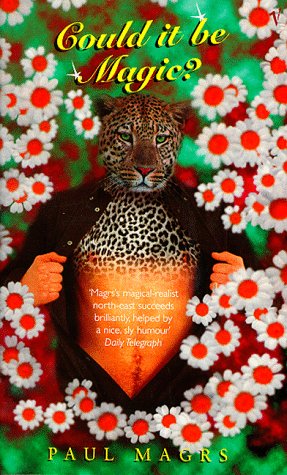
Could it be Magic by Paul Magrs


The ordinary inhabitants of a small-town council estate turn out to hold extraordinary secrets in Paul Magrs' strangely compelling novel, Could It Be Magic?. Set in the grey wastelands of the north-east, Magrs has looked beyond the ravages of boom and bust Britain--with its council ghettos and widespread unemployment--to reveal a community brimming with passions. At first glance, the leading characters are exceptional only in their mediocrity: Elsie, old before her time, weighed down by a crippled son and depressive husband, whose only solace lies in a bottle of gin; tattooed Mark, who spends his days bodybuilding and nights babysitting his ex-wife's new baby; Penny, who left school too soon and fills her house with students; Andy whose gay lover left him for a better life. But the arrival of Penny's Mam on New Year's Eve (with her own startling secret) sets off a chain of astonishing events. Fantasy mingles with the mundane until it's hard to know what to accept as commonplace and what to dismiss as trivial. A frisson of sexual energy sparks from council roof to satellite dish as Magrs' characters discover their innermost secrets and how to live life to the full. 
Goodreads description

Magic realism set on a council estate in the North East of England, really? Yes, really. If you consider magic realism to be where magic appears in an otherwise realistic world. Not if you are one of those who subscribe to a definition based on two cultures. There is one culture in this book: that of the British working class.

And does it work? Absolutely. This is a very realistic portrayal of the lives of the inhabitants of a council estate in a bleak town sitting near a motorway. Each character is drawn in detail and with love, but in such a way that you don't get overwhelmed with back story. You come to understand and even like people that in real life you might consider avoiding, such as the local busybodies. I don't know Magrs' background but I would guess that he grew up in a place like his fictional Phoenix Court. There is a sense of unease about the place, a sense of threat partly from the gang of lads at the Forsyth's house, partly from the ever present desire on the part of most of the inhabitants to know everything about everyone else and worse to meddle. There is a sense of hopes unfulfilled, lives going nowhere, a desire to get away that for most of the novel is not realized. And yet this is a community and, as the ending reveals, one that continues to call its members back.

The magic just slips in. The first time it happens you have to check that you really did read that. Then slowly it grows. In Magrs' book there is clearly a link between magic and sex. The leopard boy is a product of a one-night stand between Andy and the tattooed Mark. The clubfoot of Elsie's son Craig appears to be cured following fellatio with Penny. I was really impressed by how well Magrs writes about sex, both gay and heterosexual. There is a lovely sex scene at the end between Fran and her husband, which concludes with: tonight is quite a shock to her. She had forgotten how she and Frank were, after all, experts in each other.  

The Independent's reviewer Michael Arditti has rather snootily dubbed Magrs' style as magic soap opera and compares it unfavourably with the magic in Allende's work. Soap operas play an important part in the lives of the characters and indeed in a key moment in the plot at the end of the book. But that is only right. Soap operas are important, as Andy's grandfather commented when he first saw Coronation Street: It's like real life! They're talking like real people on here.  
Enhanced by Zemanta

Wednesday, 15 January 2014

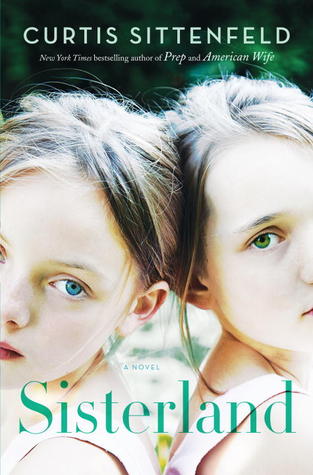
Sisterland by Curtis Sittenfield


From an early age, Kate and her identical twin sister, Violet, knew that they were unlike everyone else. Kate and Vi were born with peculiar “senses”—innate psychic abilities concerning future events and other people’s secrets. Though Vi embraced her visions, Kate did her best to hide them.
 
Now, years later, their different paths have led them both back to their hometown of St. Louis. Vi has pursued an eccentric career as a psychic medium, while Kate, a devoted wife and mother, has settled down in the suburbs to raise her two young children. But when a minor earthquake hits in the middle of the night, the normal life Kate has always wished for begins to shift. After Vi goes on television to share a premonition that another, more devastating earthquake will soon hit the St. Louis area, Kate is mortified. Equally troubling, however, is her fear that Vi may be right. As the date of the predicted earthquake quickly approaches, Kate is forced to reconcile her fraught relationship with her sister and to face truths about herself she’s long tried to deny.


The book takes its title from the notice that sister Vi posted on the girls' room when in fifth grade:
Sisterland
Population 2
Do NOT enter without permission

But that is what we as readers do in this novel - we enter sisterland. I am not a twin, but I am very close to my younger sister, and can identify with the push and pull of the relationship between Kate and Vi, although now my sister and I are adults we do not have the strains that Kate and Vi feel. 

The differences between Kate and Vi almost seem cliched - Kate is the conformist, Vi the rebel; Kate the thin one, Vi overweight; Kate married and a stay-at-home mother, Vi has just announced a lesbian relationship; and in particular Kate repressing her special powers, Vi embracing and celebrating her special powers. But in Sittenfield's hands the portrayals of the sisters are not cliched. Kate is the narrator of the piece and she is not a sympathetic character. She lacks any sense of self-awareness, unable to see how irrationally she behaves, how demanding and peevish she seems. Inevitably we see Vi through Kate's eyes and she too at times seems selfish and unaware. Although we do get the impression that Vi is the more interesting sister, but she never comes fully into focus. 

Given that the two sisters are meant to have psychic powers and are twins, it is interesting that Sittenfield does not give them the ability to read each other's minds, although at one point Kate does hear words spoken to Vi over earphones. Kate is so afraid that everything she dreams of or imagines is a prediction that she is jittery and a fussy mother. Rather than try and tune her powers, she decides to abandon them. The book seems to accept, as Kate does, that the powers do exist, and in that sense is magic realist.

The book might seem to have a plot driver in the question of whether Vi's predicted earthquake will materialize, but to my mind the plot really is about the relationship between the sisters and whether Kate will become more self-aware. The earthquake forecast is a medium for that. As the allotted time for the earthquake approaches, Sittenfield alternates the chapters between the present and accounts of significant events in the sisters' past. 

There is a lot of detailed realism in this book. The writer goes into detail about Kate's mundane life - the nappy changes, what's for lunch, etc. I know some readers really like that in a book, but I confess I don't, and I thought at times "Get on with it, already!" I would have liked more of a character arc too, particularly for Kate. But having set up Kate as the narrator, Sittenfield was trapped by the limitations of Kate's character, although part of the fun of the book was trying to work out what was really happening despite the narrator's inability to see it. 

Sisterland is not my favourite book of the year, but one I know a lot of people will enjoy. 

I received this book from the publisher via Netgalley in return for a fair review
Enhanced by Zemanta

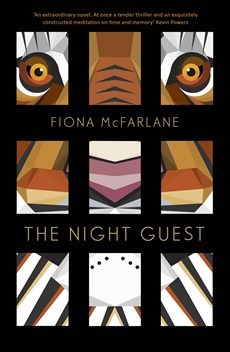
The Night Guest by Fiona McFarlane


Ruth is widowed, her sons are grown, and she lives in an isolated beach house outside of town. Her routines are few and small. One day a stranger arrives at her door, looking as if she has been blown in from the sea. This woman—Frida—claims to be a care worker sent by the government. Ruth lets her in.
     Now that Frida is in her house, is Ruth right to fear the tiger she hears on the prowl at night, far from its jungle habitat? Why do memories of childhood in Fiji press upon her with increasing urgency? How far can she trust this mysterious woman, Frida, who seems to carry with her her own troubled past? And how far can Ruth trust herself?
     The Night Guest, Fiona McFarlane’s hypnotic first novel, is no simple tale of a crime committed and a mystery solved. This is a tale that soars above its own suspense to tell us, with exceptional grace and beauty, about ageing, love, trust, dependence, and fear; about processes of colonization; and about things (and people) in places they shouldn’t be. Here is a new writer who comes to us fully formed, working wonders with language, renewing our faith in the power of fiction to describe the mysterious workings of our minds.


Goodreads Description

Psychological suspense, with its emphasis on disorientating the reader and challenging reality, is a sub-genre highly suited to magic realism. This debut novel by Australian author Fiona McFarlane is an excellent example of this.

The book starts normally enough with the retired elocution teacher Ruth pottering around in her seaside home. Even the arrival of the careworker, Frida, seems normal.  Into her life comes an old crush from her youth and everything looks set for a gentle love story, but then suddenly you feel the book jolt into more alarming territory, when Ruth discovers Frida is living in her home:

“You assumed I was leaving, obviously. Who knows why.”

“And why I wouldn’t I assume you were leaving? It’s not as if you live here.”

“Oh, dear.” Frida lifted her feet from the towel ... remember, we talked about George, all my trouble with George? And you said I could stay as long as I needed to. So here I am.” ...

“That isn’t true, Frida, what you’re saying to me now, it’s not true. I’d remember.” Ruth was certain; but there was a feeling of unraveling, all the same; an unwound thread. She did recognize the part about trouble with George.

“You know your memory’s not what it used to be.”

“I do not know that.” 

You find yourself looking back at what has gone before - Frida's arrival, the tiger in the house and Ruth's reaction to it and you realize that a) you have been seeing the world through Ruth's eyes, b) that she and you have missed clues and c) something very strange is happening and you cannot make out what it is.  From then on the story plays with your lack of certainty. Is Ruth hallucinating? Is it a very accurate picture of dementia? The mother of a friend of mine was convinced that she had a second doctor lived in her attic. Or is Frida plying her with hallucinatory drugs and playing with her mind?  The relationship between Frida and Ruth is fascinating and by no means a simple black and white affair, as there seems to be some real connection between the two. At the end of the book another character remembers how Ruth and Frida had run together like lovers.

 A key element in this uncertainty is the magic realist tiger.  Does it exist? Is it a sign of Ruth's  mind deteriorating? Is Frida play-acting? The tiger was Frida's now... She was proud of him and of her arm; the heroics of the night before seemed to give her precedence in all household matters. Nothing is clear, everything is uncertain. Maybe the tiger is even real. 

This is a story which will have you checking up on your elderly relatives and wondering what your life might be like when you become old and vulnerable. It is truly unnerving and brilliantly so - beautifully written and constructed. Fiona McFarlane is an author to watch.

I received this book from the publisher via Netgalley in return for a fair review.

Enhanced by Zemanta

Wednesday, 8 January 2014

Watering Heaven by Peter Tieryas Liu

What would you do if you found out your girlfriend laid an egg every time she had sex? Who would you be if you were invited to a party in Beijing but had to make up a brand-new identity for six weeks?

Peter Tieryas Liu's Watering Heaven is a travelogue of and requiem for the American dream in all its bizarre manifestations and a surreal, fantastic journey through the streets, alleys, and airports of China. Whether it's a monk who uses acupuncture needles to help him fly or a city filled with rats about to be exterminated so that the mayor can win his reelection bid, be prepared to laugh, swoon, and shudder at the answers Peter Tieryas Liu offers in this provocative debut collection.

Goodreads Description

From the beginning I was impressed by this collection of short stories, which is very different from other short story collections featured on this blog. The fusion of Chinese and American cultures was not one I had experienced before and gave the stories an interesting perspective. Cultural dichotomy is, as has been noted elsewhere in this blog, ideal for magic realism. In these stories there is an additional layer. Peter Tieryas Liu sometimes references Chinese myths and folktales in these tales, however the China that features in these stories is a 21st century urban modern China. Interestingly the stories often express the fusion in the form of food: I absolutely recommend their spaghetti sushi broccoli hamburger. As you can tell from that quotation, Liu brings an ironic and amused eye to what he finds. 

The stories contain a lot of surreal conversations between the male narrator and a (usually eccentric, witty) young women, with whom he is besotted. These exchanges are very clever and impressive at first, but after a time they begin to pall. Indeed that was my feeling generally about the collection. For the first third of the book I thought that it was wonderful, reminding me at times of Murakami's writing, but in the second third I found myself thinking that the stories were becoming too familiar and by the last third I confess I was skipping paragraphs.

The subjects of the stories were at times imaginative and original - the woman who lays an egg every time she has sex, the girl who sells dead moths, the man who has so much plastic surgery no one recognizes him, the levitating man living in post-crash run-down amusement park. But at other times it seemed the writer was revisiting an earlier story. The writing was often poetic, with interesting imagery: Outside our cab, there's (sic) convoys of trucks from Inner Mongolia and Hebei floating between cities like dead whales carried by convex currents. 
But as this quote reveals, the book could have done with better editing, not just in picking single verbs when they should be plural but in spotting the repetition. 

My view of this book therefore is that it is a curate's egg - wonderful in parts.  

I was given this book by the publisher via Netgalley in return for a fair review

Wednesday, 1 January 2014

The Book Thief by Markus Zusak


HERE IS A SMALL FACT - YOU ARE GOING TO DIE

1939. Nazi Germany. The country is holding its breath. Death has never been busier.
Liesel, a nine-year-old girl, is living with a foster family on Himmel Street. Her parents have been taken away to a concentration camp. Liesel steals books. This is her story and the story of the inhabitants of her street when the bombs begin to fall.

SOME IMPORTANT INFORMATION - THIS NOVEL IS NARRATED BY DEATH

It's a small story, about:
a girl
an accordionist
some fanatical Germans
a Jewish fist fighter
and quite a lot of thievery.

ANOTHER THING YOU SHOULD KNOW - DEATH WILL VISIT THE BOOK THIEF THREE TIMES


Publisher's Description

The Book Thief is a beautiful book about an ugly period of history.  There are many books about the second world war and the holocaust, but this book is one of the greats, precisely because it doesn't focus exclusively on the horror, but on the lives of ordinary people living in a small town near Munich. It is the contrast that both humanizes the story and throws the horror into relief: For the book thief, everything was going nicely. For me [Death], the sky was the colour of Jews. 

The heroine of the book is Liesel, whose story moves from tragedy (the loss of her brother to Death and of her mother) to finding a relatively normal life in Himmel Street. There her victories are those of a child: learning to read, entry into the local gang and standing up to the boys at school, but increasingly the sinister presence of Nazism begins to be felt, appropriately enough with the public burning of books. Liesel makes a wonderful spirited heroine: affectionate, loyal and resourceful. I am sure the book's young readers will identify with her.  She grows in maturity with the arrival in the house of a fugitive Jew, Max. She is as the narrator Death says, a survivor. 

Surviving, and the guilt that goes with it, is an important theme in the book. Max feels guilt having left his family behind when he went into hiding. A wounded Stalingrad soldier commits suicide after watching his brother die. And Liesel's foster-father Hans Hubermann is guilty about surviving the First World War when everyone else in his  platoon died. It is that guilt and feeling of debt to Max's father that makes Hans risk everything and hide Max in his house.For me Hans is as much the hero of the book as Liesel. 

Another theme in the book is bravery. Hans is accused by his Nazi-supporting son of being a coward, but Hans' bravery is that of a humane man retaining his humanity when all around him people are at best turning a blind eye to and worse actively participating in terrible crimes. The writer says that what inspired the story was the tale of a man helping a Jew being driven by SS guards and being whipped for his kindness. Hans offers a piece of bread to a Jew, when everyone else stand by watching, and is whipped for it. His gesture will not save the Jew,  but if nothing else, the old man would die like a human. Zusak doesn't leave it at that, because of Hans' impulsive act of kindness, he puts himself and his family at risk, but more specifically forces Max back on to the road.

The Book Thief was sold as a young adult book in the UK, but it gripped this 50+ adult. One reason is the way it portrays dilemmas facing ordinary people living under the Third Reich. We are aware of these, partly because the narrator, Death, uses foreshadowing in his tale and partly because he is trying to understand the human race: I wanted to ask her how the same thing could be so ugly and so glorious, and its words so damning and brilliant...  I am haunted by humans.

I really enjoyed this book. I enjoyed its style, at times poetic and striking. So is it great magic realism? It's great but not magic realism. It may appear frequently on lists of magic realist books, but having Death as a narrator does not make it magic realism. There isn't magic in Liesel's world. 

I received this book from the publisher via Netgalley in return for a fair review

Wednesday, 25 December 2013

The Lieutenant of San Porfirio by Joel D Hirst


Something is afoul in the Revolutionary Socialist Republic of Venezuela. Despite food shortages, blackouts and the terrible violence, El Comandante's iron grip is stronger than ever. Newly decorated Lieutenant Juan Marco Machado lovingly caresses his shiny AK-103 as he thinks about his promotion and what he would be willing to do to defend his revolution, and his position. He is about to find out it's more than he ever would have believed. Doña Esmeralda is in trouble. Ordered to demonstrate her solidarity for the revolution and open her colonial mansion (in which she carefully protects her dead husband's ghost) to the barrio dwellers, she decides she is left with no choice but to plot a counterrevolution. Meanwhile, Freddy, an American high school student is propelled by his parents to attend a socialist youth summit in Venezuela, pitting him against Pancho Randelli, a freedom activist and leader of the struggling student movement. And so the fates of four people are about to be intertwined within a country plunged into revolution. The Lieutenant of San Porfirio is the compelling story about four people seeking to find themselves under the chilling pall of socialism. People from different backgrounds and across the hemisphere will find something to love, as well as something deeply disturbing, in this new magical realism twist on a South American classic genre, the dictator novel.
 Amazon Description

This book combines comedy with serious political commentary. In Latin America, which Joel Hirst is familiar with and which he clearly loves and cares passionately about, that is the reality, a reality which is mixes with magic in this excellent novel. 

The comedic is always close to a serious, even tragic, consequence, as exemplified in the character of Lieutenant Machado, who at first appears to be a bumbling drunken fool, but morphs into Porfirio's Head of Security, recruiting a sadistic interrogator. That that interrogator is said to have been the child of a magical being shows how the magic works in this novel. Further examples are Machado's spies - a man who seems able to turn himself into an owl, or the servants at Dona Esmerelda's country club who were specially bred to be invisible. The magic in this book is not on the side of the freedom activists. 

Reading the book blurb I was not sure whether I would enjoy the book, fearing that it would be too politically right-wing for me. This is a shame as I was pleased to see that the book shows an understanding of the motivation of all the main characters, nor does it portray the opponents of the revolution in a universally good light - Dona Esmerelda, the old oligarch, is a selfish elitist, but: each had been searching in their own way for freedom and for meaning. All in different places and by different means.  The book is very good at showing how the most laudable of aspirations can be perverted.  On a minor point Mr Hirst and his publisher should note that democratic socialism has many supporters in the UK and other European countries, where it does not mean the same as it does in the Americas, so references in the description to the chilling pall of socialism will put off potential buyers.

The book weaves together the story of the four characters - the naive American youth Freddy, Lieutenant Machado, the activist student leader Pancho and Dona Esmerelda - as they move to the inevitable violent showdown. If I were to make a criticism of this book it is of how this happens. The story is told by an omniscient narrator, who allows us to see that the Lieutenant knows about the others' plans. This reduces the dramatic suspense to that of watching a slow-motion car crash. At the end it seems that the book is the first in a series and that more will be revealed in future books. I look forward to reading them. 

I recommend this book to you. 


Wednesday, 18 December 2013

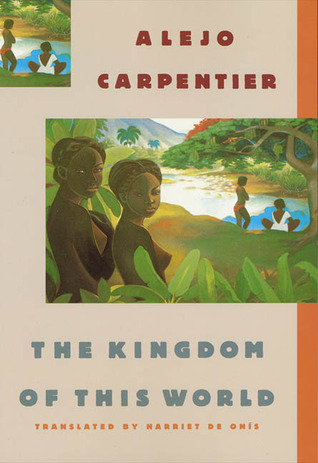
The Kingdom of This World by Alejo Carpentier


A few years after its liberation from French colonialist rule, Haiti experienced a period of unsurpassed brutality, horror, and superstition under the reign of the black King Henri-Christophe. Through the eyes of the ancient slave Ti-Noel, The Kingdom of This World records the destruction of the black regime--built on the same corruption and contempt for human life that brought down the French--in an orgy of voodoo, race hatred, erotomania, and fantastic grandeurs of false elegance.
Goodreads description

This is arguably the book that launched Latin American magic realism. First published in 1949, the book opens with a prologue which sets out to distinguish what the Cuban author calls the "marvellous reality" of Latin America from the surrealist marvellous of Europe:  But what many forget, in disguising themselves as cheap magicians, is that the marvellous becomes unequivocally marvellous when it arises from an unexpected alteration of reality ( a miracle), a privileged revelation of reality, an unaccustomed or singularly favourable illumination of the previously unremarked riches of reality, an amplification of the measures and categories of reality, perceived with peculiar intensity due to the exaltation of the spirit which elevates it to a kind of "limit state".

You can read the full Prologue here

Carpentier succeeds in this book in delivering beautiful and powerful magic realism. One of the key points made in the Prologue is that the magical depends on who believes it. Ti-Noel, who stands at the book's centre, is a black slave who believes in voodoo and its powerful magic. It is suggested that when Henri-Christophe stops believing in voodoo and adopts Christianity he starts to lose his power. It is not an accident that his personal crisis takes place in a church. Voodoo drum beats herald revolutions and echo through the book. Macandal, the first revolutionary leader, is said to be able to turn into animals, as at the end in a turning of the circle does Ti-Noel. But neither are successful in their bids for freedom.

The story is ultimately a sad one. Ti-Noel and the black slaves throw off the brutal chains of  one master only to lose their freedom to another - first their French slave owners, then black King Henri-Christophe who has them building a fantastic fortress palace in the jungle and neglecting their crops and finally the mulattoes with their measuring poles seizing the land.  It is not a surprise that many have compared it to Animal Farm. As we know, the bloody history of Haiti has continued ever since. And yet there is something affirming about the book's ending: at the end Ti-Noel understands that a man never knows for whom he suffers and hopes. He suffers and hopes and toils for people he will never know, and who, in turn, will suffer and hope and toil for others who will not be happy either,  for man always seeks a happiness far beyond that which is meted out to him. But man's greatness consists in the very fact of wanting to be better than he is.
 
 Carpentier uses nature symbolically throughout the book. There is Macandal and Ti-Noel's shape-changing. Henri-Christophe's fortress is being covered by lush red fungi even as it is built. When Ti-Noel returns to the plantation where he had been a slave, he finds it destroyed and overgrown. Nature is at once on the side of the slaves (they are aided by the weather and poisonous plants) and yet at the same time it is beyond them. 

Regular readers of this blog will know how I believe in the value of magic realism in accurately portraying history, for the very reason Carpentier sets out in the prologue - what is magic depends what people believe. Anyone wishing to get a feel for the history of Haiti would do well to read this book, which reveals as much about the island and its past as any non-fiction account.

This short book (150 pages) is unquestionably one of the masterworks of magic realism. Read it.

Wednesday, 11 December 2013

Moscow But Dreaming by Ekaterina Sedia


The first short story collection by award-winning author Ekaterina Sedia! One of the more resonant voices to emerge in recent years, this Russian-born author explores the edge between the mundane and fantastical in tales inspired by her homeland as well as worldwide folkloric traditions. With foreword by World Fantasy Award-winner Jeffrey Ford, Moscow But Dreaming showcases singular and lyrical writing that will appeal to fans of slipstream and magical realism, as well as those interested in the uncanny and Russian history.
Goodreads Description 

The twenty-one short stories in this stunning collection o=often focus on the outsider or displaced, whether it be the adopted Russian child, the ex-countess in Soviet Russia, the impoverished Prince of Burundi in exile in Moscow, or Hector of Greek myth with a mundane job yearning for a heroic death.  Magic realism works when there is this sort of dichotomy and in these stories it works really well. 

The stories are often infused with Russian myth and history.  In Kikimora a lesbian couple discover their true magical natures. In Tin Cans an old man working as a security guard at the Tunisian Embassy faces the ghosts of girls, sadistically raped and murdered by Stalin's henchman and KGB chief Beria. Other stories are set at the end of the October Revolution or at the Stalingrad Seige. All combine historical realism with fantasy and often violence.

Another element of alienation that we find in many of the stories is an alienation with  post-communist Russia, in which many people have seen their livelihoods and neighbourhoods decline in the face of materialism and gangsterism. In By the Liter two men absorb vodka and the memories of murdered mafia victims. 

Sedia is brilliant at taking a story in a way you don't expect it. It is virtually impossible to predict the ending even though the stories are short (about 15 pages). In addition she will often take a fictional genre and twist it: as in Zombie Lenin, in which a girl is pursued by the mummified Bolshevik leader, or in A Handsome Fellow - a take on the vampire myth (Upyr in Russian) set during the Stalingrad Seige. One of my favourite stories is The Bank of Burkina Faso which is based on this premise: what if those email scams about money frozen in overseas banks were actually true - and what if the banks only exist in dreams.

All the stories in this collection were excellent. The two that didn't work quite as well for me weren't set in either America or Russia (Ebb and Flow and Munashe and the Spirits), but that is quibbling. The author's writing is beautiful, her imagery unusual and the psychology of her characters is complex, even if she only has a few pages to draw it. 

Quite simply this is one of the best books I have read as part of my magic realism challenge.

Monday, 9 December 2013

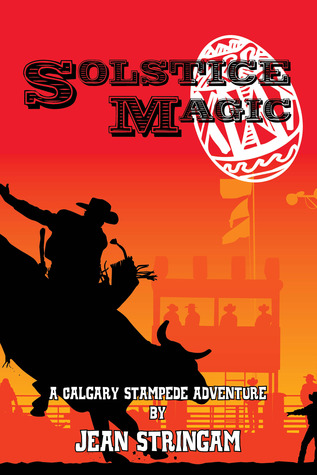
Solstice Magic by Jean Stringam


Read about the magical world of cowboys, rabbits, and Ukrainian goddesses that unfolds when Zo’s gruff baba from Ukraine arrives with her savage Caucasian Ovchorka dog. The ensuing chaos of clashing cultures catapults the characters into the extreme sport of rodeo at the Calgary Stampede. There, Vince Lapin, bull-rider extraordinaire, meets up with Susie Lago, protégé of Zo, and the outcome for the other rodeo contestants as well as the animal athletes changes stampede history. Good thing Zo has a best friend with an attractive older brother to soften the trauma. Solstice Magic is magical realism for everybody who ever wished to be more than they are. You'll love this first-in-a-series tale of the Calgary Stampede.
Goodreads description

This is a book for young adults, and I would probably put it at the lower end of that age range. Zo is at senior school but, despite a bit of a crush on her friend's brother, is mostly interested in training her rabbit to compete in hopping courses. I also think  therefore that it is unlikely to appeal to boys. 

I suppose it should be said here that I am not a young adult and haven't been one for a very long time, so long in fact that my son isn't one either. But I do get the impression that this a book which isn't being properly targeted at its core readership. The cover (above) speaks of cowboy adventure to me, not of a tale predominantly about a girl, her magical rabbit, and a fierce Ukrainian grandmother. 

So laying aside these quibbles let me say this is an enjoyable read suited to the market I outline above. It opens with the arrival of a rodeo "clown" at the Calgary rodeo and then shifts back several months to give the build-up to that arrival. Most of the story concerns Zo's family and the arrival of a grandmother from the Ukraine who doesn't want to be there and who refuses to fit in. Grandmother Dolia arrives complete with enormous fierce dog and a hatred of rabbits, which she refers to as vermin. The point of view in the story is mostly that of Zo or of her rabbit. I would have liked more about why Dolia is the way she is. She does come over as rather two-dimensional, although that might be because she is seen through Zo's eyes. 

I am sure many of the book's young readers will enjoy the portrayal of animals in the book. There is rabbit training, sheepdog trials and of course the rodeo. As a Brit I am unfamiliar with the latter and found the descriptions fascinating. All the animals are presented as conversing with each other. 

But is the book magic realism? Well almost. The book is based around Ukrainian beliefs and mysticism. Zo's grandmother brings with her from the Ukraine fierce fundamentalist views on these and she clashes with the family over their more "modern" take on them. Personally I would have liked more about what the book is based on in some sort of postscript - after all the book comes with a glossary of Ukrainian terms. In some magic realist books it doesn't matter that you do not know, maybe because they are written from the point of view of someone who believes in the magic. But Zo is as at sea about what her grandmother believes as we are. Perhaps if Zo had learned more during the story, we could too. As this book is the first in a series, perhaps this will happen in the subsequent volumes.

This book was given to me by the publisher in return for a fair review

Wednesday, 4 December 2013

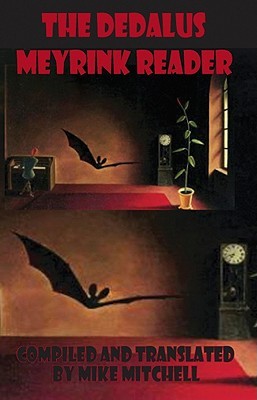
The Dedalus Meyrink Reader


Gustav Meyrink is one of the most important and interesting authors of early 20th-century German Literature. To establish his reputation in the English-speaking world Dedalus has translated his five novels plus a collection of his short stories and published the first ever English-language biography of Meyrink. Now is the time to produce an overview of Meyrink in a single volume. The Dedalus Meyrink Reader has excerpts from all the translated books and a whole section of hitherto untranslated material, including the stories from the collection Flederm use and autobiographical articles. This volume is perfect companion for both the Meyrink scholar and the first-time Meyrink reader, containing as it does the whole gamut of Meyrink's writing from his love of the bizarre, the grotesque and the macabre to the spine-chilling occult tales and his quest to know what is on the Other Side of the Mirror. Novelist, satirist, translator of Charles Dickens, dandy, man-about-time, fencer, rower, banker and mystic seer, there are many, sometimes contradictory aspects to Gustav Meyrink, who must also be the only novelist to have challenged a whole army regiment to a duel. He has left behind a unique body of work, which can be sampled and enjoyed in The Dedalus Meyrink Reader.
Goodreads description

Gustav Meyrink has suffered from being overshadowed by his fellow Prague resident Kafka. The publisher Dedalus have set out to reinstate Meyrink and his reputation. This collection includes samples of his novels, including the best known The Golem, and as tasters some work better than others. Also included are some fascinating short stories and articles, which shed a different light on Meyrink's writing.

The first question is how does Meyrink's writings relate to magic realism. This is a man who had an extraordinary life, where the real bordered on the magical - when he was accused of fraud in the running of his bank it was said he used spiritualism in the fraud. He was a man fascinated by the occult and esoteric and so the content of his writings are very much based on his beliefs. This means that "magic" is a part of the world he portrays.  In the Cardinal Napellus short story he gives the main character the following words: Some subtle spiritual instinct tells me that every act we perform has a double, magic meaning. We cannot do anything which is not magic. 

He produced a wide range of fiction. This includes psychological suspense, as in The Golem, where the Golem appears almost as a projection of the fears of Prague's Jewish population. It is never clear in the book what is real, especially as the leading character is said to have been mentally ill prior to the events portrayed. Meyrink also tried his hand at historical fiction, as in the Angel at the West Window, an account of the lives of English alchemists John Dee and Edward Kelley. As I have said elsewhere in this blog, magic realism has a role to play in portraying lives of people in the past where magic was seen as reality. 

Meyrink's short stories reveal an unexpected lighter side to his character. I particularly enjoyed The Ring of Saturn, which starts darkly and you expect it to be one of his horror stories but it twists unexpectedly. In this story a soul which has been captured escapes into the firmament and the magician, from whom it has escaped, has to recapture it and in so doing must sacrifice himself. However as he dies he tells his followers what horror the soul had been in the process of committing and why. The why is because the soul is that of a vicar's wife, being the only type of human that is truly useless and the horror was she was crocheting a ring for Saturn.

Written in 1903 the story Petroleum, Petroleum is horribly prescient. It tells of an oil magnate who deliberately releases oil into the ocean in the Gulf of Mexico. The oil flowing from huge reserves soon covers the whole of the ocean, but humanity is unable to react in a concerted way to counter the problem. 

There are also some fascinating non-fiction pieces in the book. One deals with a point in Meyrink's life where in despair he was about to shoot himself, but is stopped by a leaflet being pushed under the door. The leaflet's title was "On Life After Death." Since then I have never believed in coincidence, I believe in the Pilot.  Another is an essay on Prague, The City with the Secret Heartbeat. Prague appears almost like a leading character in much of Meyrink's writings. In this essay Meyrink says that it is indeed a character, a city that lives, but in a ghostly form: If however, I summon up Prague, it appears more clearly than anything else, so clearly, in fact, that it no longer seems real, but ghostly. Every person I knew there turns into a ghost, an inhabitant of a realm that does not know death.  As someone who spends time in the Czech Republic and knows Prague well, I have to say I know exactly what he is talking about.  As a writer myself, I cannot help but feel the magical other realism that is that great city.

Wednesday, 27 November 2013

I Heard the Owl Call My Name by Margaret Craven


In a world that knows too well the anguish inherent in the clash of old ways and new lifestyles, Margaret Cravenas classic and timeless story of a young man's journey into the Pacific Northwest is as relevant today as ever. Here amid the grandeur of British Columbia stands the village of Kingcome, a place of salmon runs and ancient totems - a village so steeped in time that, according to Kwakiutl legend, it was founded by two brothers left on earth after the great flood. Yet in this Eden of such natural beauty and richness, the old culture of totems and potlaches is under attack - slowly being replaced by a new culture of prefab houses and alcoholism. Into this world, where an entire generation of young people has become disenchanted and alienated from their heritage, Craven introduces Mark Brian, a young vicar sent to the small isolated parish by his church. This is Mark's journey of discovery - a journey that will teach him about life, death, and the transforming power of love. 
Goodreads Description

I loved this book. It is short (only 146 pages) and in many ways quite simple tale, but it moved me profoundly. At its heart is a man (the young vicar Mark) finding himself and his place in the context of nature. He does so as he comes to understand  Here every bird and fish knew its course. Every tree had its own place upon this earth. Only man had lost his way.

But it is just Mark who has lost his way, but also the younger members of the Kwakiutl tribe. This is personified in the clash of two young men: Jim, the young man who helps Mark, and Gordon who leaves the tribal lands for the city. Both men love Keetah, who must choose between the old tribal life and the white man's city. As the bishop tells Mark: The Indian knows his village and feels for his village as no white man for his country, his town or even his own bit of land... The myths are the village and the winds and the rains. The river is the village and the black and white killer whales... The village is the salmon... the seal... the bluejay... Throughout the book we, like Mark, learn to regret the loss of the tribe's old ways and affinity with the natural world of their land. The clash of cultures may be unavoidable but the reader shares Mark's sadness at what is lost. 

Mark's approach to the tribe and its beliefs is contrasted with two other sets of visitors. He refuses to help some Californian tourists gawp at the villagers. Then an English woman anthropologist arrives, who criticizes Mark's calling: What a shame that Christianity had come her! If the white man had not intruded.... the village would have remained a last stronghold of a culture which was almost gone. But she leaves after ten days having finished her studies. Mark's sympathetic commitment to the tribe's customs is demonstrated when he helps preserve the old tribal burial ground.

On the first page of the novel we discover that Mark is dying, but he doesn't know until quite late in the novel. This creates a tension within the story. According the tribal belief a dying man hears the owl call his name, and this happens to Mark. But this is more than just a bit of magic. The bishop has previously said, when talking about the Indian view of the village, that the village is the talking bird, the owl, who calls the man who is going to die. Throughout the book the village has called to the dying man.


Enhanced by Zemanta

Saturday, 23 November 2013

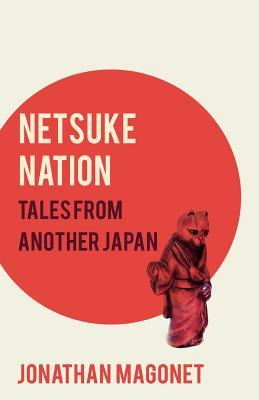
Netsuke Nation by Jonathan Maganot


Before Manga captured the imagination of the world, Japanese artists sculpted a miniature society of human and not-quite human characters. These are ‘netsuke’: tiny figures, threaded by cords, which were used to hold in place the ‘purse’ that hung from a kimono. Carved from wood, ivory or bone, they formed an exotic society, reflecting the history, culture and fantasy life of Japan.

Now, for the first time, their individual stories come to life, and the unfamiliar and often startling nature of their society. Meet Momo, the beautiful but conflicted geisha cat; discover the dreams of the mermaids who worship Esther Williams; witness the rise and fall of a ruthless politician who plays the ‘alien’ card; encounter the creatures of legend and the demons who star in horror movies; learn the peculiar practices and customs of netsuke sexuality; try to solve the mystery of why netsuke suddenly disappear; admire the heroic quest to create a national orchestra; enjoy the embarrassment of a martial arts struggle gone peculiarly awry; share the hopes of an autumn and spring love story; face the threat to netsuke society of the plastic invasion. 

Goodreads description 

This book of unusual short stories was inspired by the author's collection of netsuke. Each story is inspired by a different netsuke. The stories are whimsical and often funny - for example in the discussion of what is the best partner for a mermaid - man, cod or octopus. 

The author has said: I found they [netsuke] offered a fascinating introduction to Japanese culture. On my daily walk to the university in Fukuoka where I was teaching, some character in my small netsuke collection, would suggest a story that fed into an emerging idea of Netsuke Nation, a mixture of imagination and the experience of Japanese life.

The stories are therefore more than just tales about the individual figurines, they are tales of "Another Japan" and as such some are musings on the Netsuke nation's politics, social class (the old ivory netsuke are superior to the cheap plastic and resin ones) and even hilariously on sexuality. 

The author's style is I think influenced by the Jewish rabbinical tradition. He is the author of a number of theological books, the latest being A Rabi Reads The Torah and I think that shows as he muses on these small figures and extrapolates meaning and indeed a world from them. 

Not all the stories worked for me. I was less taken with the politics of the Netsuke nation, as with those stories which focused on the individual netsuke characters - such as the geisha cat and the wrestlers of the opening story. 

The book was produced by Matador, which is I think a self-publishing company.  If this is the case I feel that the price of £5.14 for a self-published volume of short stories is too high in the current market. 

I received this book free from the publisher via Netgalley in return for a fair review

Wednesday, 20 November 2013

The Woman in the Dunes by Kobo Abe


The Woman in the Dunes, by celebrated writer and thinker Kobo Abe, combines the essence of myth, suspense and the existential novel.

After missing the last bus home following a day trip to the seashore, an amateur entomologist is offered lodging for the night at the bottom of a vast sand pit. But when he attempts to leave the next morning, he quickly discovers that the locals have other plans. Held captive with seemingly no chance of escape, he is tasked with shoveling back the ever-advancing sand dunes that threaten to destroy the village. His only companion is an odd young woman. Together their fates become intertwined as they work side by side at this Sisyphean task.


Before reading this review, please be aware that it is not possible to talk about it in any depth about The Woman in the Dunes without giving away some key plot elements. But then in a way the plot isn't the most important thing about this book. I suppose there is the question of will he, won't he escape from the hole, but as the blurb says this is an existential novel, so you can probably work out the answer to that question. No, this is one of those books you carry on thinking about for days after you finished reading and not just because you are writing a review for your blog. It makes you ask some serious and fundamental questions about not only the book but also your life. 

So what are you doing with your life? Is it anything more than endlessly shoveling sand in return for food and a place to lay your head? Are you trapped in a hole looking up occasionally at the sky, but never seeing the horizon? If your life is more than this, why is that? What gives your life an added meaning? Is it love? Is it creating something?

This is in many ways a bleak book. It is regularly described as Kafkaesque, which I think is a fair description. There is a hopelessness about the central characters's position, but in this case the man is an innocent prisoner of people who are themselves outcasts. The writer has made his "hero" not particularly likeable: he is not brave, he is not pleasant, he is often indecisive, he is not particularly intelligent, his relationship with the woman (she doesn't get a name) and with his former lover (known simply as the other woman) is totally self-centred and mechanical. He is not the sort of person you would want to make friends with, he is the geek in the corner of the staffroom. He's a man who likes sticking pins in insects for goodness sake! He in turn becomes the insect we are studying.

But is the book totally bleak? That turns on how you interpret the ending. There is no right or wrong answer here. It could be bleak - the man has lost the will to escape and is thus trapped. Or there could be some sort of redemption - he has found some meaning in life in the hole. The choice is yours and that depends on your view of life.
 

Wednesday, 13 November 2013

The Track to Bralgu by B. Wongar


In these powerful stories B. Wongar deals with the clash of cultures, with what it means to be a  black man in a white man's continent: Australia.

This short collection of stories packs one hell of a punch. Beautiful, angry, haunting, bitter,  they show the world through the eyes of Aboriginal Australians of the Northern Territory. Wongar's characters call on the spirits of the wind and the rain, but even Jambawal, the Thunder Man, cannot drive away the white man who is destroying the Australian landscape: The settlers cleared the bush long ago and the country hereabouts looks like a skinned beast.

It came as a shock therefore to discover that the author is a white man, a Serbian. However he lived with the Aboriginal Australians of Northern Territory and married a local woman. According to his autobiography, Wongar's wife and children died of radiation poisoning arising from the uranium mining. Wongar's legitimacy as a writer about the experience of Aboriginal Australians has been called into question. Maybe that is a way of deflecting the serious issues he wrote about. It should also be said that Australia is an enormous country and so the culture, legends and experience shown here are of a specific tribe and area. 

It is a shame that it is necessary to refer to Wongar's biography, because as I say above this is a powerful collection. To this British reader the stories ring true, but who am I to know? It strikes me that Wongar is neither an Aboriginal Australian nor a white Australian. He is an outsider to both cultures and maybe this gives him an insight. 

So let us look at this book at face value: These stories are written with a stark beauty, like the landscape in which they are set. Wongar's writing style is poetic, full of powerful imagery. The stories are written in the first person (spoken by Aboriginal Australians) and are in the present tense, which gives them immediacy. 

Bralgu of the title is the land of the dead: The Rijatjigu elders say often when a man dies his spirit splits in three parts: one goes to Bralgu to join the ancestors; another sits on the bottom of the totemic waterhole and waits to be reborn; while the third, the Mogwoi, they call it, wanders around tribal country. In the stories these three parts appear. Many of Wongar's characters are on the track to Bralgu. They see the Mogwoi around them, the most startling example being the narrator of one of my favourite stories, Maramara. And they are shocked by the destruction of the sacred waterholes or are separated from them by the seizure of their lands and the brutal enforcement of anti-trespass laws. 

The ironic portrayal of the white man is as someone who values the uranium and ore-rich rocks and yet tears them from the soil, so destroying the land. Even people who should be caring, such as the priests, come with a Bible in one hand and a gun in the other. The nurse Helen in Maramara carries a bag for rocks and it is she that finds the uranium-bearing rocks in the tribe's sacred cave. There is the suggestion that she poisoned the children: your friend the nurse gave him a biscuit and he died soon after. 

This is a bleak and powerful book and a good example of how magic realism can tackle serious subjects.

Sunday, 10 November 2013

Growing Up Golem by Donna Minkowitz


In the tradition of Alison Bechdel's Fun Home, Donna Minkowitz’s Growing Up Golem is a sharply funny memoir about growing up inspired by the Jewish legend of the golem. The author's mother told Minkowitz that she could do Jewish magic and, growing up, Minkowitz completely believed her. Her mother, an unusually domineering figure, exerted even more sway over Minkowitz than mothers typically do over their children, so it is the "magical realist" premise of the book that instead of giving birth to her, her mother actually created Minkowitz as her own personal golem, a little automaton made of clay.

In the book, Minkowitz struggles to control her own life as an adult, even as she publicly appears to be a radical, take-no-prisoners lesbian journalist. In her career, dating, and especially with her own eccentric family, Minkowitz finds herself compelled to do what other people want, to horrible and hilarious effect. In sex, for example, she often feels like "a giant robot dildo."

Matters come to a head when a disabling arm injury renders her almost helpless (and permanently unable to use a computer). She must find a way to work, find people who love her, and stand up for her own desires—against the bossing she's always tolerated from girlfriends, mother, and every other single person—before her injury gets even worse.


When I saw this book I was fascinated by the idea of the magic realist memoir - the idea of combining magic realism and non-fiction. I was interested to see how the author managed it and whether it did seem arch. The answer, dear reader, is that it works brilliantly.

The author's mother appears to have been the Jewish mother from hell, manipulative, demanding, and egotistical. Add to that an abusive father, whose response to the taunting of his wife was to beat the daughter, and it is no surprise that psychological damage was done to their daughters and to Donna specifically.  This damage is portrayed through the image of the Golem.

The Golem of Jewish tradition are artificial persons that learned sixteenth century rabbis made out of wet clay to do everything their makers told them to. Their masters could destroy them by the erasing of just one letter in a word.

Throughout the book the author portrays herself ( and her sisters) as golems: I have known I was a magical being, handcrafted rather than born, from my earliest days. I'm not sure when I first found out, but it goes back at least to the time my mother , when I was four, began telling me and my sisters that she herself could perform at magic, could make us do anything she wanted, like puppets. 

Like the golem of old she feels bound to obey her mother and the other women (and occasional men) who enter her life.  She is unable to say no.  In addition golems are bred for self-disgust and a permanent discipline and this leads her into other abusive relationships. Some of these relationships are sexual (a number of lesbian affairs are described in some detail), but other non-sexual relationships are also abusive, including sadly with therapists who are supposed to be helping Donna.

This could be heavy stuff but for the way the author delivers her story, using magic realism and wry humour, indeed this book it is at times laugh-out-loud funny. The magic realism both explains and puts an emotional distance between the reader and the subject matter.  Ironically that detachment reflects the author's own psychology: a golem cannot feel.

How do you break a golem spell?
It is not easy, my dear puppet and acolyte.
The only way there is, is feeling pain.

The pain that breaks the spell for Donna Minkowitz is that of RSI, a particularly debilitating illness if you are a writer. The pain forces her to look after herself, to protect her arms, and in so doing refuse her mother and others.  The story is therefore one of healing, for just as her arms slowly heal so the author heals her psyche and sheds her golem identity.  As it happens I am writing this blog and my current book using voice recognition software because I too have developed RSI.  I cannot imagine what it must have been like for her coping with severe RSI over several years.  It seems an awful lot of pain to go through to break an evil spell. But to Minkowitz it all seems to have been worthwhile: I felt feelings from the tips of my toes to the top of my head. My head felt effervescent, as though a flowery beer had been poured into it and my hair was curling up from the blood vessels in my scalp to the tips of my curls. 


 I received a free copy of this book from the publisher via Netgalley in return for a fair review .