Showing posts with label Julia Elliott. Show all posts

Sunday, 10 July 2016

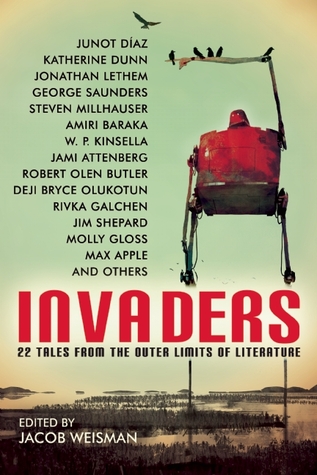
Invaders: 22 Tales from The Outer Limits of Literature


The invasion of the future has begun.

Literary legends including Steven Millhauser, Junot Diáz, Amiri Baraka, and Katharine Dunn have attacked the borders of the every day. Like time traveling mad-scientists, they have concocted outrageous creations from the future. They have seized upon tales of technology gone wrong and mandated that pulp fiction must finally grow up.

In these wildly-speculative stories you will discover the company that controls the world from an alley in Greenwich Village. You’ll find nanotechnology that returns memories to the residents of a nursing home. You’ll rally an avian-like alien to become a mascot for a Major League Baseball team.

The Invaders are here. But did science fiction colonize them first?

 Goodreads description

Whilst these stories are science fiction and not magic realism, many of the writers contributing to the anthology are already authors of magic-realist fiction, who have been invited to try their hands at speculative fiction. The resulting stories are remarkable and fascinating. One of the consequences of asking these literary authors to write sci-fi was there was generally a strong focus on the human element in the stories - relationships, sexual relations and indeed the nature of being human (something particularly appropriate to the sci-fi genre). 

I have reviewed two of the stories already on this blog (The Inner City by Karen Heuler, and LIMBs by Julia Elliott) because they have featured in collections which also contained magic realism.
W.P. Kinsella normally combines baseball stories with magic realism; in Reports Concerning the Death of the Seattle Albatross Are Somewhat Exaggerated he offers a story about an alien living as a baseball maskot. In Monstros Junot Diaz (author of The Brief Wondrous Life of Oscar Wao) has created a powerful story about a plague (and zombies) set in the Dominican Republic.

As you will have realized, the stories in the collection are very varied both in subject matter and in tone. This variety is reflected in my personal favourites, which include the aforementioned Kinsella story. While Death of the Seattle Albatross... is amusing and quirky, Fugue State by Brian Evenson and Escape from Spiderhead by George Saunders are darker and raise serious questions.

My favourite story was Molly Gloss's short story Lambing Season. As some of you will know, a literary heroine of mine is Ursula Le Guin. She is often categorized as a writer of science fiction and fantasy, but what attracts me to her writing is the ability to explore human nature and explore hard questions. Lambing Season reminded me of Le Guin's writings. It is a beautifully written and extremely human tale, in which a lonely shepherdess encounters an alien. This story is both gentle in touch and profound. 

This collection really explores the outer limits of literature as it claims. I recommend it to you. 

I received this copy of this book free in return for a fair review.


Wednesday, 24 September 2014

The Wilds by Julia Elliott


At an obscure South Carolina nursing home, a lost world reemerges as a disabled elderly woman undergoes newfangled brain-restoration procedures and begins to explore her environment with the assistance of strap-on robot legs. At a deluxe medical spa on a nameless Caribbean island, a middle-aged woman hopes to revitalize her fading youth with grotesque rejuvenating therapies that combine cutting-edge medical technologies with holistic approaches and the pseudo-religious dogma of Zen-infused self-help. And in a rinky-dink mill town, an adolescent girl is unexpectedly inspired by the ravings and miraculous levitation of her fundamentalist friend’s weird grandmother. These are only a few of the scenarios readers encounter in Julia Elliott’s debut collection, The Wilds. In these genre-bending stories, teetering between the ridiculous and the sublime, Elliott’s language-driven fiction uses outlandish tropes to capture poignant moments in her humble characters’ lives. Without abandoning the tenets of classic storytelling, Elliott revels in lush lyricism, dark humor, and experimental play.
Goodreads description

When I saw the cover and read that the contents were being compared to the stories of  Karen Russell, Aimee Bender and Kelly Link I thought this would be a great book to review for this magic realist blog. I should have been warned by the phrase "genre-bending stories" that the book would not fit neatly into magic realism. In an interview, which appears on the publisher's website, Julia Elliott is quoted as saying:  For me, minimal evocation of “unreal” elements is the best way to hit upon certain emotional or philosophical insights, though other writers do this more effectively by adhering to a strict “realism” or throwing themselves whole hog into “fantastical” worlds. Both methods, to be effective, require a meticulous mastery of language and tone. To me, genre is not a package for a story, but a vehicle to be used within it—and some of my favorite fictions genre-mix liberally and magically.

Elsewhere I have seen the collection described as Southern Gothic, which for readers who, like me, have not come across the term before, is defined on Wikipedia as a subgenre of Gothic fiction that takes place exclusively in the American South. It regularly features deeply flawed, disturbing and eccentric characters.. grotesque situations and other similar events. Examples of writers of Southern Gothic include Cormac McCarthy and William Faulkner.  The Wilds is certainly dark, too dark for me at times.  But there was also much that I enjoyed, not least the flashes of humour that leavened the darkness.

The stories are generally very different from one another and totally immerse you in their worlds. These worlds may be very different from my own, but they are so well written that I had no difficulty in seeing them. The dialogue in particular is extremely strong - it is as if it is transcribed from real conversations. The narrator also often speaks as if directly talking to the reader, whilst at the same time being almost poetic in her description: His skin's as smooth as the metalized paint that coats a fiberglass mannequin. His body's a bundle of singing muscles. When he walks, he hovers three millimeters off the ground - you have to look carefully to detect his levitational power, but, yes, you can see it: the bastard floats.

Levitation is one of the few clear examples of "magic" in the book. It is also appears in one of my favourite stories in the collection, Rapture, in which two girls go for a sleepover with a family whose live-in grandmother has mysterious religious powers. "Aw crap," said Brunell. "She's got the Holy Ghost on her. We'll never hear the end of it now."
From the depths of Meemaw, a strange voice came bubbling up: the voice of a primordial masculine spirit, the voice of Darth Vader.

The issue of old age and dementia appears in two other stories. In Jaws a woman on holiday with her elderly parents slowly recognizes her mother's confusion. Limbs has to be my favourite story in the book. It is a tale of an old woman with synthetic limbs whose memories of her relationships with two men become clear as she becomes more mobile.

The title story is about a young teenage girl drawn to a feral family next door which includes a boy who wears a wolf mask at full moon. It is a portrayal of acne, teenage awakening and insecurity. The Whipping is also about a teenage girl, this time in her own weird family, waiting for and trying to put off the beating that is coming her way. Organisms is also about teenagers but this time seen from the adult point of view. 

The stories that worked less well for me tended to be the ones which deal with the obsessions of middle age, which is interesting as I am 56. There are two stories that satirize health resorts and their users. In these the central characters, women, are in failing relationships and are looking for someone else. The same is true of the central character in Feral. The Love Machine is the exception to the general rule that the central character is female but then he isn't male either - the character is a robot. 

An interesting collection, but not one I will reread. But I am sure Julia Elliott will find readers who will.

I received this book free from the publisher via Edelweiss in return for a fair review.