Showing posts with label Karen Heuler. Show all posts

Sunday, 10 July 2016

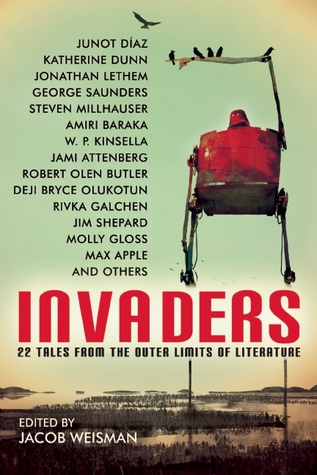
Invaders: 22 Tales from The Outer Limits of Literature


The invasion of the future has begun.

Literary legends including Steven Millhauser, Junot Diáz, Amiri Baraka, and Katharine Dunn have attacked the borders of the every day. Like time traveling mad-scientists, they have concocted outrageous creations from the future. They have seized upon tales of technology gone wrong and mandated that pulp fiction must finally grow up.

In these wildly-speculative stories you will discover the company that controls the world from an alley in Greenwich Village. You’ll find nanotechnology that returns memories to the residents of a nursing home. You’ll rally an avian-like alien to become a mascot for a Major League Baseball team.

The Invaders are here. But did science fiction colonize them first?

 Goodreads description

Whilst these stories are science fiction and not magic realism, many of the writers contributing to the anthology are already authors of magic-realist fiction, who have been invited to try their hands at speculative fiction. The resulting stories are remarkable and fascinating. One of the consequences of asking these literary authors to write sci-fi was there was generally a strong focus on the human element in the stories - relationships, sexual relations and indeed the nature of being human (something particularly appropriate to the sci-fi genre). 

I have reviewed two of the stories already on this blog (The Inner City by Karen Heuler, and LIMBs by Julia Elliott) because they have featured in collections which also contained magic realism.
W.P. Kinsella normally combines baseball stories with magic realism; in Reports Concerning the Death of the Seattle Albatross Are Somewhat Exaggerated he offers a story about an alien living as a baseball maskot. In Monstros Junot Diaz (author of The Brief Wondrous Life of Oscar Wao) has created a powerful story about a plague (and zombies) set in the Dominican Republic.

As you will have realized, the stories in the collection are very varied both in subject matter and in tone. This variety is reflected in my personal favourites, which include the aforementioned Kinsella story. While Death of the Seattle Albatross... is amusing and quirky, Fugue State by Brian Evenson and Escape from Spiderhead by George Saunders are darker and raise serious questions.

My favourite story was Molly Gloss's short story Lambing Season. As some of you will know, a literary heroine of mine is Ursula Le Guin. She is often categorized as a writer of science fiction and fantasy, but what attracts me to her writing is the ability to explore human nature and explore hard questions. Lambing Season reminded me of Le Guin's writings. It is a beautifully written and extremely human tale, in which a lonely shepherdess encounters an alien. This story is both gentle in touch and profound. 

This collection really explores the outer limits of literature as it claims. I recommend it to you. 

I received this copy of this book free in return for a fair review.


Sunday, 24 February 2013

The Inner City by Karen Heuler


Heuler’s stories dart out at what the world is doing and centre on how the individual copes with it. Anything is possible: people breed dogs with humans to create a servant class; beneath one great city lies another city, running it surreptitiously; an employee finds that her hair has been stolen by someone intent on getting her job; strange fish fall from trees and birds talk too much; a boy tries to figure out what he can get when the Rapture leaves good stuff behind. Everything is familiar; everything is different. Behind it all, is there some strange kind of design or merely just the chance to adapt? In Heuler’s stories, characters cope with the strange without thinking it’s strange, sometimes invested in what’s going on, sometimes trapped by it, but always finding their own way in.
Goodreads Description 
  
One of the joys of writing this blog is that I read books I would not normally have considered. The Inner City is just such a book. I had not come across Karen Heuler's work before reading this collection of short stories, and having read it I intend to read more. Although some of the stories in the collection are not magic realism, many are and even those that aren't show a magic realism influence. Heuler clearly identifies herself as writing magic realism on her website: it was Marquez’s freedom that influenced me the most. In his world, people levitated. Literature was moving out of Minimalism and into Magic Realism, and that’s where I was moving too, whether at the front of the crowd or in the rear didn’t matter. 

Although Heuler speaks of the influence of Marquez, her stories put me in mind of the tradition of the European magic realists - Gogol, Ayme, and most definitely Kafka. There is a sense of alienation from modern society, or rather a sense that there is something out of kilter in the modern world. In the book's title story the inner city is revealed to be a place hidden within/beneath our own from where malignant puppetmasters manipulate our lives just for the fun of it. The Hair had me laughing out loud at the satire on business report presentations: Mindy wore an iridescent pearl-coloured body stocking with a long pearl-coloured skirt with tremendous slits.... "Fine fractals advanced to 78 by knocking out the middle," she said and did a split, her arms thrown upwards. But as in Kafka's work, the humour is tempered with a personal tragedy.  

After Images starts amusingly, satirising the use of opinion polls and sociological studies, but follows a logical path to a bizarre study photographing of the eyes of the dead in an attempt to reveal what people see when they die. This focus on the afterlife is most noticeable in The Great Spin, which centres on a young man whose family believe in the imminent arrival of the Rapture. 

There are several stories that deal with environmental themes. In Down on the Farm the subject is the sinister use of genetic manipulation and in Creating Cow a vegetarian creates a Frankenstein's monster. The Large People is a less disturbing environmental story with the message that Nature always takes the long view and the long view had no sorrow.  

Throughout the book there is the theme of change in identity. Whether it is the man who finds he can float in How Lightly He Stepped In Air, the transformation or, should I say, metamorphosis of children into other animals in The Difficulties of Evolution, or the loss of identity through the theft of physical attributes in The Hair, Heuler is excellent at portraying the sense of bewilderment at change. 

I enjoyed this book tremendously, and whilst I liked some stories more than others, there was not one that I thought weak. The book, as you can see from this review, was full of metaphors and the unexpected - magic realism at its best.

Note: this book was given to me by the publisher in return for an unbiased review.


Enhanced by Zemanta