Showing posts with label science fiction. Show all posts

Thursday, 27 July 2017

The Invention of Morel by Adolfo Bioy Casares


Jorge Luis Borges declared The Invention of Morel a masterpiece of plotting, comparable to The Turn of the Screw and Journey to the Center of the Earth. Set on a mysterious island, Bioy's novella is a story of suspense and exploration, as well as a wonderfully unlikely romance, in which every detail is at once crystal clear and deeply mysterious. 

Inspired by Bioy Casares's fascination with the movie star Louise Brooks, The Invention of Morel has gone on to live a secret life of its own. Greatly admired by Julio Cortázar, Gabriel García Márquez, and Octavio Paz, the novella helped to usher in Latin American fiction's now famous postwar boom. As the model for Alain Resnais and Alain Robbe-Grillet's Last Year in Marienbad, it also changed the history of film.

Goodreads description

The Invention of Morel is one of those books which exist on the boundary of genres - magic realism, science fiction, philosophical fiction. But that does not matter, so often the best books are the most uncategorisable.  This is an amazing book:  only 100 pages long and yet so full of ideas, published in 1940 and yet so modern, indeed it is prescient in some of the ideas and themes, and as for the plot, well all I can say is Borges was right, this is a masterpiece. 

The book is written as a journal by a fugitive from the law, who in order to escape his punishment comes to an island that has the reputation of being a place of death, where everything, including anyone who visits, is dying. What crime the fugitive has committed (if any) is not made clear. Bioy Casares' approach is a class example of "less is more" in writing. A lesser writer might have been tempted to create a backstory, but by not doing so Bioy Casares not only keeps the story lean and to the point, but also introduces doubt and allows us to project our ideas on to the story. 

One day the fugitive sees a group of people in the villa, known as the museum, on the hill that overlooks the island. Among these newcomers is a beautiful woman, Faustine, with whom the fugitive falls in love from a distance. As detailed in the Goodreads description, Faustine was inspired by the author's obsession with the silent movie star Louise Brooks. 

‘To be on an island inhabited by artificial ghosts was the most unbearable of nightmares—to be in love with one of those images was worse than being in love with a ghost (perhaps we always want the person we love to have the existence of a ghost).’
  
The fugitive's account has a nightmare quality. He is both terrified that he will be discovered -  indeed that the whole thing is a cruel trick on him by his pursuers - and unable to interact with Faustine and the others. He watches them from behind curtains, inside giant urns and as he realises that they cannot or will not see him. Then there are strange occurences - people appear and disappear, scenes are re-enacted, there are two suns in the sky, objects reappear in exactly the same place as a week earlier. And then there is the constant sense of death and decay - dead fish in the swimming pool, flowers wilting, etc.  We and the fugitive begin to wonder what is real. Bioy Casares introduces some footnotes by a fictional editor  just to add another level of uncertainty.

The most complete and total perception not only of the unreality of the world but of our own unreality: not only do we traverse a realm of shadows, we ourselves are shadows.


There is a reason for these strange occurences and that is the invention of Morel (Morel organised the group's island trip). More than that I cannot tell you without spoiling the book, although knowing will not prevent me from reading the book again. However I will read it with a different eye, seeing, I am sure, the brilliantly plotted clues that I missed or misread the first time, and enjoying the development  of philosophical themes. 

I commend this book to you. 


PS If this reminds you of the TV series Lost, it probably should do. The series seems to have been influenced by the novella, and if you look closely that influence is acknowledged on the screen when Sawyer is shown reading the book. But then as the Goodreads description says this is a hugely influential novel. 


Sunday, 10 July 2016

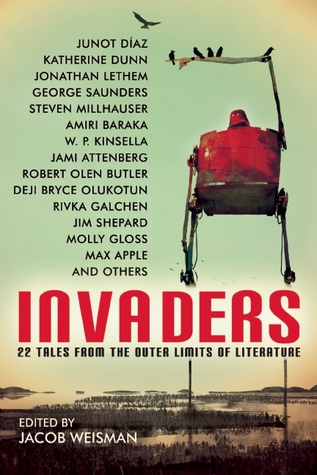
Invaders: 22 Tales from The Outer Limits of Literature


The invasion of the future has begun.

Literary legends including Steven Millhauser, Junot Diáz, Amiri Baraka, and Katharine Dunn have attacked the borders of the every day. Like time traveling mad-scientists, they have concocted outrageous creations from the future. They have seized upon tales of technology gone wrong and mandated that pulp fiction must finally grow up.

In these wildly-speculative stories you will discover the company that controls the world from an alley in Greenwich Village. You’ll find nanotechnology that returns memories to the residents of a nursing home. You’ll rally an avian-like alien to become a mascot for a Major League Baseball team.

The Invaders are here. But did science fiction colonize them first?

 Goodreads description

Whilst these stories are science fiction and not magic realism, many of the writers contributing to the anthology are already authors of magic-realist fiction, who have been invited to try their hands at speculative fiction. The resulting stories are remarkable and fascinating. One of the consequences of asking these literary authors to write sci-fi was there was generally a strong focus on the human element in the stories - relationships, sexual relations and indeed the nature of being human (something particularly appropriate to the sci-fi genre). 

I have reviewed two of the stories already on this blog (The Inner City by Karen Heuler, and LIMBs by Julia Elliott) because they have featured in collections which also contained magic realism.
W.P. Kinsella normally combines baseball stories with magic realism; in Reports Concerning the Death of the Seattle Albatross Are Somewhat Exaggerated he offers a story about an alien living as a baseball maskot. In Monstros Junot Diaz (author of The Brief Wondrous Life of Oscar Wao) has created a powerful story about a plague (and zombies) set in the Dominican Republic.

As you will have realized, the stories in the collection are very varied both in subject matter and in tone. This variety is reflected in my personal favourites, which include the aforementioned Kinsella story. While Death of the Seattle Albatross... is amusing and quirky, Fugue State by Brian Evenson and Escape from Spiderhead by George Saunders are darker and raise serious questions.

My favourite story was Molly Gloss's short story Lambing Season. As some of you will know, a literary heroine of mine is Ursula Le Guin. She is often categorized as a writer of science fiction and fantasy, but what attracts me to her writing is the ability to explore human nature and explore hard questions. Lambing Season reminded me of Le Guin's writings. It is a beautifully written and extremely human tale, in which a lonely shepherdess encounters an alien. This story is both gentle in touch and profound. 

This collection really explores the outer limits of literature as it claims. I recommend it to you. 

I received this copy of this book free in return for a fair review.


Sunday, 7 February 2016

The Assimilated Cuban's Guide to Quantum Santeria by Carlos Hernandez


A quirky collection of short sci-fi stories for fans of Kij Johnson and Kelly Link
 
Assimilation is founded on surrender and being broken; this collection of short stories features people who have assimilated, but are actively trying to reclaim their lives. There is a concert pianist who defies death by uploading his soul into his piano. There is the person who draws his mother’s ghost out of the bullet hole in the wall near where she was executed. Another character has a horn growing out of the center of his forehead—punishment for an affair. But he is too weak to end it, too much in love to be moral. Another story recounts a panda breeder looking for tips. And then there’s a border patrol agent trying to figure out how to process undocumented visitors from another galaxy. Poignant by way of funny, and philosophical by way of grotesque, Hernandez’s stories are prayers for self-sovereignty.

Goodreads description

This short-story collection explores that border country between science fiction and magic realism in a way that reminded me of not only the stories of Kelly Link (as stated in the Goodreads description) but also of Elizabeth Hand and a number of other writers reviewed on this blog. As with those other writers' collections, only a few of the stories fall firmly within the realm of magic realism. My favourite stories (although not all are magic realism) were:

The Aphotic Ghost
A modern selkie story, which brings together marine biology, jellyfish, mountain climbing and a father's search for a missing son.

Los Simpaticos
A murder mystery with no speculative elements about the death of the star of a Spanish-language reality TV show. As he pretends to be a hitman to lure out potential hirers, there are no lack of suspects. 

More Than Pigs and Rosaries Can Give
This story is about a son trying to locate the site of his mother's murder at the hands of Che Guevara's death squads. When he gets the lead he seeks, he is offered the opportunity to communicate with the dead woman. This story starts very strongly, but I found myself questioning the ending. 

Bone of my Bone
A man, separated from his wife following his affair with another woman, starts to grow a horn in a strange reverse of the traditional portrayal of the cuckold's horns.

The Magical Properties of Unicorn Ivory
This is a story where sci-fi and magic realism definitely meet. As a result of scientists playing with quantum physics, unicorns from a parallel universe start appearing in the British countryside. Immediately they are the targets of ivory poachers who kidnap a young girl to attract the attentions of the shy beast.

The Assimilated Cuban's Guide to Quantum Santeria
My favourite story in the book is the last one. After the death of his mother, a young boy tries to get her back using santeria learned from a library book.  But of course magic is not that simple and the boy has to resort to santeria again. This story is more complex, developed and thought through than most of the others. 

This is an interesting collection and one which will appeal to fans of magic realism who also like science fiction.

I received this book free from the publisher in return for a fair review.


Wednesday, 9 April 2014

The First Fifteen Lives of Harry August by Claire North


The extraordinary journey of one unforgettable character - a story of friendship and betrayal, loyalty and redemption, love and loneliness and the inevitable march of time.

Harry August is on his deathbed. Again.

No matter what he does or the decisions he makes, when death comes, Harry always returns to where he began, a child with all the knowledge of a life he has already lived a dozen times before. Nothing ever changes.

Until now.

As Harry nears the end of his eleventh life, a little girl appears at his bedside. 'I nearly missed you, Doctor August,' she says. 'I need to send a message.'

This is the story of what Harry does next, and what he did before, and how he tries to save a past he cannot change and a future he cannot allow

Goodreads description

Last year I reviewed the critically acclaimed and Booker short-listed Life After Life by Kate Atkinson – a novel in which the central character dies and then restarts their life repeatedly. Now along comes another book that is based on the same idea. What must Claire North and her publishers have thought when Kate Atkinson beat them to it? Or maybe Claire North is Kate Atkinson, having another take on the subject, which seems only appropriate in the circumstances. I am sure many writers would like to revisit a concept as strong as this. I can speculate like this because Claire North is a pseudonym for an acclaimed British author, or so the the note at the back of the book tells me. Whoever Claire North is, she has a very different approach to the concept.

Atkinson's novel is clearly literary fiction and the repeated lives are presented as a literary device. Claire North's novel is genre fiction – science fiction. There is a whole group of people who repeat their lives and even a secret society through which they help each other and protect the world from one of their kind abusing their knowledge. Of course the plot line concerns a message from the future that the world's end is being speeded up by a rogue xxxx. The book becomes a quest across Harry's fifteen lives to save the world. And a thoroughly good romp it is too, well plotted and with a strongly drawn and by no means perfect protagonist.

Whilst the heroine of Life After Life only vaguely remembers her previous lives, Harry August remembers everything. The advantage of this is that it allows Harry and us to consider the philosophical and logistical implications of the device. At times this debate can get a bit tedious, but it is thought-provoking. I'm not sure that I was entirely convinced by how the impact of alternative lives on world history was explained. But you have to accept the internal logic of such stories and get on with enjoying the action.

I read somewhere that science fiction cannot be magic realism and in this case I think that is probably true. Nevertheless I enjoyed this book.

I received this review from the publisher via Netgalley in return for a fair review.