Monday, 17 August 2015

Video - Isabel Allende on Gabriel Garcia Marquez


After the death of the great Gabo - Isabel Allende gave this interview to Democracy Now about the importance of Marquez "the master of masters" to South America and to her personally: "It was as if someone was telling me my own story."

It's a fascinating interview and includes some clips from an interview with Gabo himself.

Wednesday, 12 August 2015

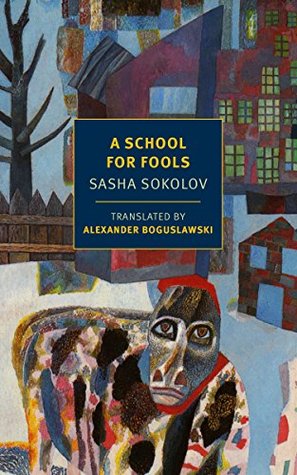
A School For Fools by Sasha Sokolov

By turns lyrical and philosophical, witty and baffling, A School for Fools confounds all expectations of the novel. Here we find not one reliable narrator but two “unreliable” narrators: the young man who is a student at the “school for fools” and his double. What begins as a reverie (with frequent interruptions) comes to seem a sort of fairy-tale quest not for gold or marriage but for self-knowledge. The currents of consciousness running through the novel are passionate and profound. Memories of childhood summers at the dacha are contemporaneous with the present, the dead are alive, and the beloved is present in the wind. Here is a tale either of madness or of the life of the imagination, in conversation with reason, straining at the limits of language; in the words of Vladimir Nabokov, “an enchanting, tragic, and touching work.”
Goodreads description

As I read this book I was reminded of a formative time in my life. I had left university only to become ill and as I waited for an operation I spent my time reading and watching films on television. One of the books I read was One Hundred Years of Solitude and so began my love of magic realism. One of the films I watched was Tarkovsky's film The Mirror. I was in the right state of mind for both book and film. I had time. I was willing to let go of expectations and experience these remarkable works of art. The experience was almost a mystical one.  

A School for Fools reminds me of Tarkovsky's film. Maybe this is partly because of its non-linear structure, the poetry, the disorientation, the slowness even, the focus on a young man growing up. It also reminds me of these things because you have to be in the right state of mind. I am not sure I was/am in the right "zone" to really appreciate the book. Perhaps the pressure of having to read and review a book a week for this blog played against me. The book is complex and full of symbols and not by any means an easy read. Nevertheless I was able to appreciate much of what it had to offer, if not fully enjoy it. 

At the centre of the novel is the narrator, or should I say two narrators, because the book's central character is a young man with schizophrenia and two distinct personalities, Pavel and Savl (Paul and Saul of the Bible), and the narration flicks between them in a sort of internal or possibly external dialogue. But the duality of the book doesn't stop there as we see the world through Pavel's eyes and find that other characters have two personifications. 

Pavel also has a problem with linear time and the narrative jumps backwards and forewards  without warning. Pavel can be at once a schoolboy at a special school (the school for fools of the title) and a successful engineer wooing a woman. I took that to mean he is at once the schoolboy and what he should have been. This is psychological magic realism of the first order.

Other elements of magic realism include the butterflies Pavel collects, which appear in the winter as well as in the summer. The schoolteacher and the boy's idol, the inhabitant of a dacha on the other side of the river, is able to be both alive and dead.  The river is identified by Pavel as the river Lethe. 

With so many magic realism books to read I seldom allow myself the luxury of saying that I intend to read a book again, but I do want to return to this book. I will do so when the time is right and my mind is able to fully grasp the book's brilliance. 

I received a copy of this book free from the publisher in return for a fair review. 


Saturday, 8 August 2015

Magic Realism Video No 2 - Salman Rushdie


In this short video Salman Rushdie really hits the spot when talking about magic realism: "Once you accept that stories are not true, once you start from that position, then you understand that a flying carpet and "Madam Bovary" are untrue in the same way, and as a result both of them are ways of arriving at the truth by the road of untruth, and so then they can both do it the same way."

The video is part of a longer interview with Rushdie in which he also talks about computer games, linear storytelling, inspiration, Islam and terrorism, and more. You can find the full-length video on the excellent Big Think website here: http://bigthink.com/videos/big-think-interview-with-salman-rushdie.

Wednesday, 5 August 2015

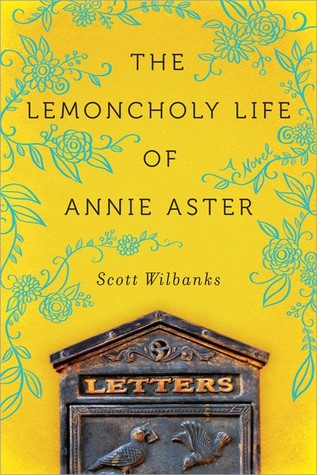
The Lemoncholy Life of Annie Aster by Scott Wilbanks

Annabelle Aster doesn’t bow to convention—not even that of space and time—which makes the 1890s Kansas wheat field that has appeared in her modern-day San Francisco garden easy to accept. Even more peculiar is Elsbeth, the truculent schoolmarm who sends Annie letters through the mysterious brass mailbox perched on the picket fence that now divides their two worlds.
Annie and Elsbeth’s search for an explanation to the hiccup in the universe linking their homes leads to an unsettling discovery—and potential disaster for both of them. Together they must solve the mystery of what connects them before one of them is convicted of a murder that has yet to happen…and yet somehow already did.
Goodreads description

Last week as part of the Magic Realism Bloghop I interviewed Scott Wilbanks, author of The Lemoncholy Life of Annie Aster.  If you haven't already done so, do read the interview here: http://magic-realism-books.blogspot.com/2015/07/interview-with-scott-wilbanks.html.  As you can see from the interview Scott has a quirky sense of humour. This also appears in his novel. In his interview Scott talks about what he considers to be magic realism. In this book the magic comes from time travel. Time travel arguably is a magic realism subgenre (or should that be sub subgenre?) with Audrey Niffenegger's Time Traveller's Wife appearing second in a list of 100 favourite magic realist books on Goodreads (between One Hundred Years of Solitude and House of Spirits.

There is another interview with the author at the back of the book, which includes an explanation of the title. It turns out that lemoncholy is a real Victorian word meaning melancholy. I am not sure that I would describe Annie's life as melancholy. She seems a pretty self-sufficient and emotionally resilient to me, making the most of a bad hand in life. And she has the lovely Christian as her best friend, a vulnerable but emotionally generous young man. Annie attracts a group of loners and misfits around her as allies in her quest to defeat the evil Mr Culler. Most of them are very well drawn, the exception is Annie's love interest, Nathaniel (but that may only be in the context of the others). One criticism/suggestion I might make is that even where you have a character, such as Cap'n or Edmond, who has shadows in the past they side with Annie too easily, without too much of a struggle. I was waiting for a crisis of some kind, even a betrayal, but they never came. This means that the dramatic tension was mainly generated by the actions of the baddies - Culler and his associate Danyer. Culler is an arch villain - pyschopathic without any redeeming feature. There is a plot twist at the end of the book about Danyer which I will not reveal, but let me just say that I didn't see it coming. 

The other generator of tension is around trying to work out what the consequence of Annie interfering with the past will be. Scott Wilbanks is obviously having fun with the concept and plot possibilities created by time traveller. If anything he has too much fun with the concept and the characters. I felt that he could achieved more with less. Nevertheless this is a fun take on time travel with a feisty heroine and some excellent supporting characters. 

I received a free copy of this novel from the publisher in return for a fair review.


Friday, 31 July 2015

Interview with Scott Wilbanks


Next week I will be reviewing The Lemoncholy Life of Annie Aster but this week I am interviewing the book's author Scott Wilbanks.

1. Who are your favourite magic realist authors and why?

Thanks for interviewing me, Zoe.  And try not to chuckle too hard at my responses. (Eye rolls are optional.)

Many will think I’m off my rocker for including him on the magical realism shelf, but A.A. Milne would have to be at the top of my list, primarily because his protagonist embodies our greatest virtue—humanity—and yet he is not human. He’s a teddy bear, a living, breathing instructional guide who teaches us how to live in the present with his philosophy of innocence. And while he lacks a beating heart, he is the more alive than anyone I know.

2. What is your all-time favourite magic realist book?


And that would be The Complete Tales of Winnie-The-Pooh, not only for the reason I listed above, but because—for me, at least—it is a time-travel portal.  (And you know how I love time-travel portals.) I don’t merely read the book, I dream it.  


And when I dream, I relive the charms of my childhood. Of those books I’ve read with an adult audience in mind, I’d have to say Erin Morgenstern’s The Night Circus has come the closest to duplicating the wakeful dream state I experienced with Winnie The Pooh. I didn’t even bother to close the book cover when I’d finished it, and simply flipped back to the first page to start all over again.

3. Can you give us your definition of magic realism?

I learned from the onset that defining magical realism is a slippery endeavor. Everyone seems to have an opinion, and no two are alike. I’m not even sure it can be defined—concretely, anyway.  If forced, I’d simply say that it involves any artistic enterprise in which fantastical elements seep into an otherwise realistic world. 


And while I may have trouble defining it, I do have a tried-and-true barometer. It’s anything within the arts containing fantastical elements that sneaks under my mom’s radar. I’m not kidding.

She’s a realist to the core who doesn’t simply dislike fantasy, she has a deep-down-in-the-bones loathing for it. She wants the world within any literature she reads to be rational, and her range is… narrow. If a novel containing any sort of fantastical element passes her sniff test, it’ll be magically realistic.

4. Why do you write magical realism?

Strangely enough, it all goes back to Tolkien. He’s the reason I became a book-a-day nerd by the age of fourteen—all of it sci fi and fantasy—while simultaneously fuelling my outside-the-lines imagination.

It was inevitable, then, that fantasy would inevitably splatter all over the page when I decided to try my hand at writing. It presented a challenge, however. I wanted my mom to read whatever it was that I wrote so I decided to infuse the magic in a world with trees and people and sounds she’d understand.

5. Tell us about your latest magic realist book?

My current work-in-progress recounts the misadventures of a young, Southern man who is burdened with the world’s only confirmed case of chronic, incurable naiveté—the result of a curious subtype of ADD and a lightning strike at the age of four.  A veritable magnet for con artists, he is reduced to becoming a shut in and a night owl.


Thank you, Scott.

Scott's online/social media links are:

Twitter: @scottbwilbanks


Thursday, 30 July 2015

Magic Realism Videos - Lois Zamora

This post is part of the Magic Realism Bloghop 2015. It is also the first in a new series of blog posts that I am planning for this blog. Every weekend over the next year I plan to bring you a video about magic realism.


My aim is to comb You Tube and other sites to find a wide variety of videos that will expand your understanding of the genre. Some will be interviews with magic realist writers, some writer profiles, some animations of magic realist fiction and some will be academic lectures. We start the series with an excellent example of the latter.

The University of Houston has made available online (in this case on You Tube - but it is also available on the University's own website) a course delivered by magic-realism specialist Professor Lois Zamora. There are 25 (yes 25) lectures on the course. The course title is Contemporary Literature - Magic Realism. The focus is on a number of key magic realist books: One Hundred Years of Solitude (Garcia Marquez), Labyrinths (Borges), The Kingdom of this World (Carpentier), Tracks (Erdrich), Ceremony (Silko) and The House of Spirits (Allende). But it also touches on magic realism in art and its influence on the concept of magical realism in literature.

Magical Realism: Theory, History, Community by Professor Zamora and Wendy B. Ferris is the classic textbook on the subject. So these videos are the perfect way to study the genre.

I have included videos number one (above) and two (below), which focus on What is Magical Realism.


You can view the other lectures here: http://freevideolectures.com/Course/2608/The-Contemporary-Novel-Magical-Realism/

Summary of lecture contents:
Lectures 3, 4 and 25 - The Art Historical Beginnings of Magical Realism
Lectures 5, 6, 7, 8 and the first half of 9 - Gabriel Garcia Marquez
Lectures Second half of 9, 10, 11, 12, 13 - Jorge Luis Borges
Lectures 14, 15, 16 - Alejo Carpentier
Lectures 17, 18, 19 - Louise Erdrich
Lectures 20, 21 and beginning of 22 - Leslie Marmon Silko
Lectures 22, 23, 24 - Isabel Allende and Magical Feminism


Tuesday, 28 July 2015

The Autumn of the Patriarch by Gabriel Garcia Marquez

Gabriel Garcia Marquez, renowned as a master of magical realism, creates stories that grip the imagination. Set in exotic locals, peoples with unforgettable characters, and crafted with exquisite prose, his stories transport the reader to a world that is at once fanciful and real.

One of Gabriel Garcia Marquez's most intricate and ambitious works, The Autumn of the Patriarch is a brilliant tale of a Caribbean tyrant and the corruption of power. Employing an innovative, dreamlike style, the novel is overflowing with symbolic descriptions as it vividly portrays the dying tyrant caught in the prison of his own dictatorship. From charity to deceit, benevolence to violence, fear of God to extreme cruelty, the dictator embodies at once the best and the worst of human nature.

Goodreads description

This novel by the great Gabo himself comes with a reputation for being hard work and dark. And to be sure The Autumn of the Patriarch deals with the darkest of subjects - inside the mind of a psychopathic dictator. So I was nervous as I settled down to read this book in advance of this review. I needen't have worried. Afterall this is a book by the master.

First of all I had to develop a new way of approaching reading the book. The Autumn of the Patriarch is made up of six huge chapters, each consisting of one paragraph. Sentences can go on for pages and are divided almost exclusively with commas (the semicolon is discarded). And within these sentences the narrative voice can shift from the Patriarch's to another character to the general mass of the Patriarch's subjects like a Greek chorus without either punctuation or formating signposting. 

Clearly you cannot read this book anywhere where you will be interrupted, but even so I soon found myself relaxing into the book and not worrying when I lost sense of who was speaking. There is a reason for that - the subject of the entire narration is the omnipresent Patriarch. The nation is an extension of the Patriarch. Or at least that is how he sees the world - he is totally self-centred - and it is one reason that The Autumn of the Patriarch is a "poem on the solitude of power" as Garcia Marquez has described it. 

It is a tribute to the author's genius that I found myself at times feeling sympathy for the monstrous Patriarch. He is a man who cannot feel love. He is also a man for whom the power he seeks and clings too brings no joy:
but he learned to live with those and all the miseries of glory as he discovered in the course of his uncountable years that a lie is more comfortable than doubt, more useful than love, more lasting than truth, he had arrived without surprise at the ignominious fiction of commanding without power, of
being exalted without glory and of being obeyed without authority.

The book opens with the people he rules breaking in to the palace to find his body. They cannot believe that he has died: afterall he has already died once. That first death was when the Patriarch's double is killed and he watches his subjects' response to his "death" - some grieving, some celebrating. When he reappears he takes typically brutal action against the latter. So it is not surprising that his subjects are cautious when he dies a second time. He has magically lived longer than a normal mortal. Can he die?

The book focuses on the Patriarch after his first death, in the autumn of his years to his end. Of course the book moves backwards and forwards in time without warning, as you would expect, but a portrait of the old man evolves as layer upon layer of story are applied. The story is at times grotesque (but no more grotesque than reality, as the stories of dictators like Idi Amin or Caligula or Pinochet show us). The cruelty of the Patriarch is likewise all too true to life. People are tortured, killed and disposed of. The shocking fate of several thousand innocent children, whose only crime was to have drawn the numbers of the lottery that the Patriarch always won, is perhaps the hardest to take. 
At the same time there is a crude gallows humour about the book, which at once relieves and heightens the horror. Some of that humour comes from the Patriarch himself: 
the day shit is worth money, poor people will be born without an asshole. 

The book reveals that the Patriarch came from a poor background, and there may have been a time when he had some sympathy for the underclass. He is set up by the British as a puppet and then they abandon him and the island. He doesn't use their departure to restore the island's fortunes but to plunder them as the British did. Towards the end of the book we learn that the Americans too have exploited the country and brought it so much into debt that they demand and get the sea surrounding the island in payment. This is magic realism as political comment as well as an exploration of the psychology of the individual. 

This is an amazing book. Whether it is a pleasurable read is another matter.


This review is my first contribution to the Magic Realism Bloghop 2015. I am planning two more posts on this blog and there are plenty more posts on the hop to be enjoyed (see below).


Wednesday, 22 July 2015

The Catalain Book of Secrets by Jessica Lourey


Faith Falls is a snug little Minnesota town constructed over a mystery, a place where the most impressive building is a gorgeous Queen Anne with turrets, cantilevered gables, and a wraparound porch. In a concealed room beneath the twisting stairs of the Queen Anne lies the Catalain Book of Secrets, the repository of the wisdom the Catalain women have gathered since the beginning of time.

Ursula Catalain, current keeper of the Book of Secrets, is content to concoct spells in her garden cottage until the ghost of the man she murdered when she was 12 appears at her door in a new form. His return pulls Jasmine, Ursula's daughter, back into the fold. Once believed to be the most powerful of the Catalains, she foreswore her gift years before to bury a shameful secret. The ghost of the murdered man also calls home Katrine, Jasmine's sister, who has been banished for fourteen years. Finally able to return to Faith Falls and the beloved Queen Anne, Katrine must claim her true Catalain power to save her mother and sister from the dark family curse.


Told in a majestic mosaic of strong women’s voices, The Catalain Book of Secrets weaves together alchemy, hope, tragedy, and true love to spin a tale in the style of Garden Spells, Eva Luna, and Practical Magic.
Extract from the Goodreads description
The description makes major claims: a book that is in the style of Garden Spells (by Sarah Addison Lee), Eva Luna (Isabel Allende) and Practical Magic (Alice Hoffman). The trouble is that whilst all three of these books are magic realist books with strong female characters they are very different and appeal to different readerships. Of these readerships I think the Addison Lee crowd are the ones who are going to have most problems - with the rape that forms a major plot element in the book and with Ursula's sexual promiscuity. You know that I do not have a problem with grittiness in a story (it's one of the reasons I like Alice Hoffman) but others will and I don't understand why you would invite Addison Lee readers to buy the book.

So what did I make of The Catalain Book of Secrets? There is a lot of magic in this book - all the Catalain women are witches and each has a different form of magic. One makes magic food, one brews potions in the garden shed, one makes magic sweets, one sees people's potential, another their emotional wounds... Usually in magic-realist books (particularly of this type) the central characters will have one form of magic. Add to this that the Catalain witches are fighting a demon and I begin to wonder if this is close to being urban fantasy or something similar. 

A main theme of the book is that of sisterhood both in the literal sense but also in the sense of the sisterhood of women in the face of violent men. As the Catalain Book of Secrets says:
Nothing multiplies your power like a sister.   
 And the converse is also the case: what weakens women's power are secrets kept from one another, silence in the face of male abuse, and the rivalry and tensions we feel for one another. When the Catalain women act on their own, they are too weak  to take on the male demon, but when all seven act together...

The mother/daughter relationship is also explored with both Ursula and Jasmine trying not to be like their mothers and making different mistakes. As a mother and a daughter that theme rings very true to me.

This is a more demanding book than those by Addison Lee and similar cosy magic realism writers. Not only because you are made to think, but also because of the narrative style. The book is written from the points of view of the main characters and moves between them. There is also some movement in the time settings. This does have the effect of slowing the book a bit as we get up to pace with the different characters, but after a while the story really kicks off. The author's slightly poetic style of description also might slow things for some people, but I enjoyed her turns of phrase - there are some particularly good descriptions of taste as you might expect given the food magic. 

I understand that this is Jessica Lourey's first magic-realist book and one which she used crowdfunding to publish - she already has a successful career as a writer of mysteries. I am fascinated to find out why she decided to diversify into magic realism and will be interested to see what she produces next.

I recieved a free review copy from the author in return for a fair review.

Wednesday, 15 July 2015

Wylding Hall by Elizabeth Hand


When the young members of a British acid-folk band are compelled by their manager to record their unique music, they hole up at Wylding Hall, an ancient country house with dark secrets. There they create the album that will make their reputation, but at a terrifying cost: Julian Blake, the group’s lead singer, disappears within the mansion and is never seen or heard from again.

Now, years later, the surviving musicians, along with their friends and lovers—including a psychic, a photographer, and the band’s manager—meet with a young documentary filmmaker to tell their own versions of what happened that summer. But whose story is true? And what really happened to Julian Blake?

Goodreads description

Can a ghost story be magic realism? And if not, why not? 

This book rang a lot of bells for me. I spent my teenage years listening to Fairport Convention, Pentangle, and Led Zeppelin. I was into ancient British customs and mythology (especially Celtic legends), wore Celtic crosses, Indian cotton blouses and layered skirts, I even had the ubiquitous Afghan coat which smelled when it rained.  The posters that lined my bedroom wall were of Tolkien's Lord of the Rings (if you are over 50 you will know the one I am referring to) and sensitive poetic lead singers. Oh yes, I would have been a fan of Julian Blake and band. Elizabeth Hand is of my generation and I guess that she too was into the same things as I. She certainly knows how to conjure up the atmosphere of the time. 

This realism is added to by the narrative style - a series of short chapters each part of an interview with one of the surviving characters. These build to create a picture of the events of that summer. It took me a little while to form an image of the characters and to hear their voices, but they are generally well-drawn and distinct and so I soon settled back into the story. 

Other aspects of the story are more predictable, indeed regular, parts of any ghost story:  a tumbledown labyrinthine abandoned manor house, strange local customs, the locals coming out with cryptic comments which give the impression that they know something of the hall's dark secrets but aren't saying, and even a naive bunch of teenagers fascinated with the occult. I had the added insight that I know enough about the traditions and myths referenced by the book to see where things were heading. With the exception of one sentence (which I will not reveal to avoid spoiling the book for you) I was not surprised by the climax of the story, however that did not worry me or dent my enjoyment.

All of which brings me back to my opening questions? I think the answer to the first question is yes, ghost stories can be magic realism. And to the second: why can't they? Just because these are British traditions and beliefs and not those of Latin Americans or any other ethnic group, why are they not acceptable as magic in the magic realist sense? It is precisely because ghost stories are moored in a deep British collective subconscious that they work so well. 

You will note that I say ghost stories can be magic realism and not that they all are. Wylding Hall certainly is magic realism as far as I am concerned. This is because of the realism in the book, which is partly down the way the narrative works. The voices are real. They also differ in their interpretation and even in their accounts. There is an ambiguity about the conclusion to the story and how the characters feel about Julian. I would go so far as to say that despite the ghost story/horror set-up the book isn't actually about what really happened to Julian. For this reason the predictability I refered to earlier does not matter. For me the book is about the dynamic of the group and their relationship with the missing man, the way they are still trying to come to terms with and explain not only Julian's disappearance but also with him their ability to regain the magic of the music generated in the sessions at Wylding Hall. 

I really enjoyed this book and thank Open Road Media for granting me a copy of the book free in return for a fair review.


Wednesday, 8 July 2015

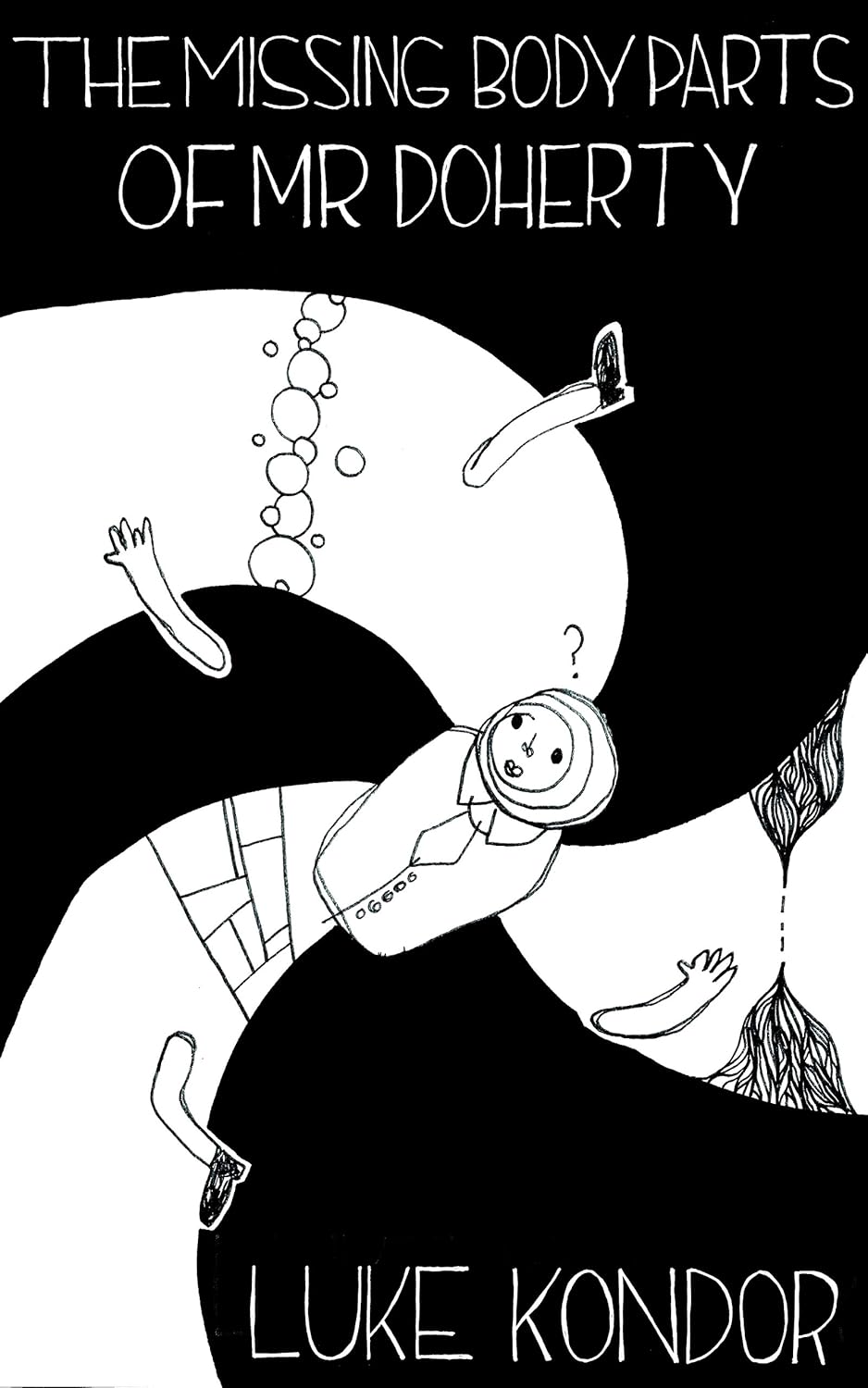
The Missing Body Parts of Mr Doherty by Luke Kondor


Every day Paddy Doherty wakes up to find another body part missing. Before he disappears completely, he wants to leave something of value in the world - a detailed guide on finding love.
 Amazon description

In Gogol's short story the main character loses a nose, in Luke Kondor's short story (some 50 pages long) the losses start with an arm and just carry on happening. Kondor's book is therefore in the tradition of surreal European magic realism, that includes Gogol, Kafka and Bulgakov.

The story is narrated in the first-person by Paddy Doherty himself. He proves to be a witty and it turns out a none-too-reliable narrator.  His guide to the sixteen ways to a girl's heart turns into an account of his life and relationships, which it emerges haven't been very successful. Doherty's accounts are laugh-out-loud amusing at time, his narration has a habit of subverting itself when it is getting too serious:

I couldn't tell you exactly what happened, but I felt like I experienced what some people refer to as the Aleph - a point where everything, the whole universe is contained - or it could've been the dodgy falafel I'd eaten. 

This is just one example from the book of how Kondor's writing works on several levels. The comment about the Aleph, I am sure, references the short story by Coehlo. And how about this:

And then I saw a man in the street doing a handstand, he reminded me of an old friend. I tried to applaud him, because I was clapping with one hand - the right one. 

The image of the man doing a handstand returns late on in the story by the way. 

So why is Paddy disappearing piece by piece? The doctor has a theory: that Paddy has never given himself to something completely, so his body is giving itself with or without his permission. Maybe the answer is to give heart to someone or something. Or maybe the theory is bullshit, as Paddy says to the medic. I hope it isn't.


Monday, 6 July 2015

2015 Magic Realism Blog Hop Sign Up


Calling all bloggers!

Last year as part of our Magic Realism Blog Hop we had 25 posts about magic realism spread over a wide variety of blogs and it was fascinating. If you are interested in taking part this year, please sign up below.

All you have to do to take part is write a post about any aspect of magic realism on your blog and programme it to appear on one of the three days. I will provide you with some code to put at the bottom of the post which will automatically generate a list of other posts on the hop. And I will email you with instructions and will help if you have any problems (most people don't).

If you want to get an idea of what you might write: here's the link to the first post in last year's hop: http://magic-realism-books.blogspot.com/p/useful-resources-about-magic-realism.html 
The links to all the posts on the hop are at the bottom of that post, hop around the blogs and see what people wrote about last year.

And if you like the idea click on the button below to add your blog to the list for this year (at the bottom of this post).

Please do copy the bloghop logo above and feature it on your blog to advertise the hop to your readers.

Any questions, just email me on zoe.brooks@googlemail.com


Wednesday, 1 July 2015

Alburquerque by Rudolfo Anaya


Abrán González always knew he was different. Called a coyote because of his fair skin, the kid from Barelas found escape through boxing and became one of the youngest Golden Gloves champions. But the arrival of a letter from a dying woman turns his entire life into a lie. The revelation that he was adopted makes him feel like an orphan and sends him on a quest to find his birth father.

With the help of his girlfriend, Lucinda, and Joe, a Vietnam veteran, Abrán begins a journey that hurls him from the barrio into a world of greed and political corruption spearheaded by Frank Dominic, a con artist running for mayor with visions of building El Dorado on the Rio Grande.

Rudolfo Anaya’s vibrant novel celebrates a land and a people struggling to preserve and reshape ancient tradition. Rich in spirituality and sense of place, Alburquerque cuts across class and ethnic lines to tell a story of hope and displacement, love and regret, and the age-old quest for roots, identity, and family.

Publisher's description

This is one of nine of Anaya's books republished as ebooks by Open Road Media. Anaya is best known for his novel Bless Me, Ultima, which I reviewed on this blog here. Open Road are to be applauded for bringing more books by this Chicano magic-realist author back into circulation and I welcome the opportunity to read and review his work again

The book's themes are familiar ones - a young man trying to find out who he is, corporate and political corruption and abuse of the environment, a love interest, the contrast between the old ways of local peoples and the new ways of the white population. These are all themes we have seen in other magic-realist books. I was reminded of Ceremony by Leslie Marmon Silko in particular, which also features a native American Vietnam veteran. 

Magic is definitely present, coming with a prescient traditional healer or curendara. The curendara at the beginning of the book gives Abran the answer to his question "tú eres tú" or you are you, but it takes him the length of a book to understand what she is saying. Ultima in Anaya's previous novel is also a curendara. This female archetype also appears in one of my favourite Chicano magic-realist novels The Hummingbird's Daughter.  The second form of magic realism in the book is the way the characters of the novelist Ben Chavez have a life of their own. Many writers will tell you that their characters talk to them, well in this case they really do. And the last element of magic realism is the appearance of the Coyote figure from indigenous American tribal mythology. All of these elements work well.

It is perhaps the realism I have a problem with. There are times where it feels unreal, too much in the mode of popular culture, particularly at the end  - the book climaxes with a boxing match a la Rocky Bilboa. The Hollywood treatment is popular but it is unrealistic.

I would have liked the characters to be less black and white, more complex and ambiguous. Looking back at my review of Bless Me, Ultima I realise it was an issue I had with that book too. The most important theme in the book to my mind is the importance of knowing one's roots. Does it matter? And where are your roots? Are they in the genes or are they learned? This question not only relates to Abran's relationship with his adoptive parents and his genetic ones, but also to the story's villain, Frank Dominic, who has reinvented himself. By making Frank Dominic a black-hat baddie, Anaya misses a chance to develop the theme. Neverthless it is a tribute to the book that I am thinking about the question.

I missed this book when it appeared and I am grateful to Open Media for contacting me about it. I received a free copy in return for a fair review.


Wednesday, 24 June 2015

The Puppet Turners of Narrow Interior by Stephanie Hammer


Just down the road from John Crowley’s characters is the town of Narrow Interior, the setting for Stephanie Hammer’s fable-ous first novel of secrets and heritage. Henry, the youngest son of a hotel magnate, is sent to calm the inhabitants as the hoteliers set about to despoil this odd byway. Instead, aided by his black sheep cousin and a cast of quirky characters, including Quirk, Henry sets out to discover the town secrets. The more he learns, the darker his mission appears, until Henry must choose if he is willing to risk all.
Goodreads description

The Puppet Turners of Narrow Interior has much in common with Magic America (see my last review). It starts with magic realism as the world seen through the eyes of a child; it features a fight against American big business whose plans are endangering a community; it even has a magic realist tattoo! But in many ways it is very different. In contrast to Magic America the frequency of magic increases through the course of the book, so much so that the book moves away from magic realism towards fantasy à la Neil Gaiman. 

The book can be categorized in many ways - there is a strong streak of humour and satire here, which had me chuckling at times; there are a lot of references to classic philosophers and writers (including Schiller and Goethe as talking condiment pots), legends (Parsifal and the Fisher King anyone?) and then there's surrealism (I was reminded of Leonora Carrington's writing at times). In fact there is so much going on and Stephanie Hammer is having so much fun in writing the story that sometimes I felt the book failed to deliver completely on its promise(s). But then how could it?

I personally was interested in the puppets strand, which disappointed as did the religious backstory to the community of Narrow Interior.  The two elements are related and so much more could have been done with them. Puppet theatre has always had a relationship with religion and not just in Japan: marionette means little Maria and the shadow puppets of South Asian portray tales from the Mahabharata and Ramayana. I worked for several years as the manager of the Puppet Centre of Great Britain and in that capacity saw the power and magic of puppets, nowhere more evident than in the ancient Japanese art of Bunraku, which the novel draws from, but doesn't explore.

The book could have been simply a book of ideas, but the characterization is strong and amusing. We engage with Henry from the get-go and even as he decides to hide his character (So, I become secret. I study unspecialness and silence. While most people in American work to develop ersatz talents, individualistic quirks, and even the occasional eccentricity, I let mediocrity shine like a beacon of nothingness. A black hole of personality.) we empathize and yearn for the real Henry to reappear.  But again I felt that the author engaged our interests in certain characters (most notably Quirk and the old man Olsen) only to let them drop. 

So, in conclusion, what did I make of this book? I enjoyed it, it is a fun and interesting read, but I don't think it is magic realism.

I received this book from the publisher in return for a fair review.


Friday, 19 June 2015

Magic America by C E Medford

Hope lives in an alternative Trenton, New Jersey of the 1980s where radioactive cats, congenital tattoos, biker angels, cocky fairy godmothers and the determination to survive another day are all that stand between her family and the creeping chemical forces of LoboChem, a manufacturer willing to destroy all that is beautiful for the sake of a profit.

Magic America is a story about coming of age in fluorescent, urbo-suburban, magic-realism America. Dust off your Wigwams and your high-tops, your banana clips and Aquanet, for a trip through the streets and skies of a Garden State where love triumphs over fear, faith is what you die with and family is who you ride with.

Goodreads description

Magic America is a fascinating take on magic realism. Set in urban blue-collar America, it reminded me of the magic realism of Paul Magrs, which is set in a similar setting in an northern British city. The two writers show that magic realism can work in the portrayal of the white working class. The magic in the book comes without comment - that's just the way it is in magic America. There's a baby who inherits congenital tattoos from his biker father, and a fairy godmother with attitude appears when Hope needs her and sometimes when she doesn't want her to.

Central to the book is the issue of abuse of the environment by LoboChem, which is poisoning Hope's world and community. As I have observed elsewhere in this blog an environmental theme often features in modern magic realism. C.E. Medford's approach is a interesting one. The reader is not always clear whether something strange is magic realism or whether it is the product of the poisoning of the environment or genetic alteration. This ambiguity is enhanced by the use of first-person narration. Hope is still young when the book opens and we see the world through her eyes. A child's eyes see magic in the world and young Hope is no different. As Hope matures through the book, some things are given realistic explanations and some remain magic.

The author's style of writing is likewise a mixture of realism (sometimes gritty) and poetic prose and it works really well. If I were to criticize, I found the transitions between the different periods in Hope's life jolted and these narrative stutters did not stop me enjoying the book. Chronological transitions can be a problem with coming-of-age stories, one which I am familiar with as an author. Nevertheless I identified with Hope and her extended family of oddballs and was on their side in their battle against evil big business which has stitched up local politics and economics. This is as much magic realism of the oppressed as any novel set in South America.

I received this book free from the author in return for a fair review.

Thursday, 18 June 2015

Interview with Lily Iona MacKenzie

1. Who are your favourite magic realist authors and why?

I’m attracted to a wide range of magical realist styles, from Haruki Murakami, Kelly Link, Aimee Bender, Salman Rushdie, Italo Calvino, to Mikhail Bulgakov. But the Latin American authors first attracted me to this genre, and they’re the ones I frequently return to. I’ve read all of Gabriel Garcia Marquez’ work. So, too, with Chilean writer Roberto Bolano. Jorge Luis Borges is always a challenge. I’ve just discovered another Chilean writer, Alejando Zambra, who flirts with this style.  Carlos Fuentes. Mario Vargas Llosa.  Julio Cortázar How to stop! These writers aren’t afraid to wallow in unreality or to speculate on where the lines between realism and unrealism are drawn. If there is such a line, it’s constantly shifting, just as reality can’t be pinned down. Was that an ice cream cone I saw woman eating in a newspaper photo, or did it only have the appearance of a cone. Was it actually corn on the cob? It’s often difficult to pin down the difference between appearances and reality, which is why so many writers have focused on this theme whether they fit into the magical or realist vein.

2. What is your all-time favourite magic realist book?

Again, it’s difficult to pick just one favorite magical realist book because I’ve liked so many. One Hundred Years of Solitude still mesmerizes me. In that novel, Marquez not only portrays an important era in Colombia’s history, but he also creates a family that has mythic roots, and I think that’s one of the most successful aspects of this genre: while the quotidian is important, it doesn’t rule. There’s always a whiff of another layer to life. This happens in my currently favorite magical realist book, Andres Neuman’s Traveler of the Century. Where are we in Neuman’s world? We’re told it’s sometime in the 19th Century, somewhere between Saxony and Prussia, but in many respects the action could also could be happening today. It’s a philosophically and emotionally rich narrative that explores multiple layers of experience. 

3. Why do you write magic realism?

The shape shifting that often happens in such novels seems psychologically true to me. For example, in my soon-to-be published novel Fling!, when my grandmother’s ashes resurrect and she appears after being dead for 70 years, it couldn’t be true literally. Though most Christians would disagree, and perhaps those who believe in reincarnation, the dead don’t come back to life. However, the dead are constantly appearing in our dreams, in our thoughts, in our inherited behavior. So while the thing being described may not exist in our physical sense of reality, it does when it’s viewed as a metaphor. It’s as if people can return from the dead. I also like to write magical realism because it allows my imagination to explore images and ideas that aren’t confined to everyday life. While I love most everything about our commonplace world, I also have a strong sense that other realities exist simultaneously. This genre helps me to investigate that possibility.

4. Can you give us your definition of magic realism? 

I’ve probably already partially covered my definition in my previous responses, but I’ll try to embellish. My view of the world is pantheistic. Everything seems alive with what some people might call the divine, though I find that term too limiting. I think magic actually comes closer to what I mean in the sense that as children, we view the world as an enchanted place. In most developed countries, especially, we are taught to dismiss such beliefs and become more realistic as adults. I’ll give a personal example. I grew up in Calgary where the winters were very cold. One of the beauties of that weather, though, was that Jack Frost visited and left amazing designs on the windows. But when I was five, my Scottish schoolmaster grandpa told me there was no such thing as Jack Frost (or Santa Claus). Of course, I didn’t believe him. I still don’t! But I think magical realism retains elements of this enchantment with our world and those who write it are trying to recapture for their readers that dimension. It’s a way of viewing life through a different lens than what realism offers. Different rules exist, allowing the writer to break out of realism’s limitations.  

5. Tell us about your latest magic realist book?

With my Scottish background on my mother’s side, I grew up hearing her talk about the Scots having a sixth sense and was accustomed to the idea that surreal things can happen. She came out of a Celtic tradition where people believe there are certain times of year when the strict boundaries between the living and dead become less firm. The Celtic New Year, November 1, is one of those periods and is also known as All Soul’s Day, our American version being Halloween. I mention this because in my novel Fling!, to be published in July, 90 year-old Bubbles and her daughter Feather’s long-dead ancestors appear. Alternating narratives weave together Bubbles and Feather’s odyssey with their colorful ancestors, creating a family tapestry. The “now” thread presents the two women as they travel south from Canada to San Francisco and then Mexico, covering a span of about six months. “Now” and “then” merge in Mexico when Bubbles’ mother, grandmother, and grandfather turn up, enlivening the narrative with their antics. In Mexico, the land where reality and magic co-exist, Feather gets a new sense of her mother. The Indian villagers mistake Bubbles for a well-known rain goddess, praying for her to bring rain so their land will thrive again. Feather, who’s been seeking “The Goddess” for years, eventually realizes what she’s overlooked.

Thank you, Lily, for a fascinating interview. 

You can find Lily's blog here: https://lilyionamackenzie.wordpress.com/


Thursday, 11 June 2015

The Carpenter's Pencil by Manuel Rivas


It is the summer of 1936, the early months of the agonising civil war that engulfs Spain and shakes the rest of the world. In a prison in the pilgrim city of Santiago de Compostela, an artist sketches the famous porch of the cathedral, the Portico da Gloria. He uses a carpenter's pencil. But instead of reproducing the sculptured faces of the prophets and elders, he draws the faces of his fellow Republican prisoners.

Many years later in post-Franco Spain, a survivor of that period, Doctor Daniel da Barca, returns from exile to his native Galicia, and the threads of past memories begin to be woven together. This poetic and moving novel conveys the horror and savagery of the tragedy that divided Spain, and the experiences of the men and women who lived through it. Yet in the process, it also relates one of the most beautiful love stories imaginable.
  

Goodreads description

I have a fellow member of the Magic Realism Books Facebook group to thank for introducing me to Manuel Rivas and this book in particular. So thank you, Ekaterina Volkova, you have introduced me to a writer whose work I will now search out. On the basis of this book alone Manuel Rivas has become one of my favourite authors. As I read The Carpenter's Pencil I was reminded of Andrei Makine, whose work , although not magic realism, has the same poetry and humanity.

This is a sublimely beautiful book about a very ugly period in European history. In the hands of a lesser writer that might have meant that the brutal ugliness of the Spanish Civil War and Franco's suppression of the left-wing opposition would have been veneered over, but on the contrary the beauty and poetry acts as a ray of light illuminating the dark corners.

Nor is the book simplistic in its portrayal of those involved on both sides of the conflict. There are two main characters - Doctor Daniel da Barca and the prison guard, Herbal, through whose eyes we mostly see the doctor. Herbal is shown as a complex and conflicted character, at once fascinated by the doctor and at the same time hating him, at times his persecutor and betrayer and at others his protector. The use of Herbal as the main means for transmitting da Barca's story at once distances and mythologizes it. The doctor is portrayed almost as a religious prophet with divine protection like the biblical character he is named after. Da Barca's comments to his fellow prisoners on illness and life, which Herbal reports to his superiors as indications of the threat the doctor offers, can be read as more simply an educated man's thoughts being misinterpreted by an uneducated one. Or are they?

The narrative structure, especially at the beginning, moves backwards and forwards through time and from one viewpoint to another. This further disorientates the reader. In addition the magic comes not from da Barca's activities but from Herbal. Early in the book in a short and shocking chapter Herbal blows the top off the head of an artist. The pencil in the title is one used by the artist to draw a church porch in which the heads of the prophets are replaced by the heads of his fellow political prisoners (another biblical reference). Herbal takes the pencil as a keepsake, but finds when he puts it behind his ear that the artist has conversations with him about art and Da Barca.

Even when Herbal is recounting the doctor's story directly to a young prostitute in a brothel his words are full of poetry - not overblown poetry but simple and powerful poetical phrases that evoke atmosphere and emotions perfectly:

Pepe Sanchez was shot one rainy dawn in the autumn of '38. The day before, all the words disappeared from the prison. Nothing was left of them but scraps in the seagulls' scream. The lament of a bolt being drawn. The gasps of the drains. And then Pepe burst into song.


The poetry is also reflected in the way certain images and phrases are woven through the story, evolving and taking on meaning as they go. At the end of the book I just wanted to go back to the beginning and start again.

Wednesday, 3 June 2015

Imaginary Things by Andrea Lochen


Watching children play and invent whimsical games of fantasy is one of life's great joys. But what if you could actually see your child's imagination as it unfolded? And what would you do if your child's imagination suddenly became dark and threatening?

Burned-out and broke, twenty-two-year-old single mother Anna Jennings moves to her grandparents' rural home for the summer with her four-year-old son, David. The sudden appearance of shadowy dinosaurs forces Anna to admit that either she's lost her mind or she can actually see her son's active imagination. Frightened for David's safety, Anna struggles to learn the rules of this bizarre phenomenon and how best to protect him. But what she uncovers along the way is completely unexpected: revelations about what her son's imaginary friends truly represent and dark secrets about her own childhood imaginary friend.

Living next door is Jamie Presswood, Anna's childhood friend who's grown much more handsome and hardened than the boy she once knew. But past regrets and their messy lives are making the rekindling of their complex friendship prove easier said than done. Between imaginary creatures stalking her son and a tumultuous relationship with David's biological father, Anna may find it impossible to have room in her life or her heart for another man. But as David's visions become more threatening, Anna must learn to differentiate between which dangers are real and which are imagined, and whom she can truly trust.

Goodreads description

As you know I always put either the Goodreads or Amazon description at the beginning of my reviews. This is partly because I don't want my reviews to spend too much time recounting the story, but sometimes, as is the case here, I find myself at a loss as to what to write because the description has given so much away, too much in my opinion.

As you can tell from the description this is an example of psychological magic realism, by which I mean a story in which magic realism is used to make manifest the psychology of key characters. The best example of this that I have reviewed was The Tooth Fairy by Graham Joyce, in which an adolescent boy's burgeoning feelings are expressed via the tooth fairy. Here we have young David's need for prtotection expressed in two imaginary dinosaur friends. The magic realism comes because his mother, Anna, can also see them and the large black cat that symbolizes what David fears.

For me the book works best on this psychological level. Indeed the book is a psychological mystery: what is it that David fears and what is it that Anna is hiding from herself - she too had an important imaginary friend in her childhood whom she has chosen to forget about. I like psychological mysteries like this and as a mother I absolutely understood Anna's fears about how to respond to what was happening to her son literally before her eyes. In fact, although the book may seem to be about David's fears, it is equally if not more so about Anna's psychological journey.

Personally I could have done with less of the will-they, won't-they love story. But romance helps sell books. I also was able to foresee what danger the black cat symbolized, but that didn't diminish my enjoyment.

All in all this is an enjoyable book with an interesting central concept. I hope many women will read it for the romance and come away with more.

I received this book free from the publisher in return for a fair review

Wednesday, 27 May 2015

A Hungry God by Pia Chaudhuri


Aruna is born with an unusual gift, which despite its extreme significance, leaves her with the ghastly side effect of burning red hot, and in turn causing her to soak everything she comes into contact with in rivers of sweat. 

Her mother despises her, the villagers fear her, and her new husband is repulsed by her. But when her marriage takes her to London, Aruna’s new life finally drives her to face up to her nature and carry out a deed she will always regret. 

Maya was abandoned by her mother at just six years old. When she makes an unexpected discovery as an adult, she questions the circumstances surrounding her disappearance for the first time. She leaves London and embarks on a journey of discovery to India, her ancestral homeland, to find the truth. 

While Aruna and Maya’s lives collide, weather patterns shift, an enchanted forest opens its heart, a sister appears only at night, dreams become messages, sacrifices are made, and an unusual gift is finally understood – ensuring the circle of life remains unbroken forever. 

Goodreads description

Pia Chaudhuri's A Hungry God is a book that shows that some really excellent new authors are using the self-publishing route to bring high quality fiction to the market. Pia is also a member of the Magic Realism Books Facebook Group. 

 As you will have realized  I really enjoyed this book, which is part of the strong tradition of magic realism that arises from the meeting of Indian and European cultures, and which is most exemplified by the books of Salman Rushdie. Chaudhuri's story moves from India to the UK and back again, and from the heat of South Asia to the cold winters of London. Heat, as you will have seen in the description above, is carried by Aruna within herself.  

The book focuses on two strong young women who grow up in two very different worlds and yet are strongly linked. I am unable to say more without giving away a key plot element. I am not sufficiently au fait with Indian mythology and the Hindu religion to put the magic element in context, but as a result of reading the book I want to learn more. And to my mind Pia Chaudhuri succeeds better than Chitra Banerjee Divakaruni does in The Mistress of Spices in creating credible magic in a realist setting.  

The realism is also very strong and the author is not afraid to tackle harsh subjects like domestic abuse. As I have said before on this blog it is the realism that makes magic realism work. 

An excellent first novel from a young author I will be watching with interest. 

I received this book free from the author in return for a fair review.

Wednesday, 20 May 2015

The Nose by Nikolai Gogol


"The Nose" is a satirical short story by Nikolai Gogol. Written between 1835 and 1836, it tells of a St. Petersburg official whose nose leaves his face and develops a life of its own.
Amazon description

Whilst in 1915 Gregor Samsa woke up to find he had been transformed into a monstrous bug, in 1836 Major Kovalyov woke to discover that he did not have a nose. Kafka's The Metamorphosis is often said to be the first piece of European magic realism, but Gogol's The Nose is every bit as magic realist. 

This is a delightful and witty short story with that very Russian sense of the surreal combined with satire, that one sees in Bulgakov's writings (Bulgakov was an admirer of Gogol's work). I could go into all sorts of linguistic and psychological analysis of the symbolism of a man losing his nose, or I probably could if I knew Russian. But I suspect that rather misses the point. As the story says: Nonsense really does occur in this world, and, sometimes, nonsense altogether without an element of plausibility.

Major Kovalyov clearly cares a lot about social status and appearances, with the result that the loss of his nose, which one suspects had been held in the air rather more than it merited, is a major blow (if you forgive the double pun). Things take an even more surreal turn when the Major encounters his nose dressed in the attire of a senior civil servant (of a higher grade than the Major's). 

As is the way in magic realism, there is no attempt at an explanation for the errant nose and in some ways the story drifts at the end, as Gogol starts to directly address the reader. An early version apparently revealed that the story was in fact a dream, but this resolution was abandoned by the author. I am glad that Gogol chose not to take this course - dream resolutions always seem something of a cop-out and the weirdness of the story works for me. It has worked for many other people as well, inspiring an opera by Shostokovich, various theatrical productions and the animated film (above) by Alexandre Alexeieff and Claire Parker, which uses pin-screen animation, probably one of the most time-consuming forms of film production ever invented, with over a million pins creating shadows on a white screen.

Wednesday, 13 May 2015

The Vorrh by Brian Catling


Prepare to lose yourself in the heady, mythical expanse of the Vorrh.

In B. Catling's twisting, poetic narrative, Bakelite robots lie broken - their hard shells cracked by human desire - and an inquisitive Cyclops waits for his keeper and guardian, growing in all directions. Beyond the colonial city of Essenwald lies the Vorrh, the forest which sucks souls and wipes minds. There, a writer heads out on a giddy mission to experience otherness, fallen angels observe humanity from afar, and two hunters - one carrying a bow carved from his lover, the other a charmed Lee-Enfield rifle - fight to the end.

Thousands of miles away, famed photographer Eadweard Muybridge attempts to capture the ultimate truth, as rifle heiress Sarah Winchester erects a house to protect her from the spirits of her gun's victims.

In the tradition of China Mieville, Michael Moorcock and Alasdair Gray, B. Catling's The Vorrh is literary dark fantasy which wilfully ignores boundaries, crossing over into surrealism, magic-realism, horror and steampunk.


Goodreads description

Okay, let's get one rather important thing out of the way first. This novel may be many things - steampunk, surrealism, horror, mythic fantasy, historical fantasy - but one thing it is not is magic realism. Magic realism is defined by its realistic context. Hence you can have any one of a number of realist genres, e.g. mystery, women's fiction, or historical fiction, and add an element of magic realism to it, but you can't add magic realism to fantasy. Yes, there are real historical characters, but that is not enough. 

Despite this and the fact that this blog is dedicated to magic realism I wanted to review the book anyway. This is partly because the claim to magic realism is made by the publishers in the product description and so some of you might pick it up under the impression that you are buying a magic realist book and partly because it is an ambitious and interesting book and one that might appeal to many who follow this blog.

If we are going to play the genre game, I suppose I would put this book on the mythic fiction shelf. To quote the Wikipedia entry on that genre: Mythic fiction is literature that is rooted in, inspired by, or that in some way draws from the themes, symbolism, myth, legend, folklore, fairy tales... Mythic fiction overlaps with urban fantasy and the terms are sometimes used interchangeably, but mythic fiction also includes contemporary works in non-urban settings. Mythic fiction refers to works of contemporary literature that often cross the divide between literary fiction and fantasy. 

As I read this large book (over 500 pages) I found myself reminded of two trilogies - The Gormenghast books by Mervyn Peake and His Dark Materials by Philip Pullman. Peake's works because of the strangeness of the characters and the evocation of place and Pullman's because of the way the mythic forest at the heart of the book is depicted as the Garden of Eden. No doubt were I more widely read in fantasy fiction other books and authors would have come to mind. It should perhaps be said that I had problems with both of these much-lauded works and so it should not be a surprise that I also had problems with The Vorrh. 

My responses were so mixed. I loved parts of it. The opening of Part One with the death of bowman's lover and the start of his journey was spectacular, moving and vivid. I enjoyed the book's mythic and archetypal nature. I admired its ambition. But the book was constantly switching from the story of one character and that of another, in a way that could be confusing and was frustrating. I kept thinking that the stories would all come together somehow and yet it didn't happen in some cases and I was left wondering why the author devoted so much time to characters that were not integral to the plot. The Vorrh is, I understand, the first book in a series, so maybe that is something that will be resolved over the course of the trilogy.

The author's writing style is as lush as the fabled forest. Sometimes it worked brilliantly and sometimes it had me shouting "What!" at the page. For example a doctor sits behind a Jurassic desk - what the hell is a Jurassic desk? And the author clearly does not believe in the principle of using adverbs and adjectives sparingly. Take this from the book's opening: The hotel was ponderous, grand, and encrusted with gloom. Its tall baroque rooms were grudgingly fortified by vicious light that desperately tried to penetrate the heavy curtains and starched formalities. After a while I stopped being distracted by the overblown style, but instead allowed myself to become absorbed in the story.

So, as you can see, I found this to be a curate's egg of a novel. Maybe the problem lies in me. Maybe the fact that I like realism with my magic made me less tolerant of this book. I don't know. I am glad I read it.

I received this novel free from the publisher via Edelweiss in return for a fair review.