Showing posts with label historical. Show all posts

Tuesday, 13 November 2018

Muscovy by Matthew Francis


Like his acclaimed Mandeville (2008), Matthew Francis's fourth Faber collection explores a world of marvels, real and fantastic. A man takes off for the moon in an engine drawn by geese, a poltergeist moves into a remote Welsh village, and a party of seventeenth-century Englishmen encounter the wonders of Russia - sledges, vodka, skating and Easter eggs. The scientist Robert Boyle basks in the newly discovered radiance of phosphorus (the noctiluca of the title) and the theme of light in darkness is taken up by the more personal poems in the book: phoneboxes, streetlamps, moonlight. 
Goodreads description

Another lovely poetry book for you. Not all the poems are magic realism, but most have that magic-realist sensibility that I have written about in the past. 

The collection opens with The Man in the Moon, an account of a trip to the moon powered by geese. It made me think of Calvino, although it is a based on a 17th century fantasy by Francis Godwin. Many of the poems in the collection are influenced by the past or by historical accounts. Some are realistic such as the title poem, which is based on an account by Andrew Marvell of an embassy to Russia. Others have a more supernatural  element e.g Corpse Candle and Familiar Spirit.  I have written before that historical novels (and poetry) that include the supernatural are presenting the world of the past realistically.

My favourite poem in the book is The Walker. It is a beautiful and subtle poem. It of course has a magic-realist angle, but also evokes its mountain setting accurately and in wonderful language:
And the sheep carried on, canted to one side,
    trotting on their adjustable legs

and the narrator's response to it:
I was an inkwash of myself, wet on wet, 
  among the limp vertebrae of ferns
  and the fuzz of bilberry. 
One stroke would smear me into a blur.

The natural eeriness sets the scene for the twist at the ending of the poem.

Wonderful stuff.


Sunday, 26 February 2017

The Bear and the Nightingale by Katherine Arden


'Frost-demons have no interest in mortal girls wed to mortal men. In the stories, they only come for the wild maiden.'

In a village at the edge of the wilderness of northern Russia, where the winds blow cold and the snow falls many months of the year, an elderly servant tells stories of sorcery, folklore and the Winter King to the children of the family, tales of old magic frowned upon by the church.

But for the young, wild Vasya these are far more than just stories. She alone can see the house spirits that guard her home, and sense the growing forces of dark magic in the woods...

Goodreads description


I read Katherine Arden's novel in my Czech house, while outside some ice crystals like diamonds glistened on the deep pristine snow and others lined the boughs like white daggers. This is a country in which the Slavic spirits of the lakes, trees, thresholds and household stoves, still feature in popular culture. At the mill a few miles from my home they will burn an effegy of the Winter Goddess, Morana, to chase away winter. 

The Bear and the Nightingale is set in medieval Russia when the old Slavic gods and spirits were still very much part of everyday life and beliefs and the Orthodox church struggled to wean its followers off their pagan beliefs. This battle is at the heart of the book. When the priest attempts to turn the people from honouring the spirits who protect them, he brings disaster on their houses. The heroine, Vasya, who not only honours the old ways but actually sees the spirits around her, must seek the help of the Winter King. This sort of cultural clash is the stuff of magic realism, but I am not sure I would describe this book as magic realist.

Over on the Magic Realism Books Facebook Group we were recently having one of our regular discussions about definitions and genre and this book is a good example of how difficult it is to pigeonhole a book. This is in a way a novel in three parts and genres. The first part is straight historical fiction, the second magic realism and the third - fantasy. It is perhaps best defined as fairytale.

Vasya's problems take a turn for the worse when her father remarries and introduces a stepmother, who like Vasya can see the household spirits but unlike Vasya believes them to be devils. The stepmother character, although a fairytale archetype, is treated with understanding and indeed sympathy, and shown to be a victim of a society in which women are treated as no more than brood mares by their relatives, to be traded and married off without any say in the matter. Vasya is potentially also a victim of the same prejudice, but she is the wild girl of the description, both more modern and more pagan.

One of the strengths of the novel is Arden's writing, which is powerful and poetic. The story builds slowly, but that is no bad thing, although it did make the climax feel rather rushed. It is good therefore that this is the first book in a trilogy, as I am sure many readers will be left wanting more of the feisty Vasya.

I received this novel free from the publisher in return for a fair review. 


Thursday, 19 January 2017

The Tremble of Love by Ani Tuzman


A novel inspired by the legendary spiritual master, Rabbi Yisroel ben Eliezar, known as the Baal Shem Tov, the Good Master of the Name, who beckoned forth love from the hearts of rag pickers, ruby merchants, midwives, and murderers.

Poor orphan. Simpleton. Harder to tame than the wind.

He hears what they call him.

But he listens to the presence his father promised would never leave him.

Yisroel finds his way to those who nurture his healing gifts and rare compassion—until he embraces a destiny he cannot yet fathom nor deny any longer.

Honoring women, children, and the poor as his teachers. Celebrating life’s simplest deeds as worship. Praying with joyous abandon. Loving without condition. Yisroel’s “irreverent” practices threaten the established authorities—among them an embittered rabbinic leader with a mission of his own: to destroy the irrepressible master known as the Baal Shem Tov and his growing community of followers.

Goodreads description 


I find myself at a disadvantage in reviewing this novel. The subject matter of the novel is the life of great Jewish religious thinker and founder of the Hasidic Judaism. I am not Jewish, nor do I have much knowledge of Jewish thought. The Tremble of Love:  A Novel of the Baal Shem Tov is a long book (over 500 pages on my kindle) and one that should be read slowly, allowing for meditation. In some ways it is itself a mystical experience. Unfortunately reviewing one book a week is not conducive to such an approach. I therefore am sure I missed much and this review is not as complete as it could be. That said I still got a great deal out of novel, as Ani Tuzman's fictional account of the great man's life is a fascinating and comprehensive introduction.

One of the issues facing the author must have been the absence of historical data about the rabbi's life. Some of the evidence is closer to legend than historical fact. But we do have the legacy of his teaching and that combined with folk memories allows this book's account to feel authentic to his spirit. In any case this is a novel not a historical biography and this liberates the author to develop certain themes that may or may not be substantiated historically. The most obvious of these is the active role of women in the rabbi's life and teaching. The central character is often seen through the eyes of women, who find liberation in the rabbi's teachings and attitudes. Important in contributing to the book's authenticity is the portrayal of the society, buildings and everyday life in the Polish-Lithuanian Commonwealth of the 1700s. There are lots of small details which all come together to give the reader a sense of being there.

One of the highlights of last year's reading for me was the book Laurus. This was another long fictional historical biography of a holy man. It is perhaps unfair of me to compare the two books, but it is instructional. In Laurus we see inside the central character's head, understanding so far as it is possible the emotional turmoil and trauma that lead his pursuit of God. We do not get the same insight in this book, instead we see the central character from the viewpoint of others, and we see the transformative impact he has on them. Of the two approaches I preferred the former as I think it allowed for more drama, but then the character in Laurus is entirely fictional and perhaps Ani Tuzman did not feel she could take such a liberty with a real holy man. In other ways the two books have much in common – the theme of course, but also the sense of time and place.

Having read this novel, I want to find out more about the historical Yisroel ben Eliezar and his teachings.

I received this book free from the author in return for a fair review.

Monday, 16 January 2017

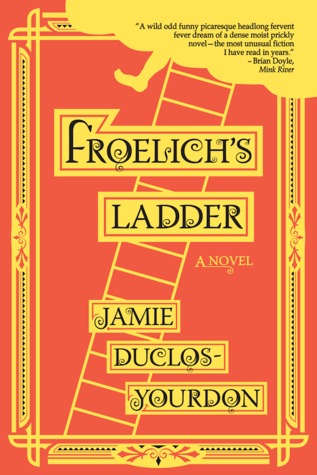
Froelich's Ladder by Jamie Duclos-Yourdon

Uncle Froelich nurses a decades-old family grudge from his perch atop a giant ladder. When he’s discovered missing, his nephew embarks on a rain-soaked trek across a nineteenth-century Pacific Northwest landscape to find him, accompanied by an ornery girl with a most unfortunate name. In their encounters with Confederate assassins, European expatriates, and a general store magnate, this fairytale twist on the American dream explores the conflicts between loyalty and ambition and our need for human connection, even at the highest rungs. 
 Goodreads description

This is a tall tale, literally in the case of the fourth highest ladder the world has ever seen. And it is in the tradition of American tall tales - Paul Bunyan, Johnny Appleseed, etc - a story form suited to the bravura of the frontier world in which Froelich's Ladder is placed.

After his brother takes the girl he fancies, Froelich climbs up the ladder in a huff and stays there, growing food between the rungs and communicating with his brother and then his two nephews by a sort of morse code. Then one day the knocking from on high stops: Froelich is missing and one of his nephews sets out to find him while the other props up the ladder.

The hunt for Froelich takes the central character and the reader into a wild west where the fanciful and the real exist alongside each other. Parents be warned: the story turns from picaresque folklore to the threat of sexual and/or physical violence at times.

One of the best things about this book is that it features two strong-willed independent female characters more than succeeding in a man's world. Something I always like to see. 

Whilst the final resolution(s) seemed a bit rushed to me, this is an entertaining undemanding read.

I received this book free from the publisher via Netgalley in return for a fair review. 


Thursday, 27 October 2016

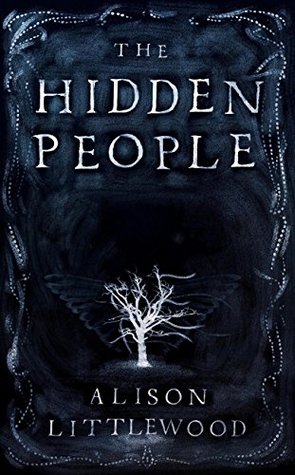
The Hidden People by Alison Littlewood

A chilling mystery - where superstition and myth bleed into real life with tragic consequences.
 
Pretty Lizzie Higgs is gone, burned to death on her own hearth - but was she really a changeling, as her husband insists? Albie Mirralls met his cousin only once, in 1851, within the grand glass arches of the Crystal Palace, but unable to countenance the rumours that surround her murder, he leaves his young wife in London and travels to Halfoak, a village steeped in superstition.

Albie begins to look into Lizzie's death, but in this place where the old tales hold sway and the 'Hidden People' supposedly roam, answers are slippery and further tragedy is just a step away . . .

Goodreads description

In time for Halloween, I bring you a review of a psychological horror story set in Victorian Yorkshire. The novel opens in London when the protagonist has his only meeting with his pretty cousin and future murder victim. They are at the Great Exhibition, an event that celebrated the triumphs of science and engineering of Queen Victoria's Britain. When Albie arrives in Halfoak after Lizzie's death, the church clock shows two times - London time and local time. Such a clock was not uncommon in that period, the arrival of the railways had highlighted the irregularity of time-keeping across the country. And it is also a symbol of the world into which Albie is stepping. The metropolis may have celebrated modern science, but in the countryside ancient beliefs (dating to pre-Christian times) continued. 

Littlewood's prose is modeled on that of Victorian novels, partly because it is narrated by Albie. A Yorkshire resident born and bred, the author is also able to reproduce the dialect of the locals accurately. Inevitably this means that the reader is reminded of Wuthering Heights, a reference that helps increase the sense of unease in the reader. 

The story unfolds slowly, perhaps too slowly, as Albie is drawn into the superstitions of the village and begins to doubt what he believes to be real. Is he going mad? Is there a rational answer to what happened to Lizzie and is now happening to Albie? When Albie's young wife arrives and they move into Lizzie's cottage and the site of the murder, things take a turn for the worse. Albie's obsession with his dead cousin causes tension within the marriage (how long has that been going on, we wonder). As his wife exhibits strange behaviour, Albie begins to wonder if she too is a changeling. Is history going to repeat.

Is this a magic-realism book? Well, it depends on how you read it. Littlewood offers a shocking alternative answer to why Lizzie died, but the ambiguity that pervades the novel continues to the end.

I received a copy of this novel from the publisher in return for a fair review.


Wednesday, 2 December 2015

Laurus by Eugene Vodolazkin


It is the late fifteenth century and a village healer in Russia called Laurus is powerless to help his beloved as she dies in childbirth, unwed and without having received communion. Devastated and desperate, he sets out on a journey in search of redemption. But this is no ordinary journey: it is one that spans ages and countries, and which brings him face-to-face with a host of unforgettable, eccentric characters and legendary creatures from the strangest medieval bestiaries.


Laurus’s travels take him from the Middle Ages to the Plague of 1771, where as a holy fool he displays miraculous healing powers, to the political upheavals of the late-twentieth century. At each transformative stage of his journey he becomes more revered by the church and the people, until he decides, one day, to return to his home village to lead the life of a monastic hermit – not realizing that it is here that he will face his most difficult trial yet.

Goodreads description 

About a week ago I was listening to an interview with the author on BBC Radio and I immediately made a note to read it, so I was delighted to be granted a review copy of this novel from the publisher a few days later. 

You can download a podcast of the BBC programme in which it featured here: http://www.bbc.co.uk/programmes/p037br7d  The interview starts 10 minutes into the programme. I am not sure how long the BBC will offer this podcast, probably for a month. 
 
I love this novel - it is already high on my list of favourite magic realist books. I have said in previous reviews how much I like Russian or Slavic magic realism. For me it actually has more appeal than, dare I say it, the Latin American version. I think this is because of the role magic realism plays in Russian novels - it is a way of expressing the alternative to the rational. This is particularly the case because it is a response to a world view (Communism and post-communism) that utterly denies the spiritual alternative. It is also deeply rooted in the pagan and Christian orthodox church beliefs of the country. You could say that there is nothing magical in this book - not the holy fools walking on water nor monks levitating nor Laurus' ability to heal by the laying on of his hands - it is merely the Russian orthodox view of the world.


Laurus has an added appeal for me - it is a historical novel. I am a historian by training and am often disappointed by the failure of writers of historical fiction to present the world through the eyes of their characters. Too often characters have an all-too-modern scepticism about magic, when in fact they would have believed in it without batting an eyelid. Vodolazkin shows how historical fiction should be done and as a result the reader is utterly immersed in the world of late medieval Russia. 

I had no problem with the author's fascinating use of language in the book, which at times becomes the language of the time and at others involves slang. Occasionally too the tenses change from the past to the present. Were this a self-published novel the author would be accused of not having used an editor, but this book has been superbly edited and translated. The shifts in tenses are appropriate to one of the major themes in the book - that there is no such thing as fixed linear time. Time is shown to be flexible and one's life through it is not just cyclical but spiralling. Several of the characters are able to foresee events and one in particular, Laurus's Italian companion on the pilgrimage to Jerusalem, does so constantly, allowing the book to travel to the twentieth century at one point. It is as if the different centuries are concurrent. 

To balance this temporal fluidity the central storyline is in many ways quite simple. It is the story of Laurus' life from young boy learning herb craft from his grandfather to ancient hermit in a cave. In this simplicity it mirrors the accounts of the lives of holy men of the time. And yet Laurus' character is so well-drawn, without pandering to modern sensibilities, that the book is a compelling read.    

 As you can see I am hugely excited by this novel. It seems to me that it takes magic realism into new territory and so I recommend it without hesitation to anyone interested in the genre.


I received this book free from the publisher in return for a fair review.

Wednesday, 19 August 2015

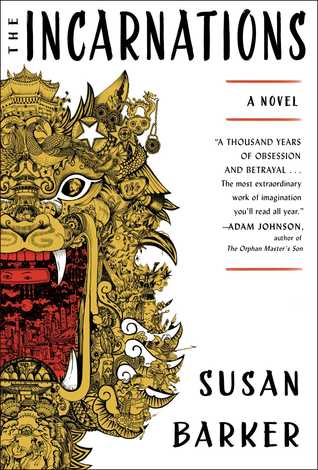
The Incarnations by Susan Barker


Hailed as “China’s Midnight’s Children” (The Independent) this “brilliant, mind-expanding, and wildly original novel” (Chris Cleave) about a Beijing taxi driver whose past incarnations over one thousand years haunt him through searing letters sent by his mysterious soulmate.

"Who are you? you must be wondering. I am your soulmate, your old friend, and I have come back to this city of sixteen million in search of you."

So begins the first letter that falls into Wang’s lap as he flips down the visor in his taxi. The letters that follow are filled with the stories of Wang’s previous lives—from escaping a marriage to a spirit bride, to being a slave on the run from Genghis Khan, to living as a fisherman during the Opium Wars, and being a teenager on the Red Guard during the cultural revolution—bound to his mysterious “soulmate,” spanning one thousand years of betrayal and intrigue.

As the letters continue to appear seemingly out of thin air, Wang becomes convinced that someone is watching him—someone who claims to have known him for over one thousand years. And with each letter, Wang feels the watcher growing closer and closer…
Goodreads description

I often discuss why a novel I am reviewing is or is not magic realism, but in this case I will not do so. The reason for this is to avoid spoiling the plot for you. 

At the centre of the novel is the question: who or what is the writer of the letters that Driver Wang receives - letters that claim to come from the reincarnation of the character that Wang encountered in his several lives. This mystery drives the narrative on and has us, the readers, and Wang himself looking around for an explanation. The answer may or may not be magic realist. It is not a spoiler to say that the book is shot through with ambiguity - Wang had endured a spell in a mental hospital as a child, so could the arrival of the Watcher be part of a delusion?

The Watcher narrates Wang's previous incarnations and the interaction between the Watcher and Wang. Although the incarnations happened at different times in Chinese history and the incarnations are very different (Wang is a woman in one) there are some common themes to these accounts. The two characters are attracted to each other (they are often homosexual lovers) and yet one will always end up betraying and hurting the other.  The Watcher claims that the letters are an attempt to bring a halt to this. As a writing device this means that Barker's novel is able to span the long and brutal history of China while keeping focused on one person. The letters are in effect a series of related short stories. 

The letters are interspersed into the account of Wang's life in contemporary China and his unsatisfactory home and work life. Wang's childhood and youth are recounted in a series of flashbacks that help explain why this potential high flyer drives taxis for a living and why he had a breakdown. Wang is struggling to cope with his current life: it is asking a lot for him to take on his other lives. The book is a study in how to draw a psychological profile of a character, as understanding Wang becomes possibly as important to the reader as the identity of the Watcher. 

Susan Barker's book is a stunning piece of writing, weaving the various threads in a way that enhances rather than hinders the plot and pace. The historical elements are beautifully if horrifyingly well-drawn. 

I received this book free from the publisher in return for a fair review.


Wednesday, 18 March 2015

The Mermaid's Child by Jo Baker


Growing up motherless in an isolated community, Malin Reed has always been made to feel different from everybody else. The fact that, according to Malin's father, the absent mother was actually a mermaid only makes matters worse. When Malin's father dies, leaving behind nothing but his stories, Malin's choice at last becomes clear: stay, and never feel at home, or leave and go in search of mermaids and the fantastical inheritance that, up to now, has always seemed completely out of reach. a picaresque journey that crosses oceans and continents - from the high seas to desert plains, from a time of slavery to life in a circus - until it finally leads to a discovery that is the very last thing Malin would ever have expected... Beautifully written and hauntingly strange, set in an unspecified historical past, The Mermaid's Child is a remarkable piece of storytelling, weaving together the fantastical and the inevitable through the power of the imagination.

Goodreads review

The content and tone of this book came as a surprise. The cover and description in no way prepared me for the level of realism, and the physical violence and casual sex in the book. I was expecting a rather fantastical story, which might or might not be magic realism, something suited to teenage female readers. I don't usually look at other reviews of books before I review them, but in this case I was fascinated to see if other readers shared my experience. And they did. Sadly this has resulted in quite a few negative or neutral reviews on Goodreads. 

Once I was over my surprise, as I was very quickly, I soon settled into enjoying Malin's story. This is a fascinating book. The description says the story is set in an unspecified historical past. To my mind it is set in a fantasy world that is very clearly based on historical realities of our own world. Baker has researched the appalling treatment of sailors on sailing ships in the 18th and 19th centuries and the even worse treatment of black slaves on slave ships. This is the brutal world in which Malin moves and Baker does not shrink from portraying it. I am, as some of you will know, a historian by training and I like this historical accuracy in fantasy. It is a form of magic realism I enjoy and indeed write.

In this pseudo-historical world Baker's use of magic or folkloric elements works well. Malin believes in mermaids. There is one in a circus that comes to Malin's village. We may suspect that this circus is a fraud, but Malin believes in it. Malin is an androgenous character. We are unclear as to Malin's gender until the very end of the book. Malin signs up as a sailor on a slaving ship, where s/he falls in love with another older sailor, a woman who has masqueraded as a man for years in pursuit of her career. This may appear to be unbelievable to a modern reader, but British folksongs are full of women dressing up as sailors and little drummer boys and indeed there are actual historical cases of women successfuly passing themselves off as men, the most famous being the military surgeon James Barry whose deception was not discovered until her death. Reality can be more fantastical than fiction.

I received this book from the publisher via Netgalley in return for a fair review.
 

Wednesday, 14 January 2015

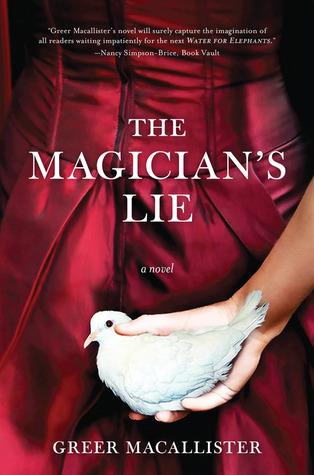
The Magician's Lie by Greer Macallister


Water for Elephants meets The Night Circus in The Magician’s Lie, a debut novel in which the country’s most notorious female illusionist stands accused of her husband's murder --and she has only one night to convince a small-town policeman of her innocence.

The Amazing Arden is the most famous female illusionist of her day, renowned for her notorious trick of sawing a man in half on stage. One night in Waterloo, Iowa, with young policeman Virgil Holt watching from the audience, she swaps her trademark saw for a fire ax. Is it a new version of the illusion, or an all-too-real murder? When Arden’s husband is found lifeless beneath the stage later that night, the answer seems clear.

But when Virgil happens upon the fleeing magician and takes her into custody, she has a very different story to tell. Even handcuffed and alone, Arden is far from powerless—and what she reveals is as unbelievable as it is spellbinding. Over the course of one eerie night, Virgil must decide whether to turn Arden in or set her free… and it will take all he has to see through the smoke and mirrors.
 

Goodreads description

A central theme of this book is magic.  No surprise there, given the subject matter. But magic realism? The reality of stage magic is shown in great detail. Greer Macallister takes us behind the illusion, behind the smoke and mirrors, and shows us the reality of the mechanics of the tricks - the false bottoms, the hidden ironwork, the sleight of hand and misdirection. And absolutely fascinating it is too. The story is located in real history  - Arden's mentor in magic is the real historical figure Adelaide Herrmann  "Queen of Magic" as Hermann's autobiography proudly announced. 


Hermann is a wonderful character and the book really takes off  when she arrives in Arden's life. Another highpoint in the book is a real historic event - The Iroquois Theatre Fire of 1903 in which over six hundred people lost their lives. 

The author uses the magician's stock-in-trade - misdirection. Throughout the book the reader is not sure whether Arden's story is true or not. We, like Virgil Holt, swing between believing and not believing her. After all the novel is called The Magician's Lie and in the first chapter Arden states that Tonight, I will escape my torturer, once and for all time.
Tonight, I will kill him.   
Misdirection takes all sorts of forms throughout the book and it is impossible to speak about them here without ruining the suspense for you. 

The magic realist element in the book - Arden's ability to speed her body's healing - could also be a form of misdirection, but there seems to be some evidence from what Virgil sees that it is real. 

Perhaps Arden's greatest ability is that of healing herself mentally. That is not to say the damage inflicted on her by her sadistic cousin, by the betrayal of the man she loves and by her mother's failure to stand up for her, do not scar her in some way, but this is one tough little lady. She is the type of strong, if flawed, female protagonist that I enjoy reading (and writing) about. In Arden and in Adelaide we have two women who forge a successful career at a time when this was an impossible dream for most women. 

This should have been the ideal book for me in, as historical fiction and mysteries are favourite genres of mine and the novel has a strong female protagonist and yet I found it hard to get into and it wasn't until 40% of the way in (when Arden meets Adelaide) that I really engaged with the story. Perhaps, dare I say it, there was just so much misdirection that I couldn't engage with Arden's story until that point. My other misgiving is that after all that build-up the ending didn't really live up to my expectations. Nevertheless the book has a lot to offer the reader and is an exciting debut from a clearly talented writer.

I received this book free from the publisher via Netgalley in return for a fair review

Wednesday, 23 April 2014

The Museum of Extraordinary Things by Alice Hoffman


Coney Island, 1911: Coralie Sardie is the daughter of a self-proclaimed scientist and professor who acts as the impresario of The Museum of Extraordinary Things, a boardwalk freak show offering amazement and entertainment to the masses. An extraordinary swimmer, Coralie appears as the Mermaid alongside performers like the Wolfman, the Butterfly Girl,and a 100 year old turtle, in her father's ""museum"". She swims regularly in New York's Hudson River, and one night stumbles upon a striking young man alone in the woods photographing moon-lit trees. From that moment, Coralie knows her life will never be the same.

The dashing photographer Coralie spies is Eddie Cohen, a Russian immigrant who has run away from his father's Lower East Side Orthodox community. As Eddie photographs the devastation on the streets of New York following the infamous Triangle Shirtwaist Factory fire, he becomes embroiled in the mystery behind a young woman's disappearance and the dispute between factory owners and labourers. In the tumultuous times that characterized life in New York between the world wars, Coralie and Eddie's lives come crashing together in Alice Hoffman's mesmerizing, imaginative, and romantic new novel.
Publisher's Description 

This book is many things: a love story, a historical novel, and a mystery. It has much that I love in fiction and in magic realism. It is magical and at the same time dark, unafraid to tackle hard subjects: the abuse by unscrupulous employers of immigrant workers, the abuse of women in a patriarchal society, and the commercial exploitation of the "freaks" in the Professor's museum. In some hands these subjects could be too heavy, but Hoffman's magical and lyrical storytelling allows the reader to engage with the story. Nevertheless, unlike some of Hoffman's other work, this book is very much for adults. 

The writing structure is an interesting one - with the two first-person narratives (Eddie and Coralie)  being interspersed by that of  an anonymous third-person storyteller. At first this structure took a bit of getting used to, but I soon found that I liked the way the third-person narrator was used to bring an extra dimension to the story. The accounts of the historically true incidents which frame the story - the Triangle Shirtwaist Factory Fire and the Dreamland Fire - are told in the third-person and are no less powerful for that. The image of the trapped factory workers jumping to their deaths will stay with you: At first, the falling girls had seemed like birds. Bright cardinals, bone-white doves, swooping blackbirds in velvet-collared coats. But when they hit the cement, the terrible truth of the matter was revealed.

Hoffman's use of themed imagery is on display here. The most obvious themes are fire and water, but there are others such as that of birds: a livery man with a dark past is shown to have changed through his love of birds; the hummingbirds in the Museum are tied to the cages on leashes of string; the imported starlings at first are seen as exotic and then despised by the people of New York. Some people might find such repeated imagery to be over-heavy, but I liked it.  

Hoffman is known for her use of magic realism. In this book there is usually an explanation for any perceived magic, indeed it is often shown as illusion, most obviously in the Professor's Museum. The Professor is a fraud, presenting as magically real that which is constructed in his cellar of horror. At the same time the freak-show performers are portrayed as very human and humane. We see them through Coralie's eyes.  The real monsters are the Professor and the people who come to gawp and abuse. And the true magic is that of human love.

I received this book free from the publisher via Netgalley in return for a fair review.