Friday, 30 January 2015

The Salt Roads by Nano Hopkinson


Hopkinson’s time-traveling, genre-spanning novel weaves a common thread of spiritualism and hope through three intertwined stories of women possessed by Ezili, the goddess of love, as she inspires, inhabits, and guides them through trying personal and historical moments. Jeanne Duval is a talented entertainer suffering from the ravages of a sexually transmitted disease; Mer is a slave and talented doctor who bears witness as Saint Domingue throws off the yoke of colonial rule in the early nineteenth century; and Meritet is a woman of the night who finds religion her own way. Though the three are separated by many miles and centuries, a powerful bond draws them together.
Epic, wrenching, and passionate, The Salt Roads is laced with graceful, lyrical prose. Hopkinson has crafted a one-of-a-kind novel that spans hundreds of years and multiple countries to tell a mystical, heartrending story of self-worth, respect, and salvation.

Goodreads description

When I decided to apply for a review copy of The Salt Roads I was a bit worried that it would not be magic realism. Nalo Hopkinson is usually listed as a writer of speculative fiction, but she also appears in the online lists of magic-realist writers. Having read this novel I can say that those lists are right. I found the book easy and most enjoyable to read.

This is an ambitious book, weaving together three distinct stories set at different historical times and continents. At the centre of each story is a strong female protagonist - Mer in 18th century Haiti, Jeanne Duval in 19th century Paris and Meritet in 4th century Egypt. Of these Jeanne Duval was a real historical personality - the mistress and muse of the poet Baudelaire. Mer's story features Makandal, the leader of a slave rebellion in Haiti. Meritet is humourously portrayed by Hopkinson as the historical source of the hagiography of St Mary of Egypt. The three stories are bound together by the Ginen goddess Lasiren or Ezili, whose first-person voice appears in short poetic chapters between the stories and who moves between the world of the spirits and the historical worlds of the three women. 

Edouard Manet 014
Edouard Manet, portrait of Jeanne Duval (Photo credit: Wikipedia)
As is often the case when the are three stories in one book, I found myself having difficulties as the novel shifted from one story to another and from one protagonist to another. This was not helped by the fact that the stories are not distributed evenly throughout the book. We start with Mer, whose story was the one I was most taken with. Meritet does not appear until much later in the book. In fact all three characters could have merited a book to themselves. 

There are several themes in the book - the most obvious being the black experience throughout history and the racism those of African heritage experienced and continue to experience. Slavery and its horrors feature in the story of Mer and to a lesser extent in that of Meritet. This brings obvious comparisons with Beloved by Toni Morrison and inevitably The Salt Roads suffers in comparison. In addition the novel also invites comparisons with Alejo Carpentier's early magic-realist novel  The Kingdom of This World which also features the Haitian slave rebellion. 

In fact all the way through this book I kept being reminded of other novels. The idea of the old gods of Africa coming with the slaves to the new world is used by Neil Gaiman in American Gods and Anansi Boys. Hopkinson's book does not explore the concept as deeply as Gaiman's, because she is also exploring other themes.
A major theme in the novel is the feminist one. Women are defined by their sexual use by men, especially white men. On the Haiti slave plantations we see the female slaves' only chance of advancement and the possible survival of their children is to provide sexual services to a white man, even a poor one. Likewise Jeanne Duval's survival is in the pleasuring of Charles Baudelaire. Meritet was sold by her parents to a brothelkeeper. When Lasiren takes over the mind of the slave plantation owner's white fiancee, we see that she too is bound by the same imperative - she is marrying him for financial security rather than affection. Only Mer's power is not based in the provision of sexual services, but as that very female archetype of wisewoman. But then she is also considered old. 
If you don't like explicit sexual scenes, don't read this book, as they feature from the very start. Both Jeanne and Mer find sexual pleasure in lesbian relationships, and their lesbian experience is contrasted with the lack of pleasure given by men. Female sexuality can be liberating.  Lasiren is a goddess of fertility and female sexuality, so that when she takes over Jeanne's dance it becomes strongly sexual and powerful

There is so much to write about in this book. I am sure that it is the subject of many an academic essay and I cannot cover it all.  I don't think Salt Roads delivers fully on all it aspires to do, but it is still a remarkable achievement. As my granny used to say "It is better to aim at the stars and hit the moon, than not to aim at all."

I received this book free from the publishers via Netgalley in return for a fair review


Wednesday, 28 January 2015

Thus Were Their Faces by Silvina Ocampo

Silvina Ocampo is undoubtedly one of the twentieth century’s great masters of the short story. Italo Calvino once said about her, “I don’t know another writer who better captures the magic inside everyday rituals, the forbidden or hidden face that our mirrors don’t show us.” Thus Were Their Faces collects a wide range of Ocampo’s best short fiction and novella-length stories from her whole writing life. Stories about creepy doubles, a marble statue of a winged horse that speaks to a girl, a house of sugar that is the site of an eerie possession, children who lock their perverse mothers in a room and burn it, a lapdog who records the dreams of an old woman.
Jorge Luis Borges wrote that the cruelty of Ocampo’s stories was the result of her nobility of soul, a judgment as paradoxical as much of her own writing. For her whole life Ocampo avoided the public eye, though since her death in 1993 her reputation has only continued to grow, like a magical forest. Dark, gothic, fantastic, and grotesque, these haunting stories are among the world’s finest.
Goodreads description.

With a description like that you can see why I asked Silvina Ocampo's publisher, New York Review of Books, for a review copy. And I can tell you the book lived up to the description.

Ocampo's style is sometimes demanding on the reader and I found myself putting down the book between stories to muse over what I had just read.  But the book is all the better for that.

Even though I read the stories several days ago, they have stayed with me like a dark shadow somewhere on the periphery of my vision.  The word "dark" is rightly used of Ocampo's stories. At times they reminded me of the adult short stories by Roald Dahl in the way they would jolt me with a sudden dark turn. But then Ocampo also  shows that the dark is only seen in the context of light. As she writes in the preface, Writing is having a sprite within reach, something we can turn into a demon or a monster, but also something that will give us unexpected happiness or the wish to die. 

English: Photo taken by Bioy Casares in Posada...
English: Photo taken by Bioy Casares in Posadas, published at the magazine Pajaro de fuego (Bird of fire) EspaƱol: Foto sacada por Bioy Casares en Posadas (Photo credit: Wikipedia)
Ocampo is probably better known as a poet  and it shows in her prose, which is at times sublime.  I could fill this review with quotations. But let us just take this one, which ends  probably my favourite story in the collection: Beauty has no end or edges. I wait for it. But where is my bed, where can I wait in comfort? I'm not lying down: I'm unable to lie down. A bed is not always a bed. There is the birthing bed, the bed of love, the deathbed, the riverbed. But not a real bed... How perfect is that! The short sentences, the repetition, the symbolism, all could be translated into poetry, all you have to do is add line-breaks. And the poetical form is also appropriate for the story and the voice of the narrator - a woman, who with these words is slipping into death.

Ocampo is masterly in her use of narrative voices. As well as the dying, she is capable of speaking as a child. Sometimes the innocence of the child's voice contrasts with the story the child is unwittingly telling. Sometimes the child narrator is far from innocent. Nor is Ocampo's skill in the use of voices restricted to children. In The Prayer the female narrator is unable to confront the horror of what might/will happen as a result of her action and so the horror is left unstated and yet can clearly be read between the lines, leaving us with a sense of impending doom.

Magic realism appears in many of the stories, sometimes subtly, sometimes overtly.  In one story a gardener's hand digs into the earth only to take root there. In the short story which lends its title to the collection a group of deaf children dream the same dreams, make the same mistakes in their notebooks and when asked to draw all draw pictures of wings. The story culminates with children jumping from a plane. When interviewed, their teacher asserts that when the children threw themselves into the void they had wings.  

I commend this magical, dark and wonderful book and its remarkable author to you.

I received this book free from the publisher in return for a fair review.


Wednesday, 21 January 2015

Senya Malina Tells It Like It Was by Stepan Pisakhov

Baron Munchausen... Paul Bunyan... SENYA MALINA!

An impish Russian peasant spins tale after tale tall about himself and the remote northern world that he calls home. Brimming with humour (much of it satirical), outrageous plots, vibrant language and clever allusion, and accompanied by masterful illustrations, this finely crafted creative translation of Pisakhov’s classic stories is for children and adults alike to cherish.

Goodreads description

I have an image in my head of a small boy lying in his bed chuckling as his father reads one of Senya Malina's tall tales. His father is laughing too, but not necessarily at the same things. After the boy has gone to sleep, his father goes downstairs and continues reading. 

This book of short stories/tall tales is an absolute delight. I am a sucker for folktales and this book falls within a tradition of tall-story folktales that you will find the world over. In the English-speaking world, especially in the UK and US, folktales are seen as suited only for children, but that is not the case elsewhere. I am writing this in the Czech Republic, where Czech adults still enjoy fairytales; their Slav cousins the Russians share this view. Stepan Pisakhov came from a family with a tradition of professional storytelling in the North of  Russia and wordplay and oral tales were part of his childhood. Born in 1879, Pisakhov grew up in Tsarist Russia, but he lived until 1960. Nevertheless the subject matter of his tales remains the lives of peasants who live close to the earth, struggling against the bureaucrats of both Tsar and the Communist party. Many of Malina's tales (Malina means raspberry) show the clever peasant putting one over on figures of authority. The divide between the rural and urban population is very obvious.  And as I read Blackwell Boyce's brilliant translation I could hear the dry rural humour and was reminded of listening to my farmworker uncle spinning his tales with a straight face and a twinkle in the eye.

There are three targets for Malina's tricks - the bureaucrats:
Bureaucrats as a species have such weak spines they need their uniforms to prop them up. It’s always puzzled me where they found the strength to laugh at us peasants and common folk,
the merchants from the town and the main representative of authority in the village - the local priest.

In the tale about the Russian/Japanese War (1904-1905) Pisakhov satirizes the way the Russion government, in order to gain support for an imperialist venture, claimed it was a religious war. The women of the village fool the army into taking felt versions of their menfolk instead, but Malina's wife is bad with the needle and he gets conscripted. The war is fought with religious symbols - crosses and incense bombs on the Russian side - and Malina narrowly escapes death when a large Buddha scores a direct hit on a warehouse he is guarding. Of course this story highlights what we have seen elsewhere in this blog, that magic realism is the literary device of the underdog, allowing in this case the Russian peasant to fight back. The truth of the campaign was that 40,000 to 70,000 Russian soldiers died in a war that was presaged the warfare of 1914-1918.

The magic realism in the tales works in several ways. In some tales Malina has extra skills - like the ability to skip on water or stretch his legs so far to block the merchants' way. In others it is whimsical such as the lovely tale of how Malina, unable to find somewhere to sleep, lies down on the seashore and draws the sea over him as blanket. In others it is beautifully poetic such as in the story Frozen Songs, in which the cold winters of the Russian north turn words into ice, so that words aren't heard but seen. Young women weave together frozen songs into lace sheets and mothers create gentle ice-words for their young children to play with. Of course when the merchants and the kings try to take advantage of these treasures, the people of the area have the last laugh. In many tales the story starts with a logic and then takes it in a surreal direction - such as the woman whose voice is so piercing that it can literally cut.

The people's closeness to nature runs through the stories and it results in some lovely pieces of magic realist humour: a bear is recruited to frighten off priests who are picking all the wildberries, specially trained polar bears sell milk and a brown bear tries to muscle in on the act by rolling himself in flour, fish catch themselves, gut themselves, salt themselves and leap all by themselves into barrels, Malina lassoes a flock of ducks and uses them as an umbrella.  

There is nothing I would fault in this book. The translation is, according to the translator, very much a liberal, creative one, but I get the impression that it is still true to the spirit of the original work. The illustrations by Dmitry Trubin (see cover above) are great fun and likewise in the spirit of the book. 

My one qualm with this book is its marketing and branding. The illustrations make it look like a children's book to my Western eyes and yet I note that Senya Malina Tells It Like It Was is not listed as in the children's category on Amazon. The pricing of the ebook however at $12 (£7) is high for a children's title and even in the current climate for an adult ebook. It is also a big book for children with a lot of stories. The publisher could have divided it into three parts and sold them at $2.99 each and I suspect got a lot more readers and made more money. It's a shame because this book deserves to be read widely.

I received this book free from the translator in return for a fair review.
 

Wednesday, 14 January 2015

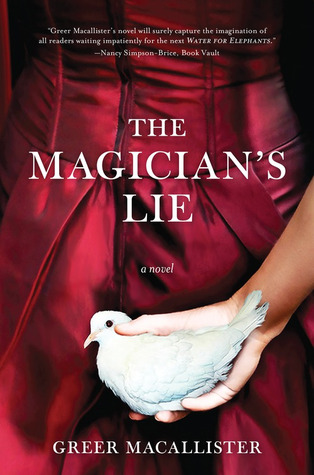
The Magician's Lie by Greer Macallister


Water for Elephants meets The Night Circus in The Magician’s Lie, a debut novel in which the country’s most notorious female illusionist stands accused of her husband's murder --and she has only one night to convince a small-town policeman of her innocence.

The Amazing Arden is the most famous female illusionist of her day, renowned for her notorious trick of sawing a man in half on stage. One night in Waterloo, Iowa, with young policeman Virgil Holt watching from the audience, she swaps her trademark saw for a fire ax. Is it a new version of the illusion, or an all-too-real murder? When Arden’s husband is found lifeless beneath the stage later that night, the answer seems clear.

But when Virgil happens upon the fleeing magician and takes her into custody, she has a very different story to tell. Even handcuffed and alone, Arden is far from powerless—and what she reveals is as unbelievable as it is spellbinding. Over the course of one eerie night, Virgil must decide whether to turn Arden in or set her free… and it will take all he has to see through the smoke and mirrors.
 

Goodreads description

A central theme of this book is magic.  No surprise there, given the subject matter. But magic realism? The reality of stage magic is shown in great detail. Greer Macallister takes us behind the illusion, behind the smoke and mirrors, and shows us the reality of the mechanics of the tricks - the false bottoms, the hidden ironwork, the sleight of hand and misdirection. And absolutely fascinating it is too. The story is located in real history  - Arden's mentor in magic is the real historical figure Adelaide Herrmann  "Queen of Magic" as Hermann's autobiography proudly announced. 


Hermann is a wonderful character and the book really takes off  when she arrives in Arden's life. Another highpoint in the book is a real historic event - The Iroquois Theatre Fire of 1903 in which over six hundred people lost their lives. 

The author uses the magician's stock-in-trade - misdirection. Throughout the book the reader is not sure whether Arden's story is true or not. We, like Virgil Holt, swing between believing and not believing her. After all the novel is called The Magician's Lie and in the first chapter Arden states that Tonight, I will escape my torturer, once and for all time.
Tonight, I will kill him.   
Misdirection takes all sorts of forms throughout the book and it is impossible to speak about them here without ruining the suspense for you. 

The magic realist element in the book - Arden's ability to speed her body's healing - could also be a form of misdirection, but there seems to be some evidence from what Virgil sees that it is real. 

Perhaps Arden's greatest ability is that of healing herself mentally. That is not to say the damage inflicted on her by her sadistic cousin, by the betrayal of the man she loves and by her mother's failure to stand up for her, do not scar her in some way, but this is one tough little lady. She is the type of strong, if flawed, female protagonist that I enjoy reading (and writing) about. In Arden and in Adelaide we have two women who forge a successful career at a time when this was an impossible dream for most women. 

This should have been the ideal book for me in, as historical fiction and mysteries are favourite genres of mine and the novel has a strong female protagonist and yet I found it hard to get into and it wasn't until 40% of the way in (when Arden meets Adelaide) that I really engaged with the story. Perhaps, dare I say it, there was just so much misdirection that I couldn't engage with Arden's story until that point. My other misgiving is that after all that build-up the ending didn't really live up to my expectations. Nevertheless the book has a lot to offer the reader and is an exciting debut from a clearly talented writer.

I received this book free from the publisher via Netgalley in return for a fair review

Wednesday, 7 January 2015

Mikawadizi Storms by Dennis Vickers


Freelance journalist Evie Arnold agrees to cover the emerging conflict between mining magnate Clive Gready, who plans to dig an open-pit mine in the Mikawadizi hills, and La Roche Verte Indian Nation, who intend to stop him. As she watches and records, the conflict spirals from serious to severe to ominous. and finally explodes into an epic battle between good and evil. 

Mikawadizi Storms casts bold characters into conflicts bristling with magic and smoldering with contradictory world views. 

Goodreads description


Every month I review an independently published book by a member of the Magic Realism Books Facebook Group. Indie books get a lot of stick  about quality, but in my experience indie magic realist books are often very good indeed. Maybe that is partly because the people on the Facebook Group are genuinely interested in magic realism and want to know more and maybe it is because the nature of magic realism attracts a certain type of writer - one that thinks about his/her work and more generally about the nature of reality. Dennis Vickers falls into both categories. 
 
This book falls into two types of magic realism - Indigenous American and environmental magic realism. Vickers teaches creative writing at the College of Menominee Nation, a tribal college located in north-central Wisconsin and, whilst he's not a member of an Indian Nation, this has clearly influenced the content of his book. The book contrasts the two world views of the Indian community and the white community to the land and nature. This split is literally depicted in the characters Ed and Ward Cormmercant. Edward Commercant is of mixed French/Indian descent and as a result of the conflict between his two backgrounds splits into Ed and Ward - an interesting magic realist concept. 

The abuse of the environment by the white mining consortium and its defence by the La Roche Verte Indian Nation and supporters is at the heart of the novel.  Early on a contrast is made between the white approach to the land of ripping it open and tearing out the treasures they seek and the Roche Verte who harvested only the silver that fell from the walls of a secret cave. The danger of digging too deep is made clear towards the end of the story when nature takes her revenge, but I will not spoil the ending for you by explaining more.

The central character in the book is the reporter Evie Arnold. Thus we get to hear and see both sides of the story, although Evie shares the writer's bias in favour of the Roche Verte. Evie too is conflicted - in her case in her attitude to her sexuality and having children. This brings her to the magical  house of Lotta Moore, where another, this time European,  shamanism is active.

On his Goodreads author's page Dennis writes: I write stories to explore concepts. The more fundamental the concepts the better. The more interesting the concepts the better. But, it still has to be a good story. What I find interesting about people are their stories, the stories they tell and the stories they live. In the end there isn't much difference.
Vickers uses that approach in structuring the book. Each chapter of the book starts with a  drawing of a different character and some of their words. The chapter then has that character at its heart. There are forty four chapters in the book. That is a lot of characters to introduce and for the reader to retain in their heads. Does the device work? Up to a point. The drawings certainly helped my memory, but at times I felt that the need to introduce a new character dictated the story rather than the other way. 

I enjoyed reading this book. There is a lot to think about within its pages (possibly a bit too much for some readers) and I always like that.

I received this book free from the author in return for a fair review.

Wednesday, 31 December 2014

The Dress Shop of Dreams by Menna Van Praag

Since her parents’ mysterious deaths many years ago, scientist Cora Sparks has spent her days in the safety of her university lab or at her grandmother Etta’s dress shop. Tucked away on a winding Cambridge street, Etta’s charming tiny store appears quite ordinary to passersby, but the colorfully vibrant racks of beaded silks, delicate laces, and jewel-toned velvets hold bewitching secrets: With just a few stitches from Etta’s needle, these gorgeous gowns have the power to free a woman’s deepest desires.

Etta’s dearest wish is to work her magic on her granddaughter. Cora’s studious, unromantic eye has overlooked Walt, the shy bookseller who has been in love with her forever. Determined not to allow Cora to miss her chance at happiness, Etta sews a tiny stitch into Walt’s collar, hoping to give him the courage to confess his feelings to Cora. But magic spells—like true love—can go awry. After Walt is spurred into action, Etta realizes she’s set in motion a series of astonishing events that will transform Cora’s life in extraordinary and unexpected ways.

From Goodreads Description

I reviewed Menna Van Praag's  The House at the End of Hope Street in March 2014 and found it enjoyable women's magic realism in the tradition of Sarah Addison Allen. The Dress Shop of Dreams is in many ways similar to the author's first work: set in the English university-town of Cambridge, a story of a young woman finding herself, a magic-wielding older woman who helps her, a magical place, and the predictability that this sort of romantic book always has. And yet I found this book much more enjoyable. Menna Van Praag is getting better at her art. 

The book weaves together several feel-good romantic tales: of the emotionally stunted and orphaned Cora, the widow Millie longing for love, Etta's long heartbreak, and the detective's broken marriage. Van Praag manages to weave them together into a whole very successfully. The point of view shifts between the various romances unusually occur several times in a chapter and this may upset some readers, but they were clearly done and effective in producing dramatic tension and counterpoint. 

The magic in this book is lightly done - Etta simply sews a small star into the target's dress to cast her spell. And it raises the question of how much of the transformation is down to the star or to the character seeing themselves differently. Most of us will know that what we are wearing can have a profound influence on how we feel about ourselves. And then there is the wisdom of Etta's words or the seeds they sow (sew?) in the other characters' minds. 

One of the reasons this book held my attention was the inclusion in it of a mystery. Before Cora is able to experience love she must first find out whether her parents' deaths in a fire were the result of an accident or murder. I enjoyed this element of the book and whilst it could only be a part of the whole it gave the book more substance. Readers of this blog will know I like a bit of grit in my magic realism. Obviously the grit content of The Dress Shop of Dreams is limited, but Menna Van Praag has written a good book of its type and will add more fans as a result. 

I received this book free from the publisher via Netgalley in return for a fair review.
 

Wednesday, 24 December 2014

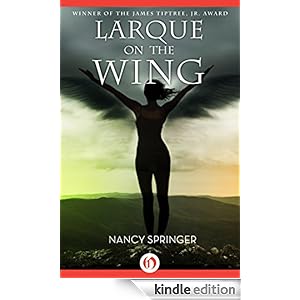
Larque On The Wing by Nancy Springer

A middle-aged housewife whose rebellious inner child runs away with her talent transforms herself into a fearless young gay man in this winner of the James Tiptree, Jr. Award

Larque Harootunian is having a midlife crisis like no other—but then again, there is much about the frumpy, middle-aged housewife and mother that could never be considered ordinary. Larque’s lifelong ability to generate “dopplegangers,” for example—physical manifestations of her thoughts and emotions—has been a constant source of stress. And now she is being tormented by Skylark, a re-creation of her younger self, an angry inner child who is tormenting Larque about abandoning her youthful ambitions while running away with her artistic abilities, thereby depriving the older Larque of a livelihood as a painter of kitsch.

But perhaps this is Larque’s opportunity to explore her options. Acquiescing to Sky’s demands that she change herself, Larque tries on a series of different personas—to the consternation of her mother, husband, and teenage sons—and finds her way to Popular Street. There, among the devil-may-care misfits, Larque can be Lark, a handsome young gay man, and quite possibly discover what her life is really about.

Amazon description

Yet again the clever folks at Open Road Media have taken a fascinating out-of-print magic realism book and given it in ebook format to a new audience. I really enjoyed this book.

For starters even now you don't get to read many books with spunky middle-aged women as their central character. We middle-aged women seem to disappear from fiction as we sometimes feel we do in real life, the latter being something Larque bemoans. This book is an exploration of how we deny what we are. Springer uses the magic realist device of the doppelgangers as a way of manifesting the aspects of Larque's personality.

As the enigmatic Shadow says: People, most people, are like flowers with three parts, three petals that overlap. One part is the child. Whatever you were as a child, everything you feared, everything you wanted or dreamed, it all stays with you. One part is the parent. Whatever your mother or father or teachers told you or wanted you to be, that is part of you too. And the rest of you is self, your unique mind and will. One part in three. Very Jungian (after all, the person saying this called Shadow for goodness sake) only it is Jungian with jokes. Lots of jokes.

If you think dealing with teenage children is bad, just imagine what it is like dealing with your young self who feels unloved and rejected. Larque initially really dislikes her childhood self, particularly when Sky puts her foot through Larque's canvases covered with kitsch but lucrative images of twee rural scenes. Until Sky arrives whenever Larque felt the urge to produce something creative, she lay down until the spasm passed. Brain farts did not sell. Real people did not want originality; they just wanted something that matched the living room drapes.  Sky's actions makes Larque rethink what she wants from her art.

Larque is forced to confront the fact that she doesn't like herself as she is and so, urged on by Sky, she allows Shadow to transform her into the character she dreamed of being. This, it turns out, is a young cowboy. Larque as a child had identified with male cowboy heroes in film or on the television  rather than any female role models. But despite her physical transformation Larque retains her soul and her woman's heart and so remains sexually attracted to men. This opens a whole can of worms about gender and sexuality, which the book deals with with the same wry lightness of touch. The homosexuality of three of the main characters in the book is handled sensitively and with understanding. It is worth remembering that this book was first published in 1994 when AIDS was a death sentence and homophobic attitudes were more mainstream. But for me the key thing that stands out is that even the adult Larque cannot see her middle-aged female self as being bold enough to pursue her dreams.

The third element in Larque's character is her mother's creation: The Virtuous Woman. Larque's mother like her daughter has a magic ability to transform people, but in contrast to Larque she does so in a way that denies what they truly are, instead getting rid of what she doesn't like and replacing it with what she does. Thus tomboy Sky is transformed into a prissy little girl. Larque calls this behaviour of her mother's "blinking". It is such a wonderful image of what most of us will have experienced - a parent who sees us as something other than we are and as a consequence we find ourselves falling into that role.

I realize on looking at what I have written so far, that one might feel that this book is feminist magic realism and indeed it does have some similarities to Virginia Woolf's Orlando, but it is actually about a midlife crisis that men and women experience, so I have no qualms about recommending it to all my readers.

I received this book free from the publisher via Netgalley in return for a fair review.


Wednesday, 17 December 2014

Music of Sacred Lakes by Laura Cowan


Peter Sanskevicz doesn’t belong anywhere. He doesn’t want the sixth-generation family farm his great great-grandfather unwittingly stole from its Odawa owners, and can’t continue his jobs serving “fudgies,” tourists in Northern Michigan who seem more at home than he is. He can’t seem to take charge of things or do anything but make a mess. Then, Peter accidentally kills a girl.

Seeing his life is at risk, his friend takes him to his uncle, a pipe carrier of the Odawa tribe, who tells him he must live by the shores of Lake Michigan until the lake speaks to him. Peter lives and loves and rages by the shores of the great lake, haunted by its rich beauty, by strange images and sounds that begin to pursue him through his waking and sleeping hours, and by the spirit of the dead girl, who seems to be trying to help him. One day, he finally finds an inner silence. And then, he hears what the lake has to say to him. A story about reconnecting with the source of your life and your joy, Music of Sacred Lakes gives voice to the spirit of the land and lakes that gave birth to us all.

Part of the Goodreads Description 

This is the latest in my series of reviews of books by members of the Magic Realism Facebook Group and it shows what an interesting bunch we are. 

The Goodreads description goes on to describe Laura as an American Fabulist and a writer of spiritually-oriented magical realism, literary fantasy, and visionary fiction.  I confess I am not much up on these sub-genres and American fabulism was new to me. Now despite a bit of online searching I am not much wiser, indeed the definitions of fabulism I found suggested that it was just another word for magic realism. Ah well, let's leave that there. I am sure someone out there would like to put me right.

The spiritual element in the book is well to the fore. The young man at the centre of the novel is lost spiritually and his journey of spiritual discovery is the subject of the story. There is a lot of frustrated anger on his part, as he hits out literally and verbally. He finds himself through listening to the lake, as the old pipe carrier instructed him. The other instructor in Peter's transformation is the dead girl who comes to him in dreams and tells hims that It's okay.... It's all lake. As if to emphasize this the girl's name is Marissa (meaning: of the sea). 

At about the same time as I was reading this book I was also reading Living With A Wild God: A Non-believer's Search for the Truth About Everything by Barbara Ehrenreich. In the latter book the author recounts her experience of the wild god  - the Other - manifesting itself through nature. Ehrenreich is an atheist but a mystical one. The Christian mysticism which Laura Cowan describes in this book is very similar. It requires a sublimation of the self in the whole, symbolized by the lake but actually meaning all of nature - it's all lake. It is interesting that Cowan feels it necessary to use the native American intermediary and his traditional beliefs to help Peter discover or rediscover the wild god. 

I was having an interesting conversation with a fellow writer the other day over a coffee. She said that she had seen a rise in the number of young authors writing magic realism. We agreed that one for reason for this is that in this agnostic, even atheist, world many people are looking for magic, for something unexplained and unpredictable. I argued that for many people the "realist" approach is two-dimensional and excludes some of the most important experiences in people's lives. Some theists would argue that magic realism is an inappropriate description for books featuring Christian or other religious beliefs, but I have no problem with it and I think Music of Sacred Lakes is a good example of why magic realism and Christian mysticism sit well together. 

In a way not much actually happens in the novel - the turmoil is almost entirely internal. There is the presence of two very different young women who in different ways are attracted to Peter and are attractive to him. However the writer does not make too much of this area of potential tension. Personally I would have liked to have seen more made of the relationships, if only in the way the two girls impact on Peter's awakening.

The writing is positively poetic at times, but also tends to be a bit repetitive. This is a book which you should allow to wash over you - rather like Peter's lake in fact - and you may well find yourself pondering the profound.

Wednesday, 10 December 2014

The Palm-wine Drinkard by Amos Tutuola

When Amos Tutuola's first novel, The Palm-Wine Drinkard, appeared in 1952, it aroused exceptional worldwide interest. Drawing on the West African Yoruba oral folktale tradition, Tutuola described the odyssey of a devoted palm-wine drinker through a nightmare of fantastic adventure. Since then, The Palm-Wine Drinkard has been translated into more than 15 languages and has come to be regarded as a masterwork of one of Africa's most influential writers.
Goodreads description

This is a fascinating book, in many ways unlike anything I have ever read and yet also very familiar. The book is narrated by the Drinkard. The first thing that strikes you (within the opening sentences) is that this is a non-judgemental world. The Drinkard describes himself as professional drinker of the alcoholic palm-wine. This behaviour is not punished, instead  his father hires a tapster to tap the 200 kegs of wine a day that the Drinkard consumes. When the tapster falls to his death from a palm tree, the Drinkard goes in search his servant. The rest of the novel follows the Drinkard's travels and his adventures. 

Tutuola said that he wrote to tell of my ancestors and how they lived in their days. They lived with immortal creatures of the forest. But now the forest are gone. I believe the immortal creatures must have moved away.

The novel is packed with amazing immortal creatures - bush spirits and strange people, some living and some dead. The Drinkard encounters a different creature every few pages. Occasionally there is a reference to modern life - eg a tree taking something like photos or a reference to a bomb - but most of the time we are firmly in the land of Tutuola's ancestors. There is not the duality between a dominant European culture and an indigenous one that one expects from magic realism. The indigenous culture is dominant. Despite Tutuola's education at an Anglican school, this is a world in which the Christian God has barely a foothold, a brutal world in which the bush spirits tend to be malicious and even dead babies drive you from the road. The narrator does occasionally talk of God, but then refers to himself as the Father of the gods who could do anything in this world. The Drinkard has juju (magical power) which allows him to shapeshift  to escape or outwit his foes. I was reminded as I read this of the ancient British ballad The Two Magicians, variations of which you find all over Europe.

The writing style is extraordinary. Tutuola was forced to give up his education, despite being a good student. He therefore writes in English but it reads as though he thinks in Yoruba. Nor has the story form been westernized. There is no normal story arc. Over on the Magic Realism Facebook Group we had a discussion about the standardized story structure (three parts etc) and how the "rules" that some people swear by aren't rules at all. Such people would dismiss this book as episodic. They would point out that there is no character development. But this is a story form that is as old as storytelling. A man goes on a journey and meets and defeats various supernatural creatures. Many old legends are just that and so are many early novels. Tutuola's novel is close to the oral tradition that first gave voice to those legends. Tutuola died in 1997 and he wrote this book in 1953. I doubt whether this novel could be written now in quite the same way. 

Wednesday, 3 December 2014

Weetzie Bat by Francesca Lia Block


This could be a book about cheap cheese and bean burritos, slinkster dogs, lanky lizards and rubber chickens ... Or strawberry sundaes with marshmallow toppings, surfing, stage-diving and sleeping on the beach ... It could even be a book about magic. But what it's definitely about is Weetzie Bat, her best friend Dirk and their search across L.A. for the most dangerous angel of all ... true love.
Amazon description

A number of people had recommended this book to me, so I thought I really ought to read and review it. Francesca Lia Block, it seems, has many fans. But this 56-year old British woman hadn't heard of her or of her character Weetzie Bat. I think the clue to my ignorance is to be found in the words "56-year" and "British". This American young adult novel was published in 1989.  The book hasn't really taken off in the UK as it has in the States - 12 reviews on Amazon UK compared to 139 on Amazon.com. Looking at those reviews it is obvious that Weetzie Bat divides readers into lovers or haters.  I found myself not falling into either camp.

The book's central character, a hip LA girl (of undefined age), bunks off school with the coolest guy around Dirk.  When Dirk's grandmother Fifi leaves Weetzie Bat a golden thing, Weetzie rubs it and the magic begins:

Weetzie could see him--it was a man, a little man in a turban, with a jewel in his nose, harem pants, and curly-toed slippers.
"Lanky Lizards!" Weetzie exclaimed.
"Greetings," said the man in an odd voice, a rich, dark purr.
"Oh, shit!" Weetzie said.
"I beg your pardon? Is that your wish?” 

Yes, it's a genie. And he grants her three wishes mostly

There is a lot of the fairytale about the book. Thanks to the genie, Weetzie Bat and her unconventional family of Dirk, Dirk's boyfriend Duck, My Secret Lover Man Weetzie's boyfriend, her pet Slinkster Dog and his girlfriend Go-Go Girl, all live in a house they were left by Fifi happily ever after. 

But the second half of the story questions what "happily ever after" actually means. Into Weetzie's pink, hippy, glittery world comes death and the threat of it. The death is that of Weetzie's father and the threat is in the form of AIDs.  I applaud the author's decision to include such issues in a YA book. They aren't confronted in a way that shocks. Nor is there a link made between irresponsible sexual behaviour and its consequences. When My Secret Lover Man says he doesn't want a baby, Weetzie decides to have a child with Duck and Dirk. She gets away with it and the baby joins the extended family. I don't know what to make of this. I suppose it's fairytale meeting reality. Isn't that a definition of magic realism? What is happily ever after in magic realism?

Maybe I am just too old. Maybe I am applying adult expectations to a YA book.  I am sure there are many girls who identify with the kooky Weetzie. I never was that girl. I was too bookish. My Britishness probably puts up a load of barriers too - a lot of the references and even words pass me by. And yet the imagery is at times wonderfully poetic. Take this about Charlie's death:
Charlie was dreaming of a giant poppy like a bed. He had taken some pills and this time he did not wake up from his dream.

I am sure (indeed I know from the reviews) that this book has had a huge impact on some of its young readers.  In the end I guess I am the wrong person to review it. 

Wednesday, 26 November 2014

When Rosa Came Home by Karen Wyld


When they open the door for their wayward daughter, Rosa's parents are not prepared for who else turns up at the Ambrosio family vineyard.

....the spirit of a poet, nurses who crochet magical rugs, a beautiful bearded lady, elephants from the dreamscape, a mƩdecin sans medicine and his dancing python, a jealous stable-hand, acrobatic pirates of the dark web, a sleeping beauty with a secret or two, and a young girl who longs for a new sister....

Angelita Ambrosio narrates the stories of her secret sister’s time on the road, and yearns for adventures of her own. Amid precious tales, graciously shared by Rosa's eclectic friends, a fractured family is reunited.

Not everyone is pleased to see Rosa return - peril lurks in dark places. Fear not: with a sprinkling of cosmic dust, a cloud of sawdust and a touch of magic, a new dawn will bloom - now that Rosa has come home.

Goodreads description

Karen Wyld is a fellow writer on the Magic Realist Books Facebook Group and I was keen to read her new book, having seen her contributions to the group and the Magic Realism Blog Hop. I was not disappointed - the book is delightful. 

The narrator is Angelita, a bright child who used to sing like an angel but who has become mute. The choice of this narrator provides both opportunities and challenges for the author (and therefore the reader). Angelita's muteness makes her the perfect listener, making her at times invisible to the adults around her and also meaning that they confide in her. As a succession of visitors to the sleeping Rosa reveal aspects of her life, the child listens and tries to piece together what happened to make Rosa leave and what she did afterwards. In this Angelita acts for the reader, but Angelita is a child so she is limited as an intermediary. 

Angelita's childish innocence means that she doesn't always understand the significance of what she is hearing. Angelita believes that everything will turn out for the best, that Rosa will wake up, that the book's one antagonist will not hurt her. There is the opportunity here for the writer to use more dramatic irony to increase tension with the adult reader seeing potential danger, however the author seems to back away from doing so. 

Over on my writer's blog, prompted by reading this book, I talk about some of the issues around using first-person narration. A lot happens off-screen in this novel. Most of the time that is part of the book's charm, but it felt unsatisfactory towards the end. I wanted to know more. It does seem to me that Karen painted herself into a bit of a corner by her choice of first-person narration.

The book has many strengths. There are some beautiful descriptions of a child's world in which magic really does exist and of the fascinating and fantastical beings that enter it. I particularly enjoyed the way that all Angelita's senses feature in those descriptions. The author draws on many traditions - myths, fairytales and of course magic realism. The realism lies in the family and sexual relationships that are revealed through the course of the book. Despite this realism there is a charming gentleness about When Rosa Came Home, a gentleness that stems from its exceptionally well-drawn narrator.

This is a lovely debut from a highly talented writer. I look forward to reading her next book.

Wednesday, 19 November 2014

Berta La Larga by Cuca Canals

Berta, born under a rainbow, has special gifts. And she is very, very tall. Depressed by her height, she has grown into a quiet, introverted girl. However, at 16 she falls in love with a very tall postman and finds that her moods have an amazing effect on the weather and just about everything else.
Goodreads description

My regular readers may have noticed I missed a review last week. You may also have noticed that I am now reviewing a book that was not scheduled until December. The reason for both is that my mother-in-law died a few weeks ago and my plans have had to change. As a result I am not in the Czech Republic where the books for November are sitting on a bookshelf awaiting my arrival (now scheduled for January).  In addition I don't feel I can give last week's planned book Of Bees and Mist a fair review, as the antagonist in that book is a totally evil mother-in-law.  I think I would have found this a problem had I not been mourning the death of a lovely lady, but as I was the problem was insurmountable. 

So I have been reading Berta La Larga instead. The comparison with Of Bees and Mist couldn't be greater. Human beings are shown lovingly with their aspirations, their faults and their strengths. The book focuses on the life of a small village in the middle of nowhere and its people's rivalry with the inhabitants of a neighbouring village. Berta falls in love with Jonas, the postman from that other village, and so the scene for a Romeo and Juliet story is set.  But this is no tragedy. The story, even though some of the main characters die during the course of the war between the two villages, is often humorous.

Canals draws a picture of a very real village in which magical things happen, but people don't always realize - contrary to the Goodreads description no one links the weather to Berta's moods, not even Berta herself.  The portraits of the various village characters and their petty squabbles - from the old woman who keeps everyone awake with her singing, the mayor's wife who never stops talking, the priest with very attractive legs and even the donkey - will all be familiar to anyone living in a small community. I was reminded of Clochemerle. Canals' style is witty and light of touch. The narrative is interspersed with comical illustrations, such as a picture of Berta's body with pointing hands indicating which parts which Jonas is allowed to touch and which not, and ends with a series of amusing appendices, which had me giggling.  

This is a delightful book, clever in its simplicity.  

Wednesday, 5 November 2014

The Vet's Daughter by Barbara Comyns


Growing up in Edwardian south London, Alice Rowlands longs for romance and excitement, for a release from a life that is dreary, restrictive and lonely. Her father, a vet, is harsh and domineering; his new girlfriend brash and lascivious. Alice seeks refuge in memories and fantasies, in her rapturous longing for Nicholas, a handsome young sailor, and in the blossoming of what she perceives as her occult powers. A series of strange events unfolds that leads her, dressed in bridal white, to a scene of ecstatic triumph and disaster among the crowds on Clapham Common. The Vet's Daughter is a uniquely vivid, witty and touching story of love and mystery.


Goodreads description


I hadn't planned to read (and review) The Vet's Daughter this week, but I found it in a bookshop and started reading it in the cafe. I was so impressed by this book and the author's ability that I had to continue reading to the end. 

The first thing that impressed me was the faultless use of first-person narrative in the book. This is a tremendously difficult thing to do at the best of times, but to do this when the narrator is a naive young woman is extremely hard, and yet Comyns never allows Alice to know more or have more spirit than is appropriate. We readers glimpse what lies beneath and watch with horror as we see, as Alice can not, what certain developments might signify.  Not everything is explained, but that is because not everything is shown to Alice. 

The book was published in the Virago Modern Classics series and is a devastating study of the appalling and powerless position of women in Britain at the turn of the 20th century. Sadly it could be the tale of many women in many parts of the world now. Both Alice and her mother are trapped in their dreary home with Alice's tyrannical father. Alice's description of her mother early in the book is haunting:  
Her bones were small and her shoulders sloped; her teeth were not straight either; so if she had been a dog, my father would have destroyed her.  

This fascinating book was first published in 1959 (before the arrival of magic realism in  British mainstream fiction). We are now used to the likes of Alice Hoffman using magic realism in modern contexts, but that was not the case then. The book was therefore ahead of its time. At the same time it looks back at the golden age of English 19th century literature. There is something Gothic about the book and the portrayal of the monstrous father. Many of the other characters verge on the grotesque in a way that reminded me of those of Dickens. 

One would like Alice to escape and gain happiness. And for a time the levitational powers that are the magic realist element in the book do give Alice an opportunity to control something in her life. But in the end they become a tool for her father to gain money. This may be a modern fairytale, but it doesn't come with a happy ending. If you want to identify with the central character you will have problems. This is feminist magic realism, but the magic does not empower and the realism accurately portrays Alice as a young woman of her time.