Sunday, 28 February 2016

The Blue Line by Ingrid Betancourt


Buenos Aires, the 1970s. Julia inherits from her grandmother a gift, precious and burdensome. Sometimes visions appear before her eyes, mysterious and terrible apparitions from the future, seen from the perspective of others. From the age of five, Julia must intervene to prevent horrific events. In fact, as her grandmother tells her, it is her duty to do so—otherwise she will lose her gift.

At fifteen, Julia falls in love with Theo, a handsome revolutionary four years her senior. Their lives are turned upside down when Juan PerĂ³n, the former president and military dictator, returns to Argentina. Confronted by the realities of military dictatorship, Julia and Theo become Montoneros sympathizers. Julia and Theo are radical idealists, equally fascinated by Jesus Christ and Che Guevara. Captured by death squadrons, they somehow manage to escape. . .

From the Goodreads description

Ingrid Betancourt is the former French Columbian politician who was kidnapped by the FARC guerillas in 2002 and endured over six years in capitivity before she was released by the Columbian army. She has written about what and how she endured her captivity in the jungle in Even Silence Has an End. In this, her first novel, Betancourt revisits in fiction many of the themes in the earlier book. At the heart of the novel is a young woman's experiences at the hands of the Argentinian military junta's thugs and torturers. Like Unspeakable Things, the previous book reviewed on this site, The Blue Line is also about the survivors of oppression and the legacy of guilt and psychological damage that impacts on their personal relationships.

The obvious comparison for this book is with Isabel Allende's The House of Spirits. It focuses on a brave young woman drawn to helping the poor and thus into radical politics. A naive idealist in the face of the political betrayals and complexity of Argentinian politics, Julia is no different from most young activists the world over, but the consequences of her decision to engage are terrible. Her treatment in the notorious military interrogation centres, and the details of her and others' torture are not glossed over and may be shocking to some readers, but are absolutely based on facts.

Also at the heart of the book are Julia's two key relationships: with her grandmother, who helps her understand and use her gift of second sight and in whose footsteps she follows in more ways than one, and with Theo, her lover and husband. It is Julia's relationship with Theo that sits at the heart of the story and drives the narrative arc, even though for much of their lives they are apart. It is Theo who introduces Julia to radical politics.

Loyalty is a major theme in the book. Julia's loyalty to Theo and other women in the detention centre is a major motivator, which at times puts her life in danger. Theo's loyalty to his brother is likewise key. Of course the betrayal and manipulation of loyalty also features. As in Unspeakable Things the survivors have a loyalty that will not let go of the past and so blights the present. 

The novel moves backwards and forwards in time, a structure that I seem to be seeing more and more in books. This can be frustrating at times and halfway through I was inclined to think that it was hindering rather than helping the story move forward. However on finishing the book I could see why this technique was used.

This is a fascinating book and, despite the graphic depictions of torture, one that demands to be read by anyone who wants to get a feel for the dilemmas facing good people living under tyranny.

I received this book free from the publisher in return for a fair review.

Sunday, 21 February 2016

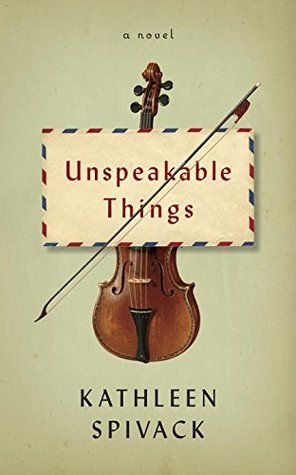
Unspeakable Things by Kathleen Spivack


A strange, haunting novel about survival and love in all its forms; about sexual awakenings and dark secrets; about European refugee intellectuals who have fled Hitler’s armies with their dreams intact and who have come to an elusive new (American) “can do, will do” world they cannot seem to find. A novel steeped in surreal storytelling and beautiful music that transports its half-broken souls—and us—to another realm of the senses. 

The setting: the early 1940s, New York—city of refuge, city of hope, with the specter of a red-hot Europe at war.

From the Goodreads description 

Unspeakable Things is a dark (very dark) and amazing book, both disturbing and beautiful. Although this is a book about the Holocaust and its consequences the unspeakable things in the title are for the most part sexual abuse rather than violent death. The phrase "Unspeakable Things" is first used in the book by the Russian countess Anna to describe what happens to her at the hands of Rasputin, who is called The Devil. Anna is a tiny woman with a  humpback and a long nose and whiskers growing out of a facial mole, which have earned her the nickname “the Rat.” But her "deformity" seems to attract the perverted attentions of not only the mad monk but also the German doctor Felix, a Nazi fetishist and asexual predator on the young children brought to him by their Jewish mothers. Note: if the subject of sexual perversion is difficult for you, do not read this book. 

But Anna is also genuinely loved by her cousin Herbert, the book's central character. Herbert is a fixer, who uses his connections and possibly magical powers, to bring fellow Jews out of Europe. He however cannot save everyone, in particular his youngest son Michael, and the gypsies of Europe. There is a cost for survival and the cost to Herbert is his son's loss and his wife's resulting madness. This is the central theme of the book - the cost and guilt of survival. It is in the context that the sexuality of the book should be seen. How do you deal with the unspeakable things that have happened to you and others, with the scars that are burned into your soul, and in Anna's case literally into your skin, by the devilish hands of others?
Hands play an important part in the story - Rasputin's devilish hand prints are burnt onto Anna's inner thighs, Herbert's wife is a pianist whose hands feverishly play on her bedsheet, and in a jar in Felix's fridge the severed little fingers of the Tolstoi Quartet tap out Schubert melodies. The jar of fingers are part of Felix's bizarre experiment in genetic engineering sponsored by the Fuhrer himself. Fed on a diet of good Teutonic foods (wurst etc), the fingers are being engineered to produce pure Germanic music. As you might be able to see from this, there are elements of satire and humour in this novel alongside the darkness I have written about above.

There are also passages of sublime beauty in the book. This is a writer who is also a poet and it shows. As in a poem it is important to understand that nearly everything is a metaphor and has more than one meaning. The severed fingers are metaphors for the exiles in New York, severed forcibly from their birthplace and confined in cramped single-room lodgings. Music pervades the book. Out on the streets of New York there are new "optimistic" rhythms and music, but the exiles are waltzing to the old tunes. The only way for the survivors to come to terms with their continued existence is to let go of the dead and for the dead to let go of them.  


I received this book free from the publisher in return for a fair review

Sunday, 14 February 2016

Witchcraft Couture by Katarina West

Oscar Pellegrini is a talented fashion designer with a deadly enemy: his own critical mind. He destroys much of what he designs and has been drifting for years, gradually retreating from the fashion business he loves but holding on to his dreams of success.

A chance meeting with a former girlfriend triggers a creative crisis so deep that Oscar escapes to Russia, where he drinks and despairs like never before. Just when he thinks he has lost everything he discovers a magical machine that turns ordinary outfits into irresistible sartorial triumphs. Oscar takes the machine back to Italy – and before he knows it, he has become famous for his designs, and celebrities and socialites are fighting to be first to wear his gorgeous garments.


From the Goodreads description

I am not someone who is interested in fashion nor the industry that creates it and yet I found much to interest me in this novel. This is the story of a tortured genius, of the excruciating self doubt that cripples Oscar Pellegrini and what it takes to overcome it and at what price. That subject matter is true of any creative process and not just the fashion business, although arguably the fashion world is a particularly brutal one in which to be creative and so is an excellent choice for a novel.

I have often said in reviews that magic realism and ambiguity go hand in hand and they certainly do in this novel. With the exception of the last chapter, the novel is told in the first person by Oscar himself. This takes us into the tortured mind of a genius, who is far from a rational or reliable narrator. And whilst we at first sympathize with Oscar, it becomes very clear that he is not the sort of person you would want as a friend, son or employee. 

And what should we make of the Sampo, the magical machine that transforms his designs? In Finnish mythology the Sampo was a magical artifact that produces food/gold/good fortune for its possessor, (for more see https://en.wikipedia.org/wiki/Sampo). Is his relationship with the machine a Faustian pact with the devil? Is the Sampo drawing its energy from Oscar's dying mother? Or is its magic simply due to Oscar believing in it and so gaining the confidence in his designs that he otherwise lacks? Or is it just a sign of its owner's insanity? You will be asking yourself these questions long after you read the final word.

Katerina West's writing is very descriptive: we see the world through the eyes of a man who finds inspiration in all sorts of places. Oscar's descriptions of colours are particularly impressive. But I found the pace dragging sometimes and I think Oscar's descriptions and vagaries may be the reason for this.
All in all,though, this is an interesting first book from a talented writer and of course if you are into fashion you will find an additional dimension to the book.

I received this book free from the author in return for a fair review.


Sunday, 7 February 2016

The Assimilated Cuban's Guide to Quantum Santeria by Carlos Hernandez


A quirky collection of short sci-fi stories for fans of Kij Johnson and Kelly Link
 
Assimilation is founded on surrender and being broken; this collection of short stories features people who have assimilated, but are actively trying to reclaim their lives. There is a concert pianist who defies death by uploading his soul into his piano. There is the person who draws his mother’s ghost out of the bullet hole in the wall near where she was executed. Another character has a horn growing out of the center of his forehead—punishment for an affair. But he is too weak to end it, too much in love to be moral. Another story recounts a panda breeder looking for tips. And then there’s a border patrol agent trying to figure out how to process undocumented visitors from another galaxy. Poignant by way of funny, and philosophical by way of grotesque, Hernandez’s stories are prayers for self-sovereignty.

Goodreads description

This short-story collection explores that border country between science fiction and magic realism in a way that reminded me of not only the stories of Kelly Link (as stated in the Goodreads description) but also of Elizabeth Hand and a number of other writers reviewed on this blog. As with those other writers' collections, only a few of the stories fall firmly within the realm of magic realism. My favourite stories (although not all are magic realism) were:

The Aphotic Ghost
A modern selkie story, which brings together marine biology, jellyfish, mountain climbing and a father's search for a missing son.

Los Simpaticos
A murder mystery with no speculative elements about the death of the star of a Spanish-language reality TV show. As he pretends to be a hitman to lure out potential hirers, there are no lack of suspects. 

More Than Pigs and Rosaries Can Give
This story is about a son trying to locate the site of his mother's murder at the hands of Che Guevara's death squads. When he gets the lead he seeks, he is offered the opportunity to communicate with the dead woman. This story starts very strongly, but I found myself questioning the ending. 

Bone of my Bone
A man, separated from his wife following his affair with another woman, starts to grow a horn in a strange reverse of the traditional portrayal of the cuckold's horns.

The Magical Properties of Unicorn Ivory
This is a story where sci-fi and magic realism definitely meet. As a result of scientists playing with quantum physics, unicorns from a parallel universe start appearing in the British countryside. Immediately they are the targets of ivory poachers who kidnap a young girl to attract the attentions of the shy beast.

The Assimilated Cuban's Guide to Quantum Santeria
My favourite story in the book is the last one. After the death of his mother, a young boy tries to get her back using santeria learned from a library book.  But of course magic is not that simple and the boy has to resort to santeria again. This story is more complex, developed and thought through than most of the others. 

This is an interesting collection and one which will appeal to fans of magic realism who also like science fiction.

I received this book free from the publisher in return for a fair review.

Monday, 1 February 2016

Interview with Smoky Zeidel


Having review Smoky's book The Storyteller's Bracelet a few weeks ago, I am delighted to welcome this talented writer to the blog to answer some questions.

Who are your favourite magic realist authors and why?
I love Gabriel Garcia Marquez, and Isabel Allende, of course. Who doesn’t? In The House of the Spirits by Isabel Allende, Clara’s psychic ability—her ability to talk to spirits, her gift for curses—are as natural for her as breathing. I think the fact so many magic realism authors are from Central and South America is because that sort of thing isn’t looked at as “crazy” in those cultures. They are considered gifts. 

Jose Saramago is another favorite. He’s from Portugal, and his Death With Interruptions is one of the finest (if toughest) books I’ve ever read. You actually fall in love with Death by the end of the book, but I don’t want to put any spoilers here, so I won’t say any more than that.

I hope Helene Wecker follows up The Golum and the Jinni with another magic realism book, because that—apparently her debut novel—was nothing short of brilliant. And I guess I should mention Haruki Murikami. I’m not as big of fan of his as some readers are, but I thought The Strange Library was one of the most fun books I read last year.

What is your all-time favourite magic realist book?
That’s a tough question. I have so many favorites, including those I mentioned already. But if I was stuck on a desert isle and could have only one magic realism book with me, it would be F.G. Hagenbeck’s The Secret Book of Frida Kahlo. Kahlo is my favorite artist, and I read everything I can get my hands on about her. This book absolutely blew me away. I was so enchanted with the ending, I had to go back and re-read it from the beginning so I could look for clues that lead to his ending.

Why do you write magic realism?
 I look at the world as a magical place. Perhaps it’s my more animistic way of looking at nature and life that is responsible, but I see magic everywhere I go. I talk to the trees, the rivers, the rocks, the desert, and they talk back. Oh, not in words, per se, but there is definitely a connection in my mind. My husband and I love to collect rocks, but I never take one without asking its permission. Sometimes, the rock is happy to be pocketed. Other times, I get the distinct impression I should leave it where it is, and I do. So, for me, it is natural to write magic realism, because, to me, magic realism is just what is.

Can you give us your definition of magic realism?  
I define magic realism as magic or supernatural occurrences happening in what otherwise is a “normal” setting and time. Books like The Wonderful Wizard of Oz are fantasy, because, for the most part, the story takes place in another world that does not exist. Same with the Harry Potter books. In both, part of the story is real: Dorothy’s life in Kansas, and Harry’s life with the Dursleys are normal settings with nothing supernatural about them, but most of those books take place in an alternate, very magical setting. But a book like House of the Spirits has Clara talking to spirits who come at her beck and call. While that has an element of fantasy to it, it’s magic realism, because not all the characters can do what she can do, yet those who know of her skills don’t question it at all. It’s part of their everyday existence.

Tell us about your latest magic realist book? 
My novel, The Cabin, was just released by Thomas-Jacob Publishing. In it, James-Cyrus Hoffmann has just inherited his grandfather’s farm, and with it a mysterious cabin deep in the woods on Hoffmann mountain, a cabin he has dreamed about since childhood. When James-Cyrus enters the cabin, he is vaulted back through time to the Civil War era, where he meets, Elizabeth, the brave young woman who lives there, and Malachi, a runaway slave. James-Cyrus’s neighbor, Cora, knows all too well the tragic history of the cabin. When James-Cyrus tells Cora about Elizabeth, Malachi, and his fantastic vault back through time, the two devise a plant to change the past and right a wrong that has haunted the Hoffmann family for generations.

While that might sound more fantasy than magic realism, it isn’t. While the magic in the book takes the characters by surprise at first, they don’t question it is happening, at least, not for long. The story is historically accurate as far as the setting and storyline about the Underground Railroad and the Civil War are concerned. The story itself was inspired by events that took place in my own family, events that were very much of this world.

The Cabin is available in print and in Kindle editions, as is my other magic realism novel, The Storyteller’s Bracelet.

Sunday, 31 January 2016

They Were Like Family to Me: Stories by Helen Marles Shankman


A radiant debut collection of linked stories from a two-time Pushcart Prize nominee, set in a German-occupied town in Poland, where tales of myth and folklore meet the real-life monsters of the Nazi invasion.

1942. With the Nazi Party at the height of its power, the occupying army empties Poland’s towns and cities of their Jewish populations. As neighbor turns on neighbor and survival often demands unthinkable choices, Poland has become a moral quagmire—a place of shifting truths and blinding ambiguities.

Blending folklore and fact, Helen Maryles Shankman shows us the people of Wlodawa, a remote Polish town.

Extract from the Goodreads description


January 27th was Holocaust Memorial Day, so I have moved this review forward a week to coincide with it. You might be forgiven for thinking that everything that can be said about the Holocaust and every way of saying it has already been published, but you would be wrong. They Were Like Family to Me  is an interesting addition to the corpus of holocaust literature, taking an original approach to the subject. 

This book is described as a collection of linked stories and so it is. But I would argue it is more than that. Each story is set in the town of Wlodawa and surroundings and each is seen from the point of view of a different character, German, Polish or Jew. The story of what happened in that town is built up in a way that is impossible if seen from one viewpoint. Certain incidents and characters which happen en passant in one story come to the fore and into focus in another. This is what a historian always experiences - there is no one narrative, no overriding story arc. There is only a series of perspectives that together enable you to form a view, but, and this is a big but, there is always the knowledge that there are millions of people's points of view that you never hear. Where is that historical reality more apparent than in the case of genocide? 

Helen Maryles Shankman comes from a family of holocaust survivors and she integrates aspects of her family's history into the stories. She also bases some of the storylines and characters on other historical personalities. The artist and writer in the title story is obviously inspired by the death of Bruno Schultz, whilst the benevolent and enigmatic Willy Reinhart bears strong similarities to Oskar Schindler and a similar less-known character from Shankman's family stories. 

One of the book's strengths is that its structure allows us to see the world through the eyes of the oppressor as well as the oppressed. The story They Were Like Family to Me is told from the point of view of a hardened SS killer who takes the artist under his protecton. In The Jew Killer the central character is an anti-semitic Pole, who is forced to confront his feelings when he has to protect a young Jewish girl. Finally of course there is the story at the end of the book told from the point of Willy Reinhart. These stories were my favourites in the collection and it seemed to me the enigma of Reinhart in some way was the narrative driver of the book. 

Magic realism pervades the stories - the resistance to the Germans is often personified in the form of a mythical being such as the Golem or a werewolf, and on one occasion the very land of Poland rises up against the oppressors. Wlodawa sits on the edge of the dark forest. It is where the Germans take the Jews to be murdered, but it is also where the mythical and subconscious dwell. It is where the Jewish partisans can be shapeshifters. The magic only partly succeeds. It cannot do otherwise. Magical monsters are no match in the long term for the real monsters of the Nazi killing machine. And yet there is a mysticism in these stories and a hope that transcends the darkness.

I received this book free from the publisher in return for a fair review.

NB this book was originally titled In the Land of Armadillos

Sunday, 24 January 2016

The Cowboy Bible and Other Stories by Carlos Velazquez

The much-anticipated English-language debut of "one of the most original and entertaining voices of contemporary Mexican literature"(Revista Gatopardo): a collection of surreal, ironic, and madcap stories about the comedy and brutal tragedies of life in Mexico.
Extract from the Goodreads description

This short story collection is unlike anything I have ever read. The language and style are extraordinary. Comparisons have been made between Velazquez's work and that of Hunter S. Thompson, Charles Bukowski, and William S. Burroughs. The tone is always ironic, frequently surreal and often spectacularly inventive. The use of contemporary Mexican popular culture, including Spanglish words, song lyrics and much more, made this a difficult book for me to understand and read. I am sure I missed a lot of references and even some plot points.

The Cowboy Bible and Other Stories is set in a mythical part of north Mexio called PopSTock! - a sort of Macondo on acid. The stories are linked by the magical Cowboy Bible, which changes shape between the stories - in one it is the talisman of a Mexican wrestling DJ and art critic, in another an unbeatable participant in drinking marathons, the leather for boots so desirable that a character sells to the devil a night with his wife, a television show on which cds are pirated by a female urban rebel, an overweight single mother, and a musical instrument. After a while you realize that the stories sometimes overlap. 

Despite the stories' obvious surrealism and fantasy they have a habit of hitting you in the face with realism. PopSTock! is a violent world in which drug dealers hold sway over people's lives and macho sexism is everywhere. It is clear that these stories are also a social and political commentary on Velazquez's homeland.

I received this book free from the publisher in return for a fair review.

Monday, 18 January 2016

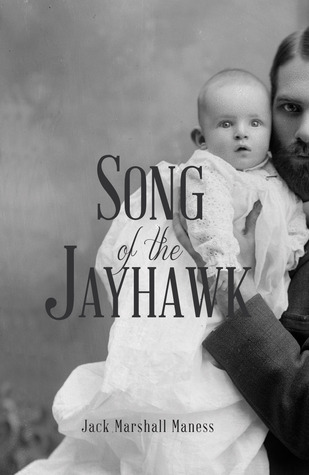
The Song of the Jayhawk by Jack Marshall Maness


Before there were red states and blue states, there was Kansas. A place that divided the nation like never before, or since. A place where mayors were generals and journalists were terrorists. A place where drunken guerrilla armies roamed the prairies, threatening farmers and rigging elections. A haunted place where mysterious beasts led settlers into undiscovered countries.

Follow two young families as they struggle with rattlesnakes, tornadoes, ice-storms, childbirth and morality in a war-torn land. A growing love between them, built over holiday ham and whiskey, is threatened as they are drawn into the territory's cycle of political violence. They must ultimately decide if they are friends or foes, and it isn't long before they all have blood on their hands.

This is a story of loyalty and betrayal, courage and despair. Set in the 1850s, the dilemmas faced by the Dugan and Hawkins families are similar to those faced by every generation in a long-divided America. It asks how ordinary people cope with extraordinary times, why they sometimes turn to violence, and more importantly, why they usually do not.
 
Goodreads description

I have to confess that, although I studied history at university, I know precious little about America in the 19th century and the run-up to the American Civil War. I therefore came to this novel with a great deal of ignorance and had no idea what a catalyst Kansas was in the tragic turmoil that hit that great country. 

The book's introduction starts with the statement It has been widely noted that one cannot comprehend American society without a fundamental understanding of the Civil War. But can you enjoy a story set in that time without such an understanding? The answer is yes, I did enjoy The Song of the Jayhawk. I found myself emotionally involved with the Dugan and Hawkins families. Jack Marshall Maness, to his great credit, shows accurately the complexity and ambiguity of real people facing difficult choices. To fight or not, to protect family or the wider community, to help or to fight your neighbours. He shows that both families have come from difficult backgrounds and want to build a new future and he also shows that within families there are clashes between younger hot-headed members and their more experienced pragmatic elders. 

Whilst the point of view of the novel stayed with the various family members, this reader was engaged with the story. However when on occasion the narrative parted from that point of view and showed political developments on the wider stage, I found myself feeling frustrated. From what I have read in the introduction to the book Mr Maness is a historian and I sympathize with his desire to clearly set his protagonists' story in its historic context, but...

The magic realism in the book comes mainly in the form of the appearance of a mythical bird of the Kanza Indians, the Mialueka, which the author associates with the infamous Kansas jayhawk. The Mialueka was said to have lured people to their destruction, and appears at times of crisis to the Dugan brothers. Other magic-realist elements include the river changing location and some magic powers belonging to Patrick Dugan's wife. The latter are not fully developed narratively, although I expect they will be in subsequent books. It should be noted that the story does rather break off at the end of the book, as this is the first in a series, so if you are someone who likes everything resolved when you read the last page, be warned. 

I received this book free from the author in return for a fair review.

Monday, 11 January 2016

The Avenue of Mysteries by John Irving


John Irving returns to the themes that established him as one of our most admired and beloved authors in this absorbing novel of fate and memory.
As we grow older—most of all, in what we remember and what we dream—we live in the past. Sometimes, we live more vividly in the past than in the present.

As an older man, Juan Diego will take a trip to the Philippines, but what travels with him are his dreams and memories; he is most alive in his childhood and early adolescence in Mexico. “An aura of fate had marked him,” John Irving writes, of Juan Diego. “The chain of events, the links in our lives—what leads us where we’re going, the courses we follow to our ends, what we don’t see coming, and what we do—all this can be mysterious, or simply unseen, or even obvious.”

Avenue of Mysteries is the story of what happens to Juan Diego in the Philippines, where what happened to him in the past—in Mexico—collides with his future.

Goodreads description

I confess that this is the first John Irving novel I have read. He is of course on my list of magic realist writers to read, but I just hadn't got round to reading his work. From what I can gather this book deals with many of the subjects of his previous novels, whether as well or worse I cannot of course say. 

The book is effectively two stories. One is the story of the writer Juan Diego, who may be in his fifties but he comes across as older than that, and one is the story of the boy Juan Diego and his sister Lupe. The novel drifts from one story to the next as the man dreams about his childhood both while he is asleep and as he is in a semiconscious state of daydreaming. Even when he is apparently fully conscious he does not seem to be in control of himself or what is happening to the degree that the reader cannot be exactly certain of the veracity of what is occurring. This is explained partly by the fact that he is playing with not taking the correct dosage of betablockers and combining that dangerous activity with taking viagra. Something that is covered over and over again. 

The problem with the novel is that the story of the young Juan Diego is more engaging than that of his older self. In part this is because of the elder Diego's somnambulist state and in part because the older man does not develop during the course of the book. Indeed he is incredibly passive at the mercy of an over-eager former student who organizes his travel itinerary and then at the mercy of two femmes fatales - a mysterious mother and daughter who are "women who appear". 

The story of Juan and his sister, whom we meet when they are scavengers in the city dump, is wonderfully drawn and yes, the way Irving reveals it in snatches as part of the writer's dreams is masterful. The character I would have preferred at the centre of the story is not young Juan but his mind-reading younger sister. Lupe for some reason speaks in a garbled language that only Juan can understand. He therefore acts as her interpreter and censor. There is much fun to be had reading what Lupe is actually saying and what Juan says she says. She is a much stronger individual than her brother, determined and angry. Not only can she read minds, but she can also see people's pasts. She also sometimes can see the future, but not always correctly. The story is in many ways driven by her and her abilities and when they combine with a fierce protectiveness towards her brother they result in a striking climax. 

Juan's early story is packed with colourful characters - Pepe the monk who encourages Juan to have an education, Edward the self-flagellating Hawaiian-shirt-wearing American Jesuit, the transsexual prostitute with a heart of gold, and the children's mother (monastery cleaner, prostitute and adult-child), to say nothing of the cast of characters to be found at the circus, that the two kids join in the run-up to the climax of their story. 

Of course there is loads of stuff in this novel about 'the avenue of mysteries', i.e. what makes us what we are, specifically what makes a writer what he is, in this case a lonely lost old man. There is a quite a lot of sex and even true love. And there is a lot on religion, the church and the uneasy relationship between the Catholic Madonna and the more native Mary of Guadalupe. But at its heart for me it was about a boy and a girl - as Lupe says "We are the miracles. . . . We’re the miraculous ones.”

I received this book free from the publisher in return for a fair review.

Friday, 1 January 2016

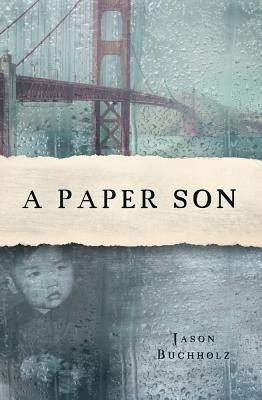
A Paper Son by Jason Buchholz

Grade school teacher and aspiring author Peregrine Long sees a Chinese family on board a ship--in his morning tea. The image inspires him to write the story of this family, but then a woman turns up at his door, claiming that he's writing her family history exactly as it happened. She doesn't like it, but she has one question: What happened to the little boy of the family, her long-lost uncle? Throughout the course of a month-long tempest that begins to wash the peninsula out from beneath them, Peregrine searches modern-day San Francisco and its surroundings--and, through his continued writing, southern China and the Pacific immigration experience of a century ago--for the missing boy. The clues uncovered lead Peregrine to question not only the nature of his writing, but also his knowledge of his own past and his understanding of his identity.
Goodreads description

Where do the ideas for stories come from? It is a question authors are often asked. The answer can be surprising. Anything can act as a stimulus - a conversation overheard, some music wafting from a doorway, a stranger passing in the street, a landscape. If the author is "in the zone" then s/he will detect these stimuli everywhere. Jason Buchholz's fictional author, Peregrine Long, finds inspiration in a cup of tea, in a swim in the rain, in an old man dressed in strange clothes and carrying a rifle in the street... But this is a magic-realist book and it becomes clear, with the arrival of the strange woman accusing him of stealing her family story, that this is more than abstract inspiration. The woman wants to know what happened to her uncle Henry - the boy at the heart of Peregrine's new work. History is leaking into Peregrine's reality. The boundaries between fiction and non-fiction become fluid. 

I use the word "fluid" deliberately. Water in all its forms appears throughout the novel. Peregrine starts the story as a major storm is about to hit San Francisco and it continues throughout the book. The first intimation of the story is in the tea-cup. What Peregrine sees in the cup is Henry's family on a ship returning to China. That water is hugely important is clear but why?

The story becomes a magic-realist mystery. What happened to the boy Henry at the centre of Peregrine's novel and the woman's real-life uncle? Why has Peregrine been chosen as the vehicle for Henry's story? The answer to the mystery can only come by Peregrine listening to his "inspiration" and writing the novel. 

As you can see there are a lot of layers to A Paper Son. The narrative keeps moving from Peregrine's story to Henry's, but the mystery and Jason Buchholz's writing kept this reader's attention.

I received this book free from the publisher in return for a fair review.

Saturday, 26 December 2015

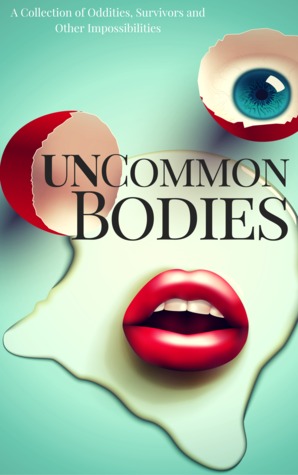
UnCommon Bodies by various

Step right up to the modern freakshow — We have mermaids, monsters, and more. You won't be disappointed, but you may not get out alive.

UnCommon Bodies presents a collection of 20 beautifully irreverent stories which blend the surreal and the mundane. Together, the authors explore the lives of the odd, the unbelievable, and the impossible. Imagine a world where magic exists, where the physical form has the power to heal or repulse, where a deal with the devil means losing so much more than your soul.

Goodreads Description 

One of publishing's necessary evils is the requirement to allot categories to books. Categories are necessary to help buyers find your book, but create a nightmare for authors and publishers of books which aren't obviously in a single genre. This issue is something magic-realist writers complain about constantly. And when it comes to short story collections the problem is well nigh impossible to solve. This is very much the case with UnCommon Bodies. Although the collection has been riding high in Amazon's magic-realism category, many of the stories are not magic realism to my thinking. I suppose if pressed I might describe the collection as slipstream, but then would immediately add provisos. What the stories have in common is that their subjects have something unusual about their bodies - sometimes natural (scars, Siamese twins), sometimes magical, fantastical or scientifically modified.

You get a lot in this collection - not only 20 stories but sci-fi, LGBT, erotica, horror, poetry, psychological fiction and yes magic realism. Some stories of course belong to several genres at once. 

With so many stories to choose from I will focus on my favourites. 

In Her Image by Vasil Tuchkov. 
Mythic fiction/magic realism. An English PhD student researching an elusive mythical woman meets with a crippled Italian painter who claims to have caught the likeness of the woman at great cost. An eerie tale.
UnTamed by Laxmi Hariharan.
An Indian take on the werewolf story, complete with mythic and spiritual references.
From the Inside by Daniel Arthur Smith.
Set in my beloved Central Europe (indeed in my local town of Cesky Krumlov) this is another tale of a search for an artist - this time a Hungarian tattooist with a secret.
Daedalus' Daughter by P.K. Tyler.
A daughter mourning the loss of her family begins to sprout feathers. She returns to the lakeside family cabin where her brother was killed and the transformation continues.
Scars: First Session by Jordanne Fuller. 
Not magic realism or indeed speculative fiction. Instead it is a moving account of how a young woman confronts the abuse that covered her body with scars as a tattooist transforms each scar into something beautiful.  
 
But your favourites will probably be different from mine. All the stories are good, although some are a bit too in-your-face for me.
 
I received this book from one of the authors in return for a fair review.

Wednesday, 16 December 2015

The Bleeding of the Stone by Ibrahim al-Koni

The moufflon, a wild sheep prized for its meat, continues to survive in the remote mountain desert of southern Libya. Only Asouf, a lone bedouin who cherishes the desert and identifies with its creatures, knows exactly where it is to be found. Now he and the moufflon together come under threat from hunters who have already slaughtered the once numerous desert gazelles. The novel combines pertinent ecological issues with a moving portrayal of traditional desert life and of the power of the human spirit to resist.
Goodreads Description

I try to bring you as varied a selection of great magic-realist novels as possible. This is no exception: a magic realist novel from "Libya's leading novelist."

Reading this novel, as the news is full of the expansion of the brutal intolerance of Daesh into Syria and Libya, I was struck by how abhorrent this book would be to them. The Sufi mysticism that inspires The Bleeding of the Stone, the fusion of Islam with pre-Islamic beliefs, the animalist magic of the moufflon (wadden in Arabic) and gazelles, all would be unacceptable, indeed heretical. Undoubtedly the gentle pacificism of the central character the old goatherd Asouf would be unacceptable. There is even a clear reference to the death of Christ in the final scene - the bleeding of the stone. And I wonder whether the world and beliefs described by al-Koni have survived. 

The novel gives you an insight into the harsh desert life of the Bedouin - the brutal beauty of the land in which they live and the constant proximity of death. Be warned there are some gruesome scenes in this book - especially the accounts of the deaths of Asouf's parents. The desert is a world of balance in which the Bedouin play their part. Into this world come three men - the two Arab hunters that Asouf meets and a white colonel who commissions them to hunt for him. The colonel supplies the hunters with the means (guns, helicopters, vehicles) to slaughter all the desert gazelles and then requires them to move on to the sacred moufflon. Nature's balance is broken and a sacrifice is called for: redemption will be at hand when the sacred wadden bleeds and blood issues from the stone.

Although a slim book (only 135 pages) The Bleeding of the Stone gives the reader much to think about and enjoy.


Sunday, 13 December 2015

Video on Magic Realism in the Art of Frida Kahlo


The term magic realism first appears in the writings of art critic Franz Roh. There is a natural movement between magic realist literature and magic realist art - see my review of Leonora Carrington's The Hearing Trumpet. Carrington was both an artist and a writer. So when I came across this video on magic realism in the self portraits of Frida Kahlo I just had to share it with you. 

The video is from the University of San Francisco's Academy of Art.

Wednesday, 9 December 2015

The Storyteller's Bracelet by Smoky Zeidel


It is the late 1800s, and the U.S. Government has mandated native tribes send their youth to Indian schools where they are stripped of their native heritage by the people they think of as The Others.
Otter and Sun Song are deeply in love, but when they are sent East to school, Otter, renamed Gideon, tries to adapt, where Sun Song does not, enduring brutal attacks from the school headmaster because of her refusal to so much as speak.

Gideon, thinking Sun Song has spurned him, turns for comfort to Wendy Thatcher, the daughter of a wealthy school patron, beginning a forbidden affair of the heart. But the Spirits have different plans for Gideon and Sun Song. They speak to Gideon through his magical storyteller's bracelet, showing him both his past and his future. You are both child and mother of The Original People, Sun Song is told. When it is right, you will be safe once more.

Will Gideon become Otter once again and return to Sun Song and his tribal roots, or attempt to remain with Wendy, with whom he can have no future?

Goodreads description

This is a story which takes a terrible and hidden part of American history - the enforced schooling of Native American children in the ways of the white man. There is an excellent Wikipedia article on the subject here: http://en.wikipedia.org/wiki/American_Indian_boarding_schools which reveals that the events depicted in The Storyteller's Bracelet - such as the abuse of Sun Song by the evil headmaster - are very much based on what really happened. Hats off to Smoky Zeidel for writing about the subject and doing so in a way that gives us an excellent story whilst not shirking from the darkness of the subject. Sadly the removal of indigenous children from their homes to often brutal boarding schools with the aim of taking away their culture and identity was not confined to North America.

The novel is not simply an account of Otter and Sun Song's experience in the school. It is also a spiritual and mythical journey, which evolves into a creation story. The fact that magic realism is so often focused on a clash between a dominant white European culture and an indigenous one is a problem for those of us white European authors who want to explore the subject. How does one approach it without appropriating the indigenous culture one is writing about? Smoky Zeidel is very clear that she is not Native American and so rather than take one first nation's experience and legends as her focus, she has drawn on different First Nations' beliefs and culture to create a creation story of her own. She does so with huge respect, admiration and love for the beliefs in question. That is one approach. Another, and one I followed, is to create a realistic fantasy world. Some people may understandably argue that no appropriation is acceptable. But where does that leave the freedom of the artist and the imagination? Comments/thoughts welcome.

Smoky Zeidel is an excellent storyteller herself. The central characters are well drawn - sympathetic while not being perfect. The pacing of the story was compelling. Recommended.

I received this book from the author in return for a fair review.

Wednesday, 2 December 2015

Laurus by Eugene Vodolazkin


It is the late fifteenth century and a village healer in Russia called Laurus is powerless to help his beloved as she dies in childbirth, unwed and without having received communion. Devastated and desperate, he sets out on a journey in search of redemption. But this is no ordinary journey: it is one that spans ages and countries, and which brings him face-to-face with a host of unforgettable, eccentric characters and legendary creatures from the strangest medieval bestiaries.


Laurus’s travels take him from the Middle Ages to the Plague of 1771, where as a holy fool he displays miraculous healing powers, to the political upheavals of the late-twentieth century. At each transformative stage of his journey he becomes more revered by the church and the people, until he decides, one day, to return to his home village to lead the life of a monastic hermit – not realizing that it is here that he will face his most difficult trial yet.

Goodreads description 

About a week ago I was listening to an interview with the author on BBC Radio and I immediately made a note to read it, so I was delighted to be granted a review copy of this novel from the publisher a few days later. 

You can download a podcast of the BBC programme in which it featured here: http://www.bbc.co.uk/programmes/p037br7d  The interview starts 10 minutes into the programme. I am not sure how long the BBC will offer this podcast, probably for a month. 
 
I love this novel - it is already high on my list of favourite magic realist books. I have said in previous reviews how much I like Russian or Slavic magic realism. For me it actually has more appeal than, dare I say it, the Latin American version. I think this is because of the role magic realism plays in Russian novels - it is a way of expressing the alternative to the rational. This is particularly the case because it is a response to a world view (Communism and post-communism) that utterly denies the spiritual alternative. It is also deeply rooted in the pagan and Christian orthodox church beliefs of the country. You could say that there is nothing magical in this book - not the holy fools walking on water nor monks levitating nor Laurus' ability to heal by the laying on of his hands - it is merely the Russian orthodox view of the world.


Laurus has an added appeal for me - it is a historical novel. I am a historian by training and am often disappointed by the failure of writers of historical fiction to present the world through the eyes of their characters. Too often characters have an all-too-modern scepticism about magic, when in fact they would have believed in it without batting an eyelid. Vodolazkin shows how historical fiction should be done and as a result the reader is utterly immersed in the world of late medieval Russia. 

I had no problem with the author's fascinating use of language in the book, which at times becomes the language of the time and at others involves slang. Occasionally too the tenses change from the past to the present. Were this a self-published novel the author would be accused of not having used an editor, but this book has been superbly edited and translated. The shifts in tenses are appropriate to one of the major themes in the book - that there is no such thing as fixed linear time. Time is shown to be flexible and one's life through it is not just cyclical but spiralling. Several of the characters are able to foresee events and one in particular, Laurus's Italian companion on the pilgrimage to Jerusalem, does so constantly, allowing the book to travel to the twentieth century at one point. It is as if the different centuries are concurrent. 

To balance this temporal fluidity the central storyline is in many ways quite simple. It is the story of Laurus' life from young boy learning herb craft from his grandfather to ancient hermit in a cave. In this simplicity it mirrors the accounts of the lives of holy men of the time. And yet Laurus' character is so well-drawn, without pandering to modern sensibilities, that the book is a compelling read.    

 As you can see I am hugely excited by this novel. It seems to me that it takes magic realism into new territory and so I recommend it without hesitation to anyone interested in the genre.


I received this book free from the publisher in return for a fair review.
Sunday, 29 November 2015

Video post - In Search of Haruki Murakami


I am sure you will all find this 50-minute documentary about Haruki Murakami as fascinating as I did when I first saw it on the BBC. It is suitably impressionistic, as Alan Yentob explores Japan in search of the roots of and inspiration for the great Japanese magic realist with the help of a talking cat.

Wednesday, 25 November 2015

Conjure Woman's Cat

Lena, a shamanistic cat, and her conjure woman Eulalie live in a small town near the Apalachicola River in Florida’s lightly populated Liberty County, where longleaf pines own the world. In Eulalie’s time, women of color look after white children in the homes of white families and are respected, even loved, but distrusted and kept separated as a group. A palpable gloss, sweeter than the state’s prized tupelo honey, holds their worlds firmly apart. When that gloss fails, the Klan restores its own brand of order.

When some white boys rape and murder a black girl named Mattie near the sawmill, the police have no suspects and don’t intend to find any. Eulalie, who sees conjure as a way of helping the good Lord work His will, intends to set things right by “laying tricks.”
Goodreads description

I very much enjoyed this novella/ short novel by a fellow member of the Magic Realism Books Facebook Group, a tale narrated by the shamanistic cat herself. 

The story is set in the Florida panhandle in the 1950's in a society dominated by racism, and tackles the serious issues of white violence, rape, day-to-day prejudice and mother/daughter relationships. This is a book that packs a lot into its 166 pages. Despite this bleak subject matter the book is beautifully written, allowing this Brit a vision of a place which the author knows well and clearly loves. The contrast of the natural beauty highlights the ugliness of human behaviour.

The central human character Eulalie is extremely well-drawn. The old woman is a "conjure woman" - a traditional healer, a practiser of hoodoo, and a former jazz/blues singer. She is proudly independent, powerful in many ways, and wily, and bears the scars of a hard and unfair life. If anything, she and her magic (tricks) are too consistently strong, so that I did not doubt that she would succeed in gaining justice for Mattie, which reduced the tension in the story for me. 

I really enjoyed the insight I gained into the traditional medicine of the area. The book comes with an excellent glossary at the end. There were many herbs that I recognised from my research for my own books, but there were others that I did not. Some of the beliefs came from Africa and others from the Native American traditions. I was struck by the way Eulalie combined a deep Christian faith and knowledge of the Bible with what might be seen by some as pagan traditions. The Archangel Michael even puts in an appearance, alongside another by the Black Rider. 

A really lovely book and a pleasure to read.

NB The book uses language which, whilst appropriate to the context, may offend some people, but I believe is necessary to the book.

I received this book free from the author in return for a fair review.
Monday, 16 November 2015

Fling by Lily Iona MacKenzie


When ninety-year-old Bubbles receives a letter from Mexico City asking her to pick up her mother’s ashes, lost there seventy years earlier and only now surfacing, she hatches a plan. A woman with a mission, Bubbles convinces her hippie daughter Feather to accompany her on the quest. Both women have recently shed husbands and have a secondary agenda: they’d like a little action. And they get it.

Alternating narratives weave together Feather and Bubbles’ odyssey. The two women travel south from Canada to Mexico where Bubbles’ long-dead mother, grandmother, and grandfather turn up, enlivening the narrative with their hilarious antics.


From the Goodreads description

This fun read is by fellow member of the Magic Realism Facebook group, Lily Iona MacKenzie. The book is a road journey featuring one old woman and her hippy daughter. The dynamic of their relationship is at the heart of the book. The ninety-year old Bubbles is in many ways a child herself and Feather acts as her mother.
 
As the chapters flick backwards and forwards in time following Bubbles back to her childhood in Skye and Feather to her adolescence, we come to see the roots not only of the two women's behaviour but also that in some ways the women are not so dissimilar and are following a family pattern. When in the latter part of the novel Bubbles's mother and grandmother turn up, this family dynamic is expanded and further explored. 
 
Many readers will identify with Feather's feelings of frustration, resentment and love towards her mother. And many will enjoy the comedy and zaniness of Bubbles and her adventures. There are times when the reader might feel that she too has been smoking some of Feather's weed. But the novel is more than just a light-hearted read. Of course there is the daughter/mother relationship to consider. But it is also interesting to note the parallels drawn between the Gaelic beliefs of the family's Scottish roots and those they encounter in Mexico. And what is more there are some delightful references to the magic realist tradition for those if us who care about such things. 

One quibble I have with the book is that at times I found the constant moving between the characters and in time, including point of view within scenes, meant that I lost focus. In a way this disorientation reflects the hallucinatory nature of the story, but it did intrude somewhat into my enjoyment. 

I received this book free from the author in return for a fair review.


Wednesday, 28 October 2015

The Mystics of Mile End by Sigal Samuel


Sigal Samuel’s debut novel, in the vein of Nicole Krauss’s bestselling The History of Love, is an imaginative story that delves into the heart of Jewish mysticism, faith, and family.

“This is not an ordinary tree I am making.

“This,” he said, “this is the Tree of Knowledge.”

In the half-Hasidic, half-hipster Montreal neighborhood of Mile End, eleven-year-old Lev Meyer is discovering that there may be a place for Judaism in his life. As he learns about science in his day school, Lev begins his own extracurricular study of the Bible’s Tree of Knowledge with neighbor Mr. Katz, who is building his own Tree out of trash. Meanwhile his sister Samara is secretly studying for her Bat Mitzvah with next-door neighbor and Holocaust survivor, Mr. Glassman. All the while his father, David, a professor of Jewish mysticism, is a non-believer.

When, years later, David has a heart attack, he begins to believe God is speaking to him. While having an affair with one of his students, he delves into the complexities of Kabbalah. Months later Samara, too, grows obsessed with the Kabbalah’s Tree of Life—hiding her interest from those who love her most–and is overcome with reaching the Tree’s highest heights. The neighbors of Mile End have been there all along, but only one of them can catch her when she falls.


Goodreads description 

I am unfamiliar with the Jewish mysticism that is at the heart of this book. This didn't stop me enjoying the story and indeed the author helped me understand enough to allow my enjoyment, but I do wonder if I missed out. Note to self: do some background research. 

At the heart of the story is the concept of the tree of life or tree of knowledge (https://en.wikipedia.org/wiki/Tree_of_life_(Kabbalah) and the way the desire to climb the tree takes over the lives and minds of several key characters. Mr Katz's eccentric behaviour causes local amusement and frustration, but is shown to be a consequence of his obsession with climbing the tree and should have been a warning to others. Of course it is a warning that goes unheeded and two key characters also lose touch with reality. Early in the book one of the characters says: 

What is the moral of this story?
Don't see signs in everything. It makes it impossible to live.

He is quite right.  But we cannot ignore signs altogether, they are how human beings communicate.

The book's subject matter is more than just mysticism and esoteric Jewishness. It is also about two children who have lost their mother and have a father who does not communicate well with them. Indeed communication or its absence is equally important as a theme. Even non-communication can be a sign - as is the case of a phone ringing but no one speaking when it is answered. Samara literally puts up a sign in her window, which simply says "Please call" and which their non-Jewish neighbour, Alex, responds to. Alex in turn is obsessed with getting a message from space, and with coding and decoding messages. Alex may be a scientist by inclination, but isn't he also trying to find meaning and order in the universe in much the same way the kabbalists are? 

The structure of the book with four parts, each narrated from the point of view of a different character (Lev, David, Samara and Alex), allows us to see just how often they misinterpret each other. Lev misreads his father. Alex misreads Samara. But in the end the book makes the case for communication, no matter how faulty. You cannot climb the tree of life on your own. 

I received this book free from the publisher in return for a fair review.